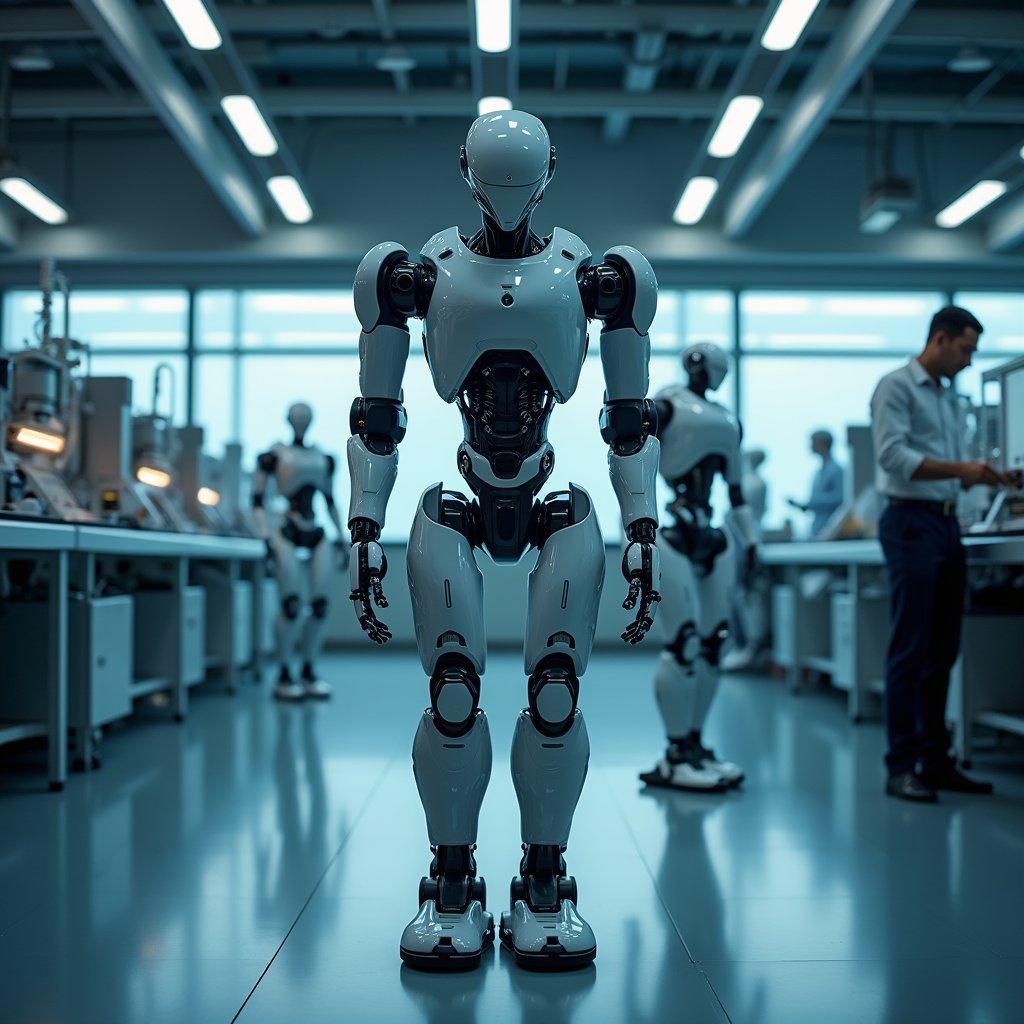
The Cutting Edge of Humanoid Robotics: Innovations, Industry Leaders, and Emerging Technologies in 2025

TABLE OF CONTENTS
- Executive Summary
- Introduction
- Leading Players in the Humanoid Robot Market
- Technological Innovations and Breakthroughs in Robot Mobility and Design
- Advanced Robotic Systems, Control Technologies, and Industry Applications
- Conclusion
1. Executive Summary
The humanoid robotics industry in 2025 stands at a pivotal crossroads, propelled by rapid technological innovations and a dynamic ecosystem of market leaders. This report highlights the emergence of a diverse network of 25 key companies, including prominent players such as NVIDIA, Samsung Electronics, Tesla, and AI frontrunner OpenAI, whose strategic integration of artificial intelligence, sensor fusion, and hardware advancements is redefining the potential and applications of humanoid robots. National efforts, exemplified by South Korea’s comprehensive robotics policy and industrial investment, underscore the global momentum driving the commercialization and adoption of humanoid robotic solutions across sectors.
Technological breakthroughs in robot mobility and design have significantly advanced the capabilities of humanoid and micro-robots alike. Research institutions like MIT have pioneered AI-driven aerial microrobots exhibiting unprecedented agility and speed, while enterprises such as XPENG have demonstrated hyper-realistic humanoid locomotion, bridging the gap between mechanical precision and natural human movement. These innovations translate into improved operational versatility, enabling robots to function effectively in diverse and unpredictable real-world environments. Concurrently, sophisticated control systems leveraging patented methods and augmented reality interfaces optimize real-time coordination, multi-agent dispatch, and interactive programming, enhancing robot deployment efficiency and adaptability in service industries.
Collectively, the converging trajectories of market expansion, physical innovation, and advanced control architectures signal a transformative era for humanoid robotics. The integration of AI intelligence, refined mobility, and scalable operational frameworks not only elevates robot autonomy and service quality but also opens new frontiers for cross-industry applications. Forward-looking strategies focusing on interoperability, modular software ecosystems, and AI-enhanced predictive control will be essential to capitalize on evolving market demands and technological opportunities through 2050 and beyond.
2. Introduction
This report, "The Cutting Edge of Humanoid Robotics: Innovations, Industry Leaders, and Emerging Technologies in 2025," presents a comprehensive exploration of the rapidly evolving humanoid robotics sector. It aims to provide professionals and stakeholders a clear understanding of current market dynamics, breakthrough technological advancements, and strategic control systems that collectively drive the humanoid robot revolution. By synthesizing data-driven analyses and case studies, the report outlines the key forces shaping this industry’s trajectory toward widespread commercial viability and operational sophistication.
The core objective is to delineate the interrelated dimensions of the humanoid robotics landscape: market leadership and ecosystem development; technical progress in mobility and design; and the advanced backend control technologies enabling seamless deployment. The report spotlights influential companies and national initiatives, such as South Korea’s government-led robotics agenda, alongside detailed examinations of innovative solutions in robot locomotion and interactive control methods. This structured approach ensures an integrated narrative, providing readers with strategic insights into both conceptual and practical facets of humanoid robot advancement.
Ultimately, this analysis endeavors to equip industry participants with a holistic perspective on how artificial intelligence, sensor technologies, and system architectures converge to expand robotic functionality beyond traditional industrial applications. It foregrounds the challenges and opportunities that lie ahead in transforming humanoid robots into versatile assistants capable of adapting to complex human-centric environments, thereby setting the stage for sustained innovation and market growth in the coming decades.
3. Leading Players in the Humanoid Robot Market
The humanoid robot market in 2025 emerges as a rapidly evolving ecosystem characterized by the convergence of advanced artificial intelligence, sensor technologies, and hardware integration. Morgan Stanley’s recent analysis highlights a cohort of 25 leading companies that are positioned to dominate this transformative industry, projecting the market’s worth to exceed $5 trillion by 2050. This diverse group extends beyond robot manufacturers to encompass critical component and software suppliers, including chipmakers, perception technology developers, and AI innovators. Notably, industry giants such as NVIDIA, Samsung Electronics, AMD, and emerging specialists like Hesai and Synopsys are distinctly recognized for their foundational contributions to the humanoid robotics value chain. The strategic emphasis on AI, sensor fusion, and computing power underscores the industry's pivot towards creating interoperable systems capable of complex perception, autonomous decision-making, and efficient human environments interaction. Meanwhile, established players like Tesla with its Optimus robot project are accelerating the commercialization timeline, expecting mass production to commence by the end of 2026, signaling an imminent shift from prototype demonstrations to real-world deployment and scaling.
OpenAI stands out as a significant potential disruptor within this market, primarily through its unparalleled capabilities in AI research and large language model development. While OpenAI has not publicly confirmed active humanoid robot manufacturing projects, it remains a pivotal force driving the integration of sophisticated AI algorithms into robotic platforms. The conceptual synergy between OpenAI’s advanced AI models—capable of natural language understanding, adaptive learning, and problem-solving—and humanoid robot embodiments heralds a new paradigm in robotics. Such integration promises multi-functional robots capable of versatile task execution in human-centric environments, ranging from industrial assistance to personal companionship. The appeal of humanoid robots, enabled by AI brains like those developed by OpenAI, lies in their adaptability to existing infrastructures and human social contexts, thus maximizing utility across diverse sectors. Therefore, even in the absence of explicit hardware projects, OpenAI’s contributions materially shape the competitive landscape by fostering the development of AI ‘brains’ that enhance robotic intelligence and autonomy.
South Korea exemplifies national leadership in advancing humanoid robotics through a coherent policy framework and robust industrial base, positioning itself as a formidable market and innovation hub in the global context. With the second largest industrial robot market worldwide and an extensive network of approximately 2,000 robotics companies—many of which focus on both industrial and service robots—South Korea underscores the strategic importance of robotics in its Fourth Industrial Revolution agenda. Government initiatives, such as the ‘5-Year Plan of Robot Industry Development,’ allocate substantial public investment (approximately $440 million through 2022) for expanding public demand, fostering smart factory integration, and promoting service robot pilot projects in sectors like medicine and social safety. Importantly, Korea’s emphasis on building advanced ecological capabilities through research centers dedicated to humanoid robotics and AI/ICT convergence creates fertile ground for innovation that complements global market growth. Although the country faces technological gaps relative to leading robotics nations, its forward-looking strategies and vibrant SME ecosystem underpin sustained competitiveness and position South Korea as a critical node in the commercialization and deployment of humanoid robotic solutions.
4. Technological Innovations and Breakthroughs in Robot Mobility and Design
In 2025, humanoid robotics is witnessing transformative advancements in mobility and design that push robots closer to human-like fluidity and agile responsiveness. Central to this progress is the integration of sophisticated physical mechanisms with advanced computational systems that optimize movement precision, speed, and adaptability under dynamic conditions. Among the most notable developments are those achieved by research institutions and leading innovators who have successfully replicated natural motion patterns with unprecedented realism and efficiency. This section delves into exemplary cases exemplifying how robotics engineers are overcoming long-standing challenges in replicating biomechanics and flight agility, underscoring the trajectory toward robots capable of complex, multi-modal locomotion in varied real-world environments.
The Massachusetts Institute of Technology (MIT) has taken a significant leap forward with its aerial microrobot platform, designed to mimic the flight dynamics of insects such as bumblebees. Unlike previous microrobots limited to slow and simplistic trajectories, MIT’s aerial robots now demonstrate rapid and agile flight patterns that include continuous somersaults and rapid directional changes, all achieved through a novel AI-based dual-stage control system. This system combines a model-predictive controller that plans optimal flight paths with a deep-learning policy that enables real-time adjustments, compensating for external disturbances such as wind. Quantitatively, these robots exhibit a 447% increase in speed and a 255% boost in acceleration compared to earlier iterations, allowing for sustained performance even in cluttered, unpredictable environments. The integration of bio-inspired control architectures fundamentally shifts the operational capabilities of microrobots, enabling application scenarios previously deemed infeasible, such as search-and-rescue missions in confined spaces or hazardous zones.
Complementing advances in aerial microrobotics, XPENG’s hyper-realistic humanoid robot IRON represents a milestone in replicating human-like walking and gestural fluidity. Revealed at XPENG’s AI Day in Guangzhou, IRON stunned observers with its smooth gait and natural movements, to the extent that skepticism arose about its artificial nature. The robot’s walking mechanism leverages innovative actuators and flexible joint designs that synchronize to emulate the continuous dynamics and balance control characteristic of human locomotion. This achievement is more than an aesthetic triumph; it signals a considerable enhancement in mobility precision and mechanical responsiveness. Such sophistication paves the way for humanoid robots to operate seamlessly alongside humans, navigate complex terrains, and execute tasks requiring subtle motor skills with greater safety and reliability. The fidelity of IRON’s movement has implications not only for entertainment and companion robots but also for practical applications in logistics, healthcare, and service industries where naturalistic interaction is paramount.
Performance data across these technological fronts demonstrate tangible improvements that validate the ongoing focus on mobility innovation. Increased speed and acceleration in microrobots enable rapid deployment and navigation in environments unsuitable for larger robots, while enhancements in humanoid gait capture improvements in joint control algorithms and actuator design, resulting in energy-efficient and stable locomotion. These breakthroughs collectively illustrate a shift from rigid, pre-programmed movement patterns toward adaptive, context-aware mobility integrated tightly with sensory feedback. For robotics engineers and developers, these advancements highlight the importance of co-designing physical hardware and control algorithms, creating synergy that drives performance leaps. Future innovation will likely capitalize on this integration, expanding capabilities with added sensory modalities and learning-driven adaptability.
In summary, the current wave of technical breakthroughs in robot mobility and design marks a foundational phase in realizing sophisticated humanoid and micro-scale robots capable of authentic movement and operational versatility. By translating biological inspiration into engineered solutions, efforts exemplified by MIT and XPENG serve as benchmark milestones ushering in a new era of robotics. These innovations not only broaden the functional landscape of humanoid robots but also prepare the groundwork for the next stage of development focused on advanced control systems and operational applications, which are explored in the subsequent section.
5. Advanced Robotic Systems, Control Technologies, and Industry Applications
As humanoid robots increasingly transition from experimental platforms to fully operational service entities, the underlying control systems and deployment frameworks become pivotal enablers of functional scalability and real-world integration. In 2025, advanced robotic control technologies facilitate seamless coordination of heterogeneous robot units operating in dynamic and complex service environments such as restaurants, logistics centers, and public spaces. Patented methods now emphasize adaptive real-time control by leveraging centralized servers that continuously aggregate contextual data—including customer orders, spatial occupancy, and task load—to optimize task distribution across robot fleets. This information exchange supports a multi-agent ecosystem where distinct robots specialize in complementary roles such as customer guidance, order reception, cooking, food delivery, and dishwashing. Dynamic service management technologies enable context-aware task sequencing, spatial route optimization, and priority-based execution, collectively elevating operational efficiency and customer satisfaction in automated service settings without compromising safety or responsiveness.
Augmented reality (AR) integration is emerging as a transformative control-system enhancement that enriches human–robot interaction and operational transparency. Contemporary robot systems incorporate video display apparatuses capable of superimposing virtual objects—such as end effectors and peripheral equipment—onto real-time images of physical robots through AR head-mounted displays or fixed units. These systems empower operators to perform precise robot teaching and programming tasks even when essential hardware components are unavailable, effectively simulating robot capabilities in a virtual space. The AR-capable displays dynamically adjust virtual overlays based on robot movement and orientation data, ensuring accurate spatial correlation. This innovative visualization technique reduces setup times, improves programming accuracy, and facilitates remote collaboration. Furthermore, AR serves as an interactive interface for end users, enabling augmented informational displays that enhance service experiences while providing operators with intuitive control feedback in complex multi-robot operations.
Robust multi-robot coordination is achieved through sophisticated dispatching and program-sharing technologies that underpin collective robot operations in crowded or intersecting environments such as warehouses, supermarkets, and large-scale service venues. State-of-the-art dispatching algorithms address intersection bottlenecks by assigning clearance priorities based on weighted parameters such as task urgency, robot waiting time, and crossing importance, thereby mitigating congestion and collision risks. These control mechanisms arrange sequential robot passage at critical junctures, providing orderly flow and ensuring timely task fulfillment. Complementing dispatch systems, program-sharing platforms facilitate rapid dissemination and collaborative development of robot control programs across user communities, enhancing adaptability and continuous improvement of robot behaviors. Such platforms employ tokenization schemes to securely share programs while accommodating privacy constraints, supporting educational initiatives and fostering ecosystem-wide innovation. The integration of these backend technologies enables scalable robot service deployments characterized by enhanced cooperation, resilience, and contextual responsiveness.
Collectively, the convergence of dynamic service control methods, AR-enhanced teaching and visualization, and advanced multi-robot dispatching form a cohesive backend technological foundation essential for operationalizing humanoid robotics beyond laboratory environments. These innovations support not only efficiency gains but also enrich stakeholder engagement—operators, developers, and customers alike—by providing transparent, adaptive, and extensible robotic service frameworks. Strategic emphasis on patented control methodologies and modular software-sharing ecosystems is critical for maintaining competitive advantages amid the rapidly evolving humanoid robot market landscape. Looking forward, continued refinement of these systems will likely focus on integrating AI-driven predictive analytics for proactive task management, deeper AR multi-sensory interfaces, and standardized protocol frameworks to harmonize multi-vendor robot collaborations across global service sectors.
5-1. Service Area Control and Real-Time Operational Adaptation
Humanoid robots deployed in service domains such as restaurants, cafes, and hospitality environments require sophisticated control architectures to manage real-time interactions and task adaptations amid dynamic human activities. Recent patented systems (e.g., as exemplified by Korean Patent Application No. 10-2019-0163032) introduce a centralized control server that orchestrates multiple specialized robots—including guide, cooking, serving, table, and dishwashing robots—through continuous data exchange concerning customer positions, order statuses, and environmental variables. These systems utilize contextual information to generate optimized cooking instructions, coordinate food delivery routes, and dynamically schedule cleaning operations, thereby responding effectively to fluctuating service demands. Importantly, movement sensitivity settings are adapted based on task complexity and spatial congestion, ensuring safe navigation in environments with irregular human activity. By enabling distributed yet coordinated task execution and information sharing, these systems significantly enhance automation reliability and throughput in service scenarios that traditionally posed challenges due to unpredictable human behavior and spatial constraints.
5-2. Augmented Reality-Enhanced Robot Teaching and Interaction Systems
Augmented reality technologies are increasingly incorporated into robot control frameworks to bridge gaps between physical robot availability and programming needs. A leading innovation is the use of AR head-mounted displays integrated with robotic control units, which allow operators to visualize virtual representations of unavailable end effectors or peripheral equipment overlaid on live robot imagery. This capability resolves traditional limitations where operators had to wait for physical components before proceeding with robot teaching tasks. The AR display system dynamically adjusts virtual object positioning based on precise robot position and orientation data, maintaining spatial fidelity during robot motion. Such systems facilitate efficient programming, debugging, and training by providing an intuitive and immersive interface. Beyond operator utilities, AR can enhance user engagement by projecting interactive virtual content during service delivery, offering new dimensions for information display and entertainment. This dual applicational role of AR technology strengthens both backend robot control and frontline human-robot interaction modalities.
5-3. Robot Dispatching and Collaborative Program Sharing Technologies
Effective multi-robot cooperation in operational environments with intersecting pathways and shared resources depends critically on intelligent dispatching mechanisms. Current dispatching methods employ weighted priority algorithms that adjudicate clearance at intersections based on criteria such as robot task priority, wait times, and crossing significance. By implementing controlled passage sequences, these systems address congestion and collision risks, which are prevalent when multiple autonomous units contend with shared spatial constraints. Additionally, the emergence of program-sharing systems enables robots and operators to distribute, modify, and share control algorithms and task programs efficiently within community platforms. Such systems utilize unique program tokens and community-centric features to encourage collaborative development while addressing privacy and accessibility concerns, especially for educational or child-oriented applications. This program-sharing ecosystem accelerates innovation dissemination, facilitates customization for varying operational contexts, and nurtures a robust collaborative community around humanoid robot control software.
6. Conclusion
The humanoid robotics sector as of 2025 manifests a synergistic blend of market vitality, technological ingenuity, and operational sophistication. The delineated cohort of industry leaders, ranging from global conglomerates to specialized AI innovators, reflects a maturing ecosystem that is aggressively advancing both hardware capabilities and intelligent software frameworks. South Korea’s strong government support and strategic investment create an illustrative example of how national policies can catalyze sectoral growth, nurture innovation clusters, and reinforce global competitiveness. This alignment of market actors and public initiatives underscores the importance of ecosystem-wide cooperation in accelerating humanoid robotics commercialization.
Breakthroughs in robot mobility and design exemplify a critical foundation enabling the next generation of humanoid robots to transcend prior functional constraints. The remarkable progress demonstrated in bio-inspired movement patterns, exemplified by MIT’s aerial microrobots and XPENG’s IRON humanoid robot, signal a significant elevation in robotic agility and environmental adaptability. These advances enable deployment across a spectrum of applications—from intricate service tasks in dynamic environments to rapid-response missions in hazardous zones. The integration of sophisticated AI control algorithms with mechanical innovation is pivotal to realizing authentic, energy-efficient, and context-aware robotic locomotion.
Complementing the physical and AI-driven progress, advanced control systems play an indispensable role in operationalizing humanoid robotics at scale. Patented methods for real-time task coordination, augmented reality-enabled robot programming, and sophisticated multi-robot dispatching collectively foster responsive, efficient, and safe service deployment. These backend technologies not only optimize performance but also facilitate human-robot collaboration through enhanced transparency and interactivity. Moving forward, sustained investment in modular, AI-enhanced control architectures and open program-sharing ecosystems will be crucial for addressing scalability challenges and accelerating innovation across diverse application domains.
In conclusion, the trajectory of humanoid robotics portends transformative impacts on multiple economic sectors and societal functions. The strategic synthesis of market leadership, technological breakthroughs, and control system advancements forms an integrated pathway to robust, adaptable, and intelligent humanoid robots. Stakeholders should prioritize cross-disciplinary collaboration, continued R&D in AI and mobility, and robust policy frameworks to harness emerging opportunities. By doing so, the humanoid robot revolution can realize its full potential, delivering value that spans industrial productivity, service efficiency, and human well-being in the decades ahead.