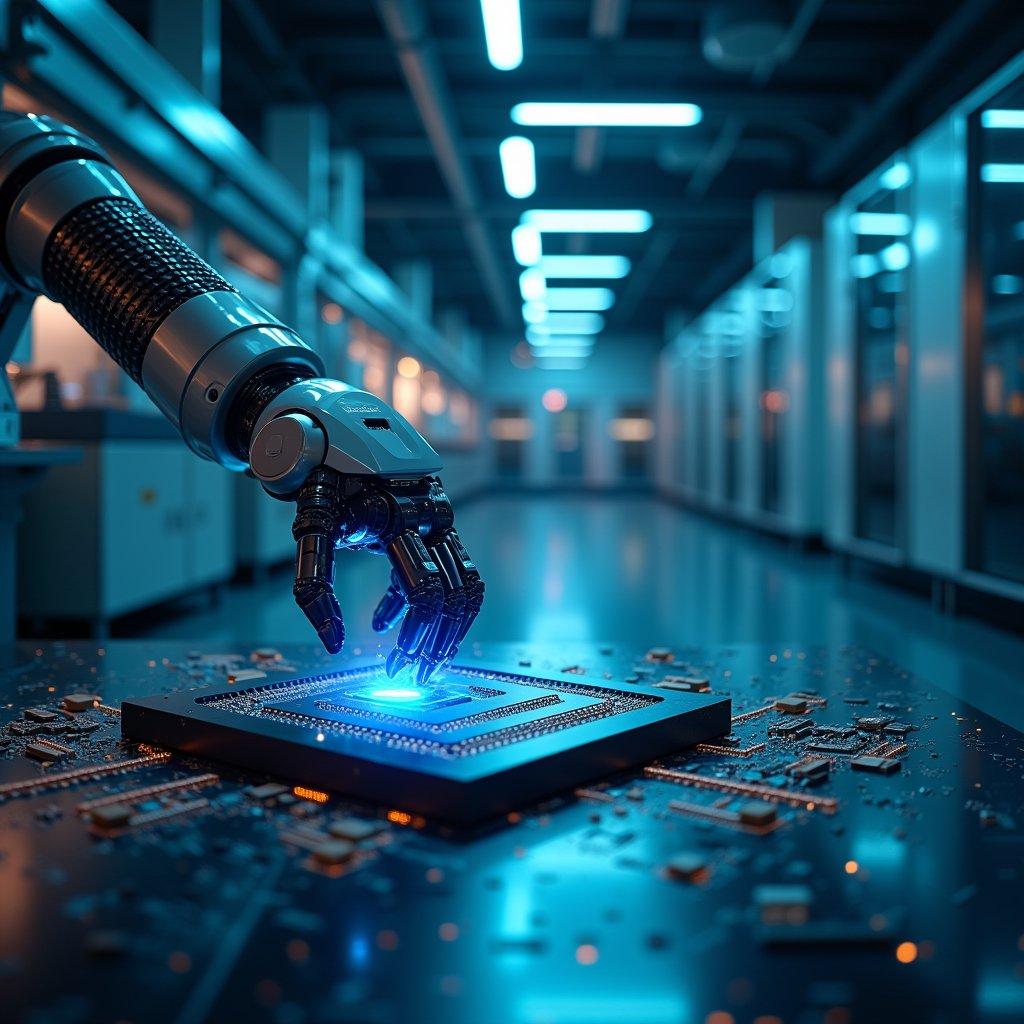
AI Factories: Revolutionizing Efficiency in Semiconductor Production

TABLE OF CONTENTS
- Executive Summary
- Introduction
- The Rise of AI Factories in Semiconductor Manufacturing
- Enhancing Production Efficiency through AI-Driven Optimization
- Industry Challenges and the Strategic Role of AI Factories
- Conclusion
1. Executive Summary
The semiconductor manufacturing landscape is undergoing a profound transformation driven by the advent of AI factories—sophisticated, AI-integrated production ecosystems leveraging advanced computing hardware, including high-performance GPUs. These AI factories enable real-time data processing, autonomous decision-making, and comprehensive digital twin simulations that collectively revolutionize chip production workflows. Industry pioneers such as Samsung Electronics, in collaboration with NVIDIA, have demonstrated substantial operational enhancements, including accelerated lithography simulations and predictive maintenance, typifying the tangible benefits of embedding AI deeply into manufacturing infrastructures. This paradigm shift is crucial for managing rising global demand while enhancing precision, reducing costs, and fostering ecosystem-wide innovation.
Operational efficiency gains stemming from AI-driven optimization techniques have been integral to this transformation. Machine learning-powered defect detection, adaptive process controls, and smart automation—coupled with digital twin environments—have empowered fabs to aggressively reduce yield variance and cycle times. Statistical yield improvements of 2% to 5% represent considerable value given semiconductor wafer costs, while AI-enabled predictive maintenance mitigates equipment downtime and stabilizes throughput. These advancements yield a resilient, agile manufacturing framework capable of continuous self-improvement, meeting stringent quality standards and augmenting production scalability to address evolving market requirements.
Against a backdrop of supply chain volatility, sustainability mandates, and geopolitical complexities, AI factories serve not only as centers of production excellence but also as strategic assets enhancing supply chain resilience and digital transformation in the semiconductor industry. By integrating advanced analytics with real-time monitoring and resource optimization, AI factories enable adaptive responses to disruptions, support sustainable manufacturing practices, and facilitate diversified production strategies aligned with reshoring and friendshoring trends. Looking ahead, semiconductor companies investing strategically in AI factory infrastructures are best positioned to secure competitive advantage, drive rapid innovation cycles, and meet escalating market demands while adhering to environmental and operational imperatives.
2. Introduction
The semiconductor industry is at a pivotal juncture, confronting rising global demand driven by rapid advancements in AI, IoT, automotive electronics, and consumer technologies. To meet these complex challenges, manufacturers are increasingly adopting AI factories—integrated production ecosystems embedding artificial intelligence at every stage of semiconductor fabrication. These AI factories fundamentally reimagine manufacturing paradigms by leveraging cutting-edge AI hardware, such as GPUs, and sophisticated software frameworks to enable autonomous, adaptive, and highly precise chip production processes. This report delves into the technical underpinnings of AI factories, their operational impacts, and their strategic significance in shaping the next generation of semiconductor manufacturing.
This comprehensive analysis is structured into three core sections. First, it elucidates the rise of AI factories, describing their architecture, key technological components, and pivotal industry collaborations, exemplified by the Samsung and NVIDIA partnership. The second section explores the concrete efficiency gains realized through AI-driven process optimization, defect reduction methodologies, smart automation, and digital twin deployments within fabs. The final section situates AI factories within the broader industry context, addressing supply chain challenges, sustainability goals, geopolitical dynamics, and how AI-enabled manufacturing capabilities foster resilience and competitive advantage. Collectively, the report aims to provide stakeholders with a clear understanding of AI factories’ transformative potential and actionable insights for strategic decision-making.
As the semiconductor sector navigates an increasingly complex landscape characterized by rapid technological evolution and market volatility, embracing AI factories offers a pathway to sustainable growth and operational excellence. By integrating real-time data analytics, predictive modeling, and automated workflows, AI factories empower manufacturers to accelerate innovation cycles, optimize yield, and manage supply chain risks proactively. This report thus underscores AI factories as foundational infrastructures that will define the industry’s ability to meet future demands with agility, precision, and environmental responsibility.
3. The Rise of AI Factories in Semiconductor Manufacturing
Artificial intelligence (AI) factories represent a groundbreaking evolution in semiconductor manufacturing, integrating advanced AI-driven computing infrastructure directly into production environments. At their core, AI factories leverage cutting-edge hardware components—most notably high-performance graphics processing units (GPUs)—to enable real-time data processing, dynamic analytics, and autonomous decision-making across the entire semiconductor value chain. These components power sophisticated AI models and simulation platforms that can ingest vast volumes of manufacturing data from design, fabrication, testing, and packaging stages, facilitating enhanced control and optimization of complex chip production workflows. The inclusion of AI hardware such as NVIDIA’s GPU architectures, embedded within these factories, supports accelerated computation necessary for tasks like computational lithography, quality inspection, and production scheduling. This approach fundamentally transforms the traditional, linear semiconductor manufacturing processes into agile, intelligent, and highly interconnected systems capable of continuous self-improvement and adaptation.
Leading semiconductor corporations have already begun pioneering AI factory initiatives that exemplify this transformative potential. A prominent example is the strategic collaboration between Samsung Electronics and NVIDIA, launched in late 2025, which features the deployment of an AI factory infrastructure comprising over 50,000 NVIDIA GPUs. This partnership extends their long-standing relationship beyond memory supply to embrace a comprehensive AI-driven manufacturing ecosystem. Samsung's AI factory integrates NVIDIA’s CUDA-X AI computing libraries and Omniverse platform to construct detailed digital twins of fabrication facilities, enabling predictive maintenance, real-time anomaly detection, and process automation within a simulated environment. The performance enhancements observed include a 20-fold increase in lithography simulation speeds through GPU acceleration, significantly shortening development cycles and enabling rapid adjustments in process parameters. Such industry collaborations underscore the trend toward embedding AI deeply into manufacturing operations, marking a shift from incremental digital improvements to a fully autonomous and intelligent semiconductor production paradigm.
The anticipated impact of AI factories on semiconductor manufacturing infrastructure is profound, spanning operational, economic, and strategic dimensions. By embedding AI capabilities at the factory level, manufacturers can establish tightly integrated ecosystems that combine edge AI computing, cloud-based data analytics, and robotics to enhance productivity, agility, and innovation capacity. This integration supports not only process acceleration but also fosters ecosystem-wide collaboration with equipment, design, and material suppliers, facilitating more responsive and flexible supply chains. Furthermore, the expansion of AI factory infrastructure globally—as evidenced by Samsung’s plans to extend AI factory capabilities to overseas production sites such as its Texas facilities—reflects the scalability and modularity of these platforms. The resulting intelligent manufacturing ecosystems are poised to become foundational pillars for future semiconductor industry growth, enabling manufacturers to meet escalating demand while achieving higher precision, reduced downtime, and lowered operational costs. Ultimately, AI factories are setting a new standard for smart manufacturing infrastructures that can dynamically support the rapid innovation cycles inherent in next-generation semiconductor technologies.
4. Enhancing Production Efficiency through AI-Driven Optimization
The incorporation of advanced artificial intelligence (AI) technologies within semiconductor manufacturing has fundamentally transformed production efficiency by enabling precise process optimization and defect reduction. AI-driven optimization leverages machine learning algorithms and real-time data analytics to identify and rectify inefficiencies in complex multi-stage fabrication workflows. By continuously monitoring critical process parameters and applying adaptive control strategies, these AI systems discern subtle deviations that could result in defects or yield losses, enabling proactive adjustments that minimize waste and maximize throughput. Such dynamic process control surpasses conventional static settings by accommodating process variability and equipment wear, thereby stabilizing production and enhancing device uniformity. This continuous feedback mechanism is crucial given semiconductor manufacturing's sensitivity to nanometer-scale variations, where even minute fluctuation can degrade product quality and lead to costly rework or scrap. Consequently, AI-driven process optimization directly contributes to higher yields, reduced cycle times, and lower operational expenses, representing a pivotal advancement in modern fab operations.
Central to AI-enabled operational efficiency is the deployment of smart automation technologies and the utilization of digital twin environments within semiconductor fabrication plants (fabs). Leading-edge fabs, exemplified by industry players such as Samsung and Intel, have integrated intelligent robotic systems capable of automating repetitive and precision-critical tasks—ranging from wafer handling and lithography exposure to defect inspection and metrology. These automation systems synergize with AI-powered analytics to dynamically adapt workflows, optimize equipment utilization, and mitigate human error. Complementing physical automation, digital twin technology constructs virtual replicas of fabrication environments, allowing real-time simulation and predictive analysis of production scenarios. This enables fabs to conduct virtual process trials, forecast equipment failures, and test process changes without interrupting actual production lines. The net effect is an enhanced capacity for rapid response to anomalies, accelerated root-cause analysis, and continuous process refinement. Such digital manufacturing paradigms foster an agile, data-driven production ecosystem that is critical to sustaining competitiveness amidst rising complexity and volume demands.
Statistical yield improvements represent a quantifiable testament to AI’s transformative impact on semiconductor fabrication efficiency. Utilizing Statistical Yield Limits (SYL) frameworks, fabs establish upper-bound yield targets that account for inherent process variation and defect distributions. AI empowers fabs to approach these theoretical maxima more closely by optimizing defect detection and process adjustments based on advanced statistical process control (SPC) methodologies. For example, machine learning models trained on historical and real-time yield data can predict yield losses arising from specific defect phenomena or process drifts, facilitating timely interventions. Industry evidence shows that AI implementations have enabled yield improvements in the range of several percentage points, translating to millions of dollars in value given the high cost of semiconductor wafers and stringent quality requirements. Furthermore, predictive maintenance facilitated by AI reduces unplanned equipment downtime, indirectly sustaining yield by maintaining process stability. Such improvements not only reduce waste and cost per unit but also shorten time-to-market by lowering the frequency of post-production failures and retests. These data-driven benefits reinforce AI’s role as an indispensable enabler of continuous yield enhancement in next-generation semiconductor manufacturing.
4-1. AI-Driven Process Optimization and Defect Reduction Methods
AI-driven process optimization in semiconductor manufacturing encompasses sophisticated methods including machine learning-based anomaly detection, adaptive process control, and predictive analytics. These methods analyze large volumes of sensor data from process tools, such as lithography steppers and etchers, to identify variations beyond normal operational thresholds. By incorporating unsupervised learning algorithms, fabs can detect unknown or emerging defect patterns without prior explicit definitions, allowing for earlier intervention. Reinforcement learning techniques adjust process parameters in near real-time to maintain process windows that optimize yield. Defect reduction is further enhanced through deep learning-based image recognition systems that inspect wafers at nanometer resolutions, automating inspection tasks that were historically manual and error-prone. These AI systems sharply increase detection accuracy, minimize false positives, and speed defect classification. Consequently, fabs benefit from reduced scrap rates and enhanced product reliability, directly impacting overall production efficiency.
4-2. Smart Automation and Digital Twin Environments in Semiconductor Fabs
Smart automation integrates AI with robotics and enterprise data systems to create intelligent manufacturing workflows at semiconductor fabs. Automated material handling systems (AMHS) equipped with AI optimize wafer transport routes, minimizing idle times and increasing throughput. Collaborative robots (cobots) enhance flexibility by performing delicate assembly and inspection tasks while working alongside human operators safely. AI-driven scheduling software optimizes resource allocation by balancing equipment workloads against production demands. Meanwhile, digital twin technology replicates the real-world fab environment in virtual space using high-fidelity models coupled with real-time data streams. This synthetic environment offers a powerful platform for scenario testing, predictive maintenance planning, and yield impact forecasting without interrupting production. For example, fabs employing digital twins have reduced cycle times by simulating and optimizing process flows before actual implementation, thereby curtailing trial-and-error iterations and minimizing downtime. The synergy between smart automation and digital twins establishes a resilient, adaptable, and continuously improving manufacturing ecosystem.
4-3. Statistical Yield Improvements Attributable to AI Implementation
The adoption of AI in semiconductor manufacturing correlates strongly with measurable statistical yield improvements. Utilizing Statistical Yield Limits (SYL), fabs quantify maximum attainable yields accounting for process variability and defect probabilities. AI accelerates convergence toward these limits by facilitating precise control of critical parameters and early defect identification. Studies show that fabs incorporating AI-driven analytics achieve yield uplifts between 2% and 5%, which, in high-volume contexts, translate into substantial financial gains. Beyond yield uplift, AI enhances yield stability by predicting and mitigating transient disturbances that cause variability. Analytical models incorporating Murphy’s yield equation enable fabs to estimate defect densities and critical areas, guiding targeted process interventions. Predictive maintenance algorithms reduce unexpected tool downtime, ensuring consistent processing conditions necessary for maintaining high yield levels. In sum, AI’s role in statistical yield improvement is a cornerstone of enhanced production efficiency, delivering lower costs, less waste, and improved output quality.
5. Industry Challenges and the Strategic Role of AI Factories
The semiconductor industry today faces a convergence of multifaceted challenges that place unprecedented pressure on manufacturers and their supply chains. Driven by surging global demand fueled by expanding AI, IoT, automotive, and high-tech sectors, the market contends with persistent supply-demand imbalances manifesting in prolonged lead times and volatile pricing. Compounding these pressures are evolving sustainability imperatives that demand cleaner manufacturing processes, efficient material utilization, and aggressive reduction of hazardous emissions. Further complicating the landscape are geopolitical tensions and trade constraints, including export controls and tariff regimes, which disrupt the seamless global flow of raw materials and finished products. For instance, ongoing trade conflicts impact access to critical semiconductor materials and manufacturing equipment, adding layers of operational complexity and cost uncertainty. This triad of supply constraints, environmental responsibility, and geopolitical volatility underscores the critical need for resilient, adaptive strategies within semiconductor ecosystems.
Within this challenging context, AI factories emerge as pivotal enablers of the semiconductor industry’s broader digital transformation and supply chain resilience. Rather than solely focusing on production efficiency, these AI-powered facilities serve as comprehensive intelligence hubs, integrating advanced data analytics, real-time supply chain monitoring, and predictive insights to anticipate disruptions and optimize resource allocation dynamically. By leveraging AI-driven demand forecasting, inventory management, and logistics optimization, AI factories enhance the agility and responsiveness of semiconductor supply chains amidst global uncertainties. Moreover, their capacity to embed sustainability considerations — through smarter process control, waste reduction, and energy efficiency monitoring — directly addresses mounting environmental mandates. This strategic repositioning of AI factories transcends operational automation by embedding intelligence into decision-making frameworks, thus fortifying semiconductor manufacturers against both cyclical economic fluctuations and structural industry shifts.
Looking forward, the strategic implications of AI factories are profound and multifarious. Market forecasts project continued exponential growth in semiconductor demand, propelled notably by AI-specialized chips and emerging technologies requiring increasingly sophisticated fabrication techniques. In response, semiconductor companies adopting AI factory models position themselves to capitalize on these trends by accelerating innovation cycles, reducing exposure to supply chain shocks, and meeting escalating customer expectations for speed, quality, and sustainability compliance. The digital transformation catalyzed by AI factories also supports more decentralized and diversified production footprints, aligning with reshoring, nearshoring, and friendshoring strategies designed to mitigate geopolitical risk. Thus, the integration of AI factories possesses the dual capacity to future-proof semiconductor operations and sustain competitive advantages in a rapidly evolving global market. Strategic investments in AI-enabled infrastructures and capabilities will therefore be integral for industry leaders aiming to navigate complexity while driving profitable growth through the next decade.
5-1. Key Industry Challenges: Navigating Supply, Sustainability, and Trade
The semiconductor industry grapples with a complex set of challenges that threaten its ability to meet growing demand and maintain operational continuity. A foremost issue is the persistent supply-demand imbalance, which arises from rapidly evolving end-market needs—especially for AI processors, IoT devices, and automotive electronics—and constrained manufacturing capacity. Despite recent expansions, lead times remain elevated globally, often exceeding 25 weeks, driven by tight wafer fabrication capacity and bottlenecks in assembly and testing stages. Additionally, raw material scarcity, including rare and critical elements like tantalum, exacerbates supply fragility. Sustainability is an equally pressing concern: semiconductor manufacturing is resource intensive, with significant water, energy, and hazardous chemical usage that contribute to environmental footprint and regulatory scrutiny. Recycling semiconductor materials at device end-of-life is exceptionally challenging, given the minute quantities and toxicity involved, further complicating the circular economy prospects. Finally, multinational trade tensions and export controls—such as US restrictions on advanced chip technology exports to certain countries—introduce supply chain uncertainties and incentivize regionalization, disrupting established global collaboration networks.
5-2. AI Factories as Catalysts for Digital Transformation and Supply Chain Resilience
Against this intricate backdrop, AI factories serve as transformative agents catalyzing the semiconductor sector’s digital evolution. By embedding AI-powered analytics and process intelligence at scale, these factories enhance transparency, precision, and responsiveness across the manufacturing and supply chain continuum. Advanced AI models facilitate real-time anomaly detection, predictive maintenance, and adaptive scheduling, enabling proactive management of equipment reliability and process deviations that could otherwise amplify downtime and yield loss risks. On a supply chain level, AI factories incorporate big data-driven forecasting and optimization tools that anticipate demand fluctuations and mitigate inventory imbalances. This empowers semiconductor firms to reconfigure supply networks dynamically, accommodating the geographical diversity and complex tiering characteristic of modern sourcing strategies, including friendshoring and nearshoring. Moreover, through continuous monitoring and automated feedback loops, AI factories contribute to reducing waste and energy consumption, aligning operational imperatives with sustainability targets. This integration of intelligence thus transcends traditional automation, establishing a resilient infrastructure better equipped for uncertainty and rapid change.
5-3. Future Market Impact and Strategic Implications for Semiconductor Companies
The continued evolution and proliferation of AI factories herald significant strategic shifts within the semiconductor landscape. Projections anticipate the global semiconductor market approaching $800 billion by 2025, fueled largely by demand for AI-specialized chipsets whose complexity and volume necessitate agile, high-precision production methods. Semiconductor organizations embracing AI factories stand to enhance their competitiveness by shortening innovation cycles and scaling production with greater flexibility. Crucially, the intelligence embedded within AI factories supports diversified manufacturing footprints and supply chain architectures aligned with geopolitical realities—facilitating onshoring, friendshoring, and nearshoring to mitigate risks associated with concentrated production. Furthermore, by meeting stringent sustainability demands through smarter resource management, AI factories position companies favorably with regulators, customers, and investors focused increasingly on Environmental, Social, and Governance (ESG) criteria. Looking ahead, semiconductor companies unwilling or slow to invest in AI-enabled digital transformation risk losing market share, operational efficiency, and innovation leadership, underscoring the strategic imperative to integrate AI factories fully into their long-term growth plans.
6. Conclusion
AI factories have emerged as a revolutionary force within semiconductor manufacturing, reshaping traditional production models into intelligent, autonomous, and interconnected ecosystems. By embedding advanced AI hardware and software capabilities—including massive GPU-powered computation, machine learning-driven process control, and digital twin simulations—these factories enable real-time optimization and predictive insights that markedly enhance production precision and agility. The pioneering initiatives by industry leaders, such as Samsung and NVIDIA, exemplify the potential for AI factories to accelerate development cycles and elevate manufacturing throughput, setting new industry benchmarks for efficiency and innovation.
The operational advantages delivered by AI factories—from adaptive process optimization and defect reduction to smart automation and statistical yield improvements—translate directly into tangible economic and competitive benefits. By narrowing yield gaps, minimizing downtime through predictive maintenance, and fostering rapid response to process variations, AI-driven manufacturing elevates fab performance and reduces per-unit costs. These capabilities not only improve product quality but also underpin resilient, scalable production architectures capable of accommodating increasingly complex semiconductor technologies and volumes demanded by evolving markets.
Strategically, AI factories address the broader challenges constraining the semiconductor industry, including supply chain fragility, sustainability imperatives, and geopolitical uncertainties. Their integrative intelligence platforms enable more agile supply chain management, supporting diversified and decentralized production models aligned with reshoring and friendshoring initiatives. Moreover, by embedding sustainability considerations into operational processes, AI factories position manufacturers to comply proactively with environmental regulations and stakeholder expectations. Looking forward, investing in AI factory infrastructure is essential for semiconductor companies aiming to sustain technological leadership, adapt to shifting market dynamics, and secure long-term growth.
In summary, AI factories represent a transformative convergence of artificial intelligence and manufacturing that will define the semiconductor industry's future trajectory. To capitalize fully on these benefits, stakeholders must pursue strategic investments in AI technologies, foster cross-industry collaborations, and cultivate organizational capabilities that reinforce continuous learning and innovation. Such commitments will enable semiconductor manufacturers not only to meet escalating global demands but also to lead with agility and resilience in an increasingly competitive and complex global environment.