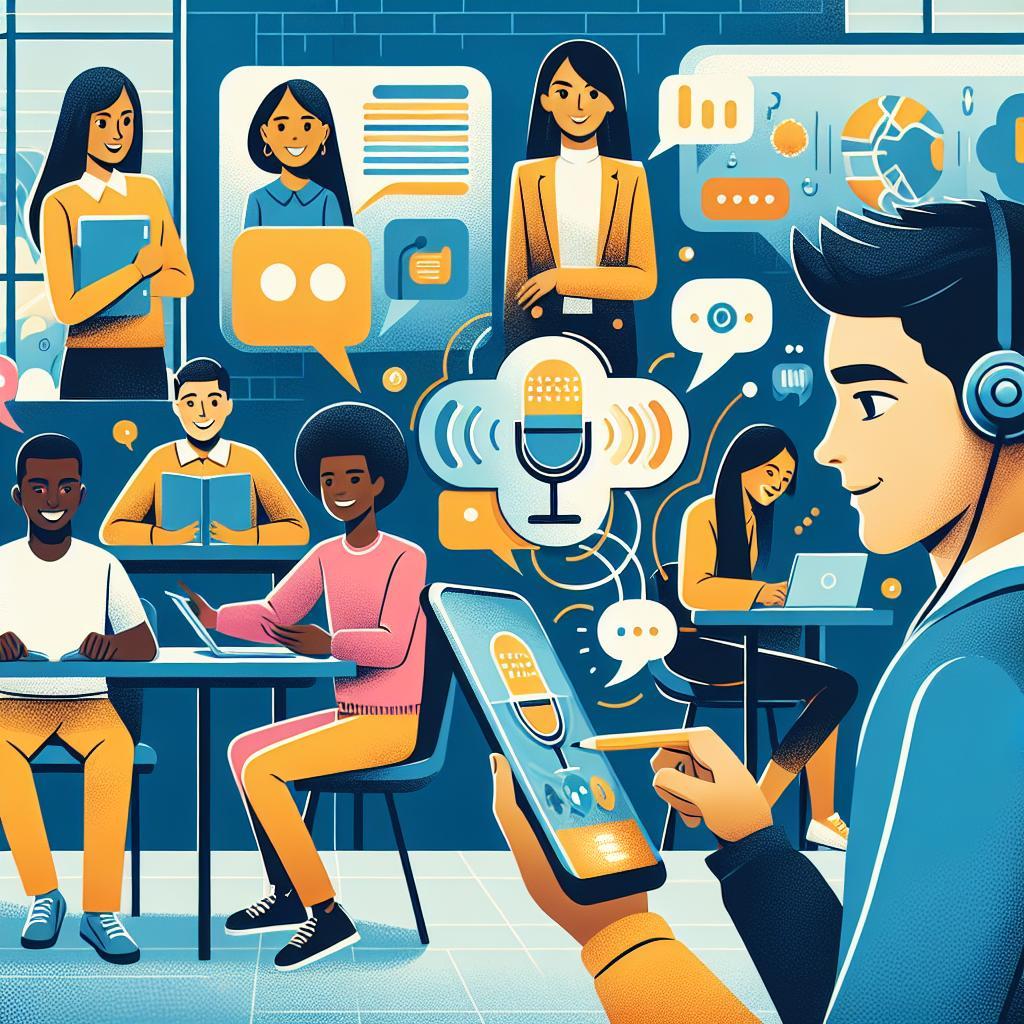
Echoes of Learning: Assessing AI Voice Generation’s Potential to Replace Human Narration

In the past year, remarkable strides have been made in generative AI that have led to the development of text-to-speech systems with naturalness levels that closely rival those of human narrators. Noteworthy advancements include Perplexity’s AI voice assistant now available on iOS and Google’s Gemini, which is set to replace Google Assistant on Wear OS devices. These innovations mark a pivotal moment in the accessibility and functionality of AI voice technology across various platforms, enhancing its integration into daily life.
The evaluation of AI voice generation technologies reveals a dynamic landscape, characterized by significant technological evolution that has culminated in ongoing performance assessments against human narration. As of April 2025, various benchmarks have been established to gauge the intelligibility and naturalness of AI-generated speech, emphasizing the critical role that quality plays in determining the viability of these systems as replacements or supplements for human narrators. Concurrently, the application of AI voices in educational settings brings to light remarkable pedagogical and accessibility benefits, as AI can provide scalable narrations tailored to diverse learning materials, thus improving educational experiences for many learners.
However, challenges remain. Research into limitations surrounding emotional expressiveness, the presence of persistent artifacts, and ethical considerations surrounding bias and representation emphasizes the need for introspection within the field. As AI-generated voices continue to evolve, a holistic approach that takes into account user perceptions, emotional depth, and ethical implications remains paramount. The anticipated future wherein AI and human voices operate collaboratively promises not only an enhancement in learning methodologies but also solutions to existing challenges in educational and communicative contexts.
Evolution of AI Voice Generation Technologies
Perplexity’s AI voice assistant launch on iOS
On April 23, 2025, Perplexity announced the launch of its AI voice assistant on iOS, expanding its capabilities beyond the previously available Android platform. This strategic move allowed Apple users to access the assistant for various practical applications such as writing emails, setting reminders, and even making restaurant reservations. This transition signifies a crucial step in making AI voice technology more widely accessible and functional across different operating systems. The integration on iOS was notable as it involved enhancing user permissions, allowing the assistant to manage tasks effectively while maintaining user privacy.
Initial user experiences have highlighted some limitations; for instance, the assistant does not support camera interactions as competitors might, such as being unable to contextually see what users see. However, it retains substantial functionality through its text-based chatbot interface. The rollout of this feature showcases the growing emphasis on conversational AI within mobile applications, reflecting a broader trend where companies seek to enhance user interaction with natural language processing capabilities.
Gemini replacing Google Assistant on Wear OS
Google has been progressively aligning its wearable technology with next-generation AI capabilities by preparing to replace the traditional Google Assistant with Gemini on Wear OS smartwatches. This transition was initiated with subtle branding changes observed in late April 2025, indicating that the shift towards Gemini is imminent. The AI model, Gemini, aims to offer a more intuitive and natural interaction experience than its predecessor, which has been serving users since its introduction nearly a decade ago.
Gemini’s planned full integration into Android phones and Wear OS throughout 2025 suggests a significant leap in AI voice interaction. The future of Gemini is being designed to meet users' demands for a smarter, more responsive assistant, even as work continues to optimize its functionality for smaller devices like smartwatches. The transition to Gemini reflects a strategic pivot by Google, focusing on evolving user experiences through enhanced natural language understanding and context handling.
Underlying large-model improvements
The evolution of AI voice generation technologies has been significantly influenced by advancements in large language models (LLMs). Recent developments include improvements in multimodal capabilities, which enable these models to process and generate diverse types of content, including text, audio, images, and video. Such enhancements have positioned LLMs at the forefront of generative AI, marking a substantial shift in how voice generation systems understand and produce human-like speech.
Models like Baidu's Ernie 4.5 Turbo and Ernie X1 Turbo epitomize this progress, showcasing superior reasoning capabilities, enhanced multimodal processing, and significantly reduced operational costs. The implications of these advancements extend beyond mere technological novelty; they usher in new methodologies for AI applications across various sectors. As generative AI continues to mature, the focus on high-quality, contextually aware voice synthesis is transforming how educational content and customer interactions are mediated, underpinning the future landscape of AI-driven communication.
Current Performance and Naturalness: Human vs AI Voice
Quality benchmarks for synthetic speech
As of April 2025, the quality of synthetic speech has advanced significantly, meeting or even exceeding certain benchmarks traditionally associated with human narration. Key metrics include intelligibility, clarity, and naturalness of speech. Research in this domain focuses on evaluating how closely AI-generated voices can mimic human speech patterns, tones, and nuances. Benchmarking tests often involve both subjective assessments—where listeners rate the pleasantness and authenticity of voices—and objective measurements, utilizing scoring systems to evaluate fidelity to human-like traits. These quality benchmarks are crucial for assessing whether AI voices can serve as viable replacements or supplements to human narrators in various settings.
Prosody, intonation, and expressiveness
One of the hallmarks of effective voice narration is its prosodic features, which include rhythm, pitch variation, and intonation patterns. Recent developments in AI voice technology have emphasized these elements, enabling synthetic voices to incorporate more natural-sounding variations that align closely with human emotional expression. Ongoing improvements in deep learning and neural networks facilitate the replication of complex prosodic attributes, allowing AI systems to convey emotions, emphasize key phrases, and adjust intonation based on context. However, while AI voices have become adept at mimicking these features, the depth of emotional expressiveness remains a challenge, often resulting in outputs that, while technically proficient, can lack the nuanced warmth of human narration.
User perceptions of AI-narrated content
User acceptance of AI-narrated content has seen an upward trend as individuals become more accustomed to synthetic voices in their daily interactions. Surveys and studies conducted in 2025 reveal that many users find AI-generated narratives satisfactory, particularly in applications like newsreading and educational materials. Factors such as familiarity, context, and user expectations play pivotal roles in shaping these perceptions. Importantly, while some users appreciate the efficiency and accessibility offered by AI voices—especially for multitasking scenarios and personalized content delivery—others express a preference for human narrators, particularly in emotionally charged or complex storytelling contexts. This duality highlights the importance of understanding user demographics and situational usage when evaluating the effectiveness of AI voices.
Pedagogical and Accessibility Benefits of AI Voice in Education
Scalable narration for diverse learning materials
One of the foremost benefits of AI voice technology in educational contexts is its scalability. AI voice can produce high-quality narration across a vast array of learning materials, including textbooks, online courses, and supplemental resources. This capability enables educators to provide consistent and engaging audio content to a broader range of learners, optimizing the learning experience without the need to record individual narrations for each material. Moreover, AI-generated narration can adjust the pace and clarity according to the target audience. For example, text-to-speech systems can increase the speed of narration for advanced learners while slowing down for beginners or those needing additional support. This adaptability allows for a more tailored educational experience that meets diverse learning needs effectively.
Personalization through voice tuning
AI voice technologies allow for significant personalization in the learning environment, enhancing the engagement of students. Users can customize the voice characteristics, such as pitch, tone, and even emotional expression, to suit their personal preferences. This degree of personalization not only increases comfort for learners but can also facilitate a stronger connection with the material being taught. Additionally, some platforms are exploring the incorporation of learner feedback to continually refine voice output. This iterative improvement means that students can engage with content that resonates more closely with their learning style, fostering an environment conducive to deeper comprehension and retention.
Enhanced accessibility for visually impaired learners
The accessibility benefits of AI voice are particularly noteworthy for visually impaired learners. These students often face significant barriers when engaging with traditional learning materials, which may not always be available in formats that accommodate their needs. AI voice technology can bridge this gap by transforming written content into spoken word, thus making educational resources more accessible. Furthermore, enhanced text-to-speech systems have progressed to a point where they can perform well in diverse contexts, ensuring that the nuances of language are conveyed accurately. This improvement in quality allows visually impaired students not only to participate more fully in classrooms but also to access independent study materials, significantly leveling the educational playing field.
Limitations, Challenges, and Ethical Considerations
Persistent artifacts and uncanny valley effects
Despite significant advancements in AI voice generation, the technology still grapples with persistent artifacts that can detract from the overall quality of synthetic speech. These artifacts manifest as unnatural pauses, intonations, or pronunciation errors, which can disrupt the flow of narration and lead to a less engaging user experience. While some users may tolerate minor imperfections, others are sharply critical, particularly in educational contexts where clarity and engagement are paramount. The phenomenon known as the 'uncanny valley' becomes salient here; as AI-generated voices grow more realistic, discrepancies become more pronounced, eliciting discomfort or disbelief in listeners who are otherwise accustomed to human narration. Therefore, ongoing efforts to refine AI algorithms, improve training datasets, and increase adaptability to various speech contexts remain crucial for overcoming these limitations.
Bias and representation in synthetic voices
One of the most pressing ethical concerns surrounding AI voice technologies is the presence of bias in synthetic voices. As articulated by Dr. Sheetal Bhoola in her recent discussion on the ethical complexities of AI, these biases stem from the training data used to develop voice models, which may not adequately represent diverse linguistic or cultural backgrounds. Consequently, marginalized groups may find their voices underrepresented or mischaracterized in AI systems. This raises questions about the fairness and inclusivity of AI outputs, particularly in educational settings. Institutions face the challenge of ensuring that voice technology enhances rather than impedes equitable access to learning resources. Moreover, ongoing assessments of how voice technologies perpetuate societal biases will be essential in guiding both development and deployment.
Intellectual property and attribution issues
The emergence of AI voice generation also brings notable intellectual property challenges. As AI-generated content becomes increasingly prevalent in academic and creative fields, defining ownership rights becomes convoluted. For example, if an AI voice is used to narrate an educational material, who holds the copyright? The user of the AI platform, the developers of the technology, or perhaps the original sources of the training data? Clarifying attribution standards is critical to combat plagiarism and ensure that creators receive proper recognition for their contributions. Additionally, the ethical implications surrounding the use of AI-generated voices must be carefully navigated to avoid violations of privacy and intellectual property laws. Researchers, educators, and policymakers must collaborate to create frameworks that balance innovation with ethical accountability in the realm of AI voice technologies.
Future Directions: Coexistence of AI and Human Voices in Learning
Hybrid AI-human narration workflows
As educational needs evolve, the integration of AI voice generation with human narration is expected to foster a hybrid approach that enhances learning outcomes. Hybrid workflows can capitalize on the strengths of both realms, allowing AI to handle repetitive and straightforward narration tasks, thereby enabling human narrators to focus on more complex, emotive content. This collaboration is not only anticipated to streamline academic content delivery but also to enrich learner engagement by providing diverse auditory experiences tailored to different learning contexts.
Emerging voice-style transfer techniques
The development of voice-style transfer techniques represents a significant frontier in AI voice technology. This approach allows for the adaptation of AI-generated voices to better mimic the nuances of human emotion, intonation, and personal style. As these techniques mature, they are expected to facilitate more personalized and relatable learning experiences, where the voice of the AI can be adjusted to resonate more closely with the learner's preferences or the subject matter at hand. As educators look to customize educational materials, such advances may bridge the gap between machine-generated and authentically human narratives, creating a more seamless auditory landscape.
Regulatory and quality-assurance frameworks
As the coexistence of AI and human voices becomes more entrenched in educational settings, establishing regulatory and quality-assurance frameworks will be crucial. Such frameworks should encompass ethical considerations regarding the use of AI, ensuring transparency in its application while safeguarding against biases inherent in synthetic voices. Quality-assurance measures will be necessary to evaluate the effectiveness of AI voice generation in educational contexts, assessing user satisfaction and learning outcomes. By laying down clear guidelines and standards, stakeholders can ensure that the implementation of AI in education enhances rather than detracts from the learning experience.
Wrap Up
As of April 2025, AI voice generation technology has reached a pivotal level of development where synthetic narration is increasingly perceived as indistinguishable from human speech. The scalability and customization offered by these advanced systems unlock new avenues for inclusive and adaptive educational experiences, allowing for the personalization of learning at unprecedented scales. Despite the advancements, the limitations regarding emotional depth, occasional artifacts, and unresolved ethical challenges underscore the necessity for human oversight and integration of AI within a hybrid framework.
Looking towards the future, it is crucial for educators and developers to cultivate collaborations between AI and human narration. Such a hybrid approach could utilize AI for routine, high-volume tasks while delegating emotionally nuanced or critical content to human narrators, preserving the authenticity that only the human voice can provide. Establishing clear standards for attribution, conducting bias audits, and maintaining rigorous quality benchmarks will be essential in ensuring the ethical deployment of these technologies.
The envisioned blend of AI efficiency and the irreplaceable human touch in narration promises to create richer, more accessible learning environments. This duality not only enhances the educational landscape but also ensures that as we move forward, education remains a profoundly human endeavor supported by the best technological achievements. The integration of AI voice technology in learning thus stands at the crossroads of innovation and ethical responsibility, paving the way for a future where learning is more engaging, personalized, and inclusive.