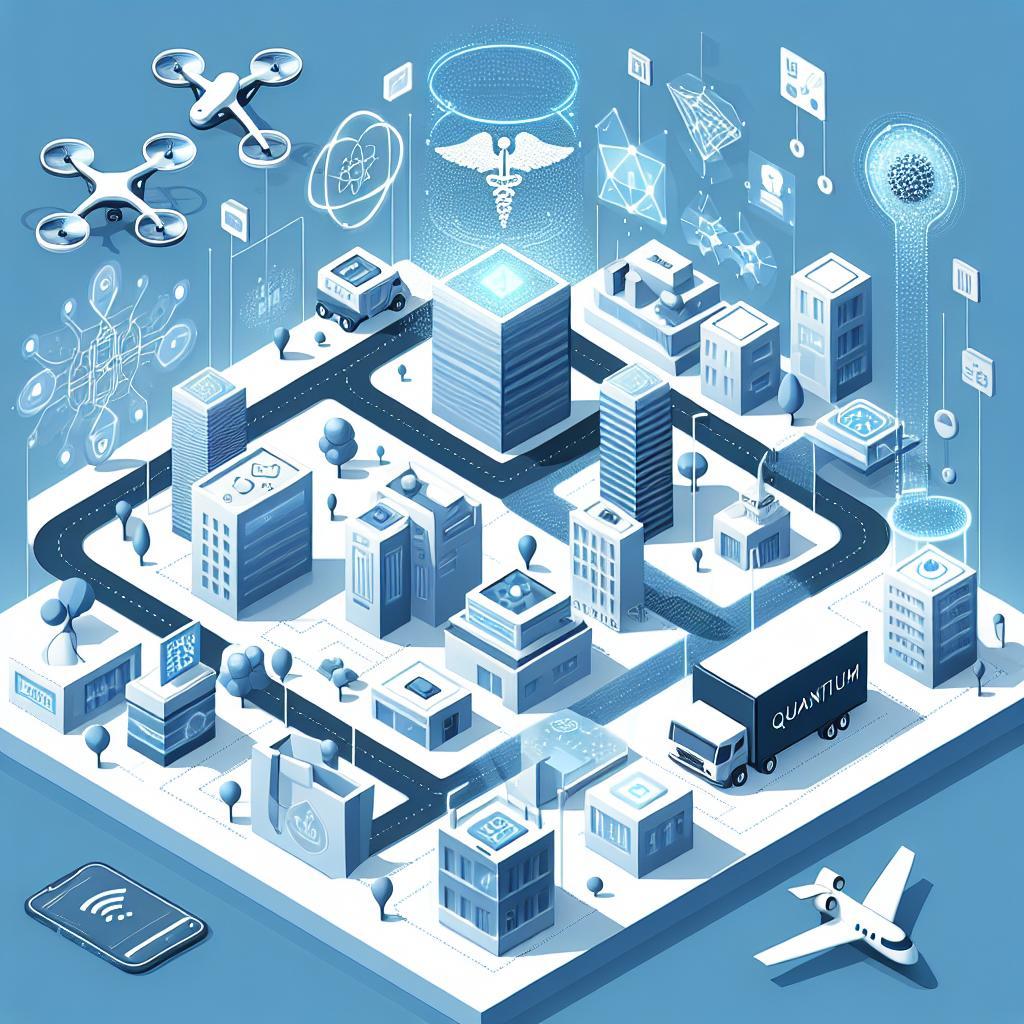
Cutting-Edge Innovations at CES 2025

TABLE OF CONTENTS
- Summary
- AI Innovations at CES 2025
- Mobility Solutions and Trends
- Quantum Computing Developments
- AI in Healthcare and Personalization
- Market Dynamics and Industry Collaborations
- Conclusion
1. Summary
CES 2025 has become a pivotal platform for showcasing the remarkable advancements in AI, mobility, and quantum computing. The event featured seminal developments in smart glasses by Vuzix, emphasizing solutions for warehouse logistics and remote support, and highlighting the rapid adoption of AI in consumer electronics. NVIDIA captured attention with its announcement of the Blackwell AI accelerator and the Cosmos platform for robotics and autonomous vehicles, asserting a vision for future mobility solutions. The report also revealed strides in advanced driver assistance systems and the promising potential of eVTOL technologies, such as RICTOR's Skyrider X1, in urban transport innovation. In the arena of quantum computing, landmark breakthroughs by IonQ and IBM indicate a significant leap in computational power with partnerships enhancing the field’s capabilities. Furthermore, the integration of AI in healthcare continues to evolve, facilitating personalized health records and advancing digital health solutions. Such innovations reflect the growing influence of AI on customer success and business strategies, underscoring an industry-wide shift toward personalization and efficiency through strategic collaborations.
2. AI Innovations at CES 2025
2-1. Vuzix Smart Glasses Applications
At CES 2025, Vuzix (NASDAQ: VUZI) and its partners are unveiling advanced applications for smart glasses. The primary applications include: Warehouse & Logistics using Moviynt's Mobilium platform on M400 smart glasses, which integrates mobile devices with ERP systems to enhance workflow efficiency; Remote Support through Augmex's AUGASSIST solution on M400 smart glasses that employs live annotations, AI, and AR overlays to minimize downtime and travel costs; and Conversational AI & Learning via Mentra's applications on Z100 smart glasses, specifically Mentra Merge for improved problem-solving and Mentra Link for real-time language learning.
2-2. AI Integration in Consumer Electronics
CES 2025 has shifted its focus towards AI technology integrated into consumer electronics. The event attracts more than 4,800 exhibitors across 160 countries, with approximately 1,031 companies from South Korea participating, marking a record. Innovations highlighted during the event include Samsung's smart refrigerator featuring a 9-inch touchscreen and LG's 'empathy intelligence' technology that connects and enhances user experiences in daily life.
2-3. Keynote Highlights by NVIDIA
NVIDIA's CEO, Jensen Huang, delivered significant keynote presentations at CES 2025, marking his return after eight years. He announced advancements in NVIDIA's next-generation AI accelerator, Blackwell, and emphasized the company's entry into mobility and robotics markets. Huang suggested that the era of robotics is approaching, introducing the 'Cosmos' platform, designed for humanoid robots, industrial robots, and autonomous vehicles, aiming to democratize physical AI technology.
3. Mobility Solutions and Trends
3-1. Advanced Driver Assistance Systems (ADAS)
The CES 2025 showcased advanced Driver Assistance Systems (ADAS) technology, particularly highlighting its role in enhancing driving safety. Companies like StradVision and Mobileye unveiled mass-production models that integrate AI technologies to improve accuracy and efficiency. ADAS features primarily focus on 'sensing' capabilities, including Lane Keeping Assist (LKA), Automatic Emergency Braking (AEB), and Adaptive Cruise Control (ACC). However, current ADAS retains limitations, as drivers still primarily control the vehicle's operation. This year, innovations combining deep learning with ADAS were presented, with a shift toward more proactive systems capable of real-time processing. This evolution indicates a growing integration of AI within vehicle systems aimed at fostering greater autonomy.
3-2. eVTOL Technologies and Urban Mobility
The mobility industry is evolving rapidly with the advent of eVTOL (Electric Vertical Takeoff and Landing) technologies, addressing urban transportation challenges such as congestion and the need for sustainable movement. RICTOR's introduction of the Skyrider X1, a hybrid flight motorcycle at CES 2025, emphasizes a vision for feasible personal flight solutions. The Skyrider X1 is designed for both land and air mobility, featuring advanced safety measures including autonomous flight control and emergency systems. Its dual functionality aims to revolutionize urban transport and create new business models that can impact logistics, emergency services, and tourism.
3-3. Autonomous Vehicle Development
The development of autonomous vehicles continues to gather momentum, with a significant focus on leveraging advanced technologies to enhance operational efficiency. Companies are increasingly integrating high-performance computing capabilities into their systems, exemplified by Mobileye's introduction of the EyeQ6 chip, which boasts ten times the performance of its predecessor. Furthermore, innovations in software that enable better perception and real-time data processing are proving essential in the push towards fully autonomous vehicles. The industry's direction suggests a collaborative approach to improve safety, performance, and operational capabilities.
4. Quantum Computing Developments
4-1. Innovations in Quantum Processing
The field of quantum computing is rapidly advancing, significantly marked by important progress from industry leaders who are innovating technology. IonQ has gained attention through a recent partnership with Oak Ridge National Laboratory, successfully reducing the number of 2-qubit gates necessary for quantum systems by over 85%. This breakthrough promises enhanced computational efficiency and capabilities. Additionally, Rigetti Computing has unveiled its Anka-3 system equipped with 84 qubits, which improves coherence and gate fidelity, essential for precise and scalable quantum calculations. IBM has introduced the R2 Heron quantum processor, comprised of 156 qubits, that allows execution of tasks up to 50 times faster than previous models, positioning IBM at the forefront of quantum computing.
4-2. Partnerships Advancing Quantum Technologies
To further enhance quantum technology, collaborations have been pivotal. Nvidia has partnered with Google Quantum AI to improve quantum computer architecture, aiming to address the prevalent issue of noise in quantum systems, which is critical for the overall performance. D-Wave Quantum has secured $175 million in funding while maintaining SOC 2 Type 2 compliance, emphasizing their focus on high-security standards in their quantum solutions. Such partnerships and funding initiatives reflect the growing investment and commitment of industry leaders to advance quantum computing capabilities.
4-3. Current Status and Trends
The current landscape of quantum computing illustrates a vibrant and rapidly evolving field, where various trends are emerging. Investment in quantum technology is expected to rise, facilitating the integration of quantum algorithms in diverse sectors including cryptography, materials science, and complex systems simulation. Challenges remain in stabilization of qubits and error rates, as well as the high costs associated with the development and maintenance of quantum infrastructure. Nevertheless, the potential for exponential increases in problem-solving capabilities and unprecedented innovation across industries continues to drive interest and development within the field.
5. AI in Healthcare and Personalization
5-1. AI Health Record Applications
Axilla Personal Health Record (PHR) is a mobile app designed to assist users in compiling their medical data from various sources. It enables users to securely store their own and their family’s health history on their mobile device. The app allows for the organization of medical data, measurements, and observations, which can later be presented visually to healthcare providers. Key features include managing health details, controlling chronic diseases through early symptom recognition, and easily accessing health records for improved healthcare service when needed.
5-2. Impact of AI on Medical Services
The integration of AI into daily life and various industries, including healthcare, has rapidly increased. AI plays a significant role in many domains such as smart speakers, chatbots, and medical services. However, while AI excels in creative tasks, it still has limitations in simple calculations. Acknowledging the need for critical thinking is important for learners using AI technologies, ensuring they maintain self-efficacy and control over their learning processes. The concept of 'prompt engineering' is pivotal in optimizing communication with generative AI, and is essential for accurate outcomes.
5-3. Trends in Digital Health Solutions
Digital health solutions are emerging as critical components in healthcare, reflecting a growing trend towards personalized care. AI acts as a customized learning assistant in various areas such as task grading and information retrieval. The focus on enhancing user experience through effective digital health solutions is becoming increasingly evident. Ongoing developments indicate that as AI technologies advance, they will continue to change the landscape of healthcare, promoting better personal health management and data-driven decision-making.
6. Market Dynamics and Industry Collaborations
6-1. Growth of Customer Success Management
The document highlights the significant growth of Customer Success Management (CSM) in response to the increasing demand for personalized customer experiences in various industries. CSM leverages data analytics to enhance customer engagement and drive product adoption, ultimately leading to improved customer satisfaction and retention rates.
6-2. Collaborations in AI and Mobility
Collaborations in the AI and mobility sectors have intensified as companies seek to share resources and expertise. Notable examples include partnerships involving major firms like NVIDIA and various startups that aim to innovate in autonomous vehicle technology and AI-driven solutions. Such collaborations are crucial for accelerating technological advancements and addressing complex industry challenges.
6-3. Impact of AI on Business Strategies
The integration of AI into business strategies has had a profound impact on how companies operate. Businesses are increasingly utilizing AI to streamline operations, enhance decision-making processes, and improve overall efficiency. The document provides evidence of organizations leveraging AI to reshape their strategies in order to remain competitive in the rapidly evolving technology landscape.
Conclusion
The CES 2025 event underscores the transformative impact of technology across diverse sectors, with Vuzix and NVIDIA standing out for their innovative contributions. Vuzix's advancements in AI applications for smart glasses demonstrate their potential to significantly enhance efficiency in logistics and remote support. NVIDIA's emphasis on AI acceleration through its Blackwell AI accelerator and the Cosmos platform signifies a paradigm shift towards more autonomous and robotic-driven industries. Quantum computing developments by leaders like IonQ and IBM highlight the sector’s fast-paced evolution, foreshadowing exponential increases in computational power and problem-solving capabilities. However, limitations still exist, particularly in areas like qubit stabilization and the high costs associated with quantum infrastructure. Future prospects suggest a burgeoning investment in AI and quantum technologies, which are poised to dramatically reshape industries like healthcare, logistics, and urban mobility. To harness these advancements, industries must cultivate robust collaborations and explore innovative business models to unlock new possibilities. Practical applications of this technology hold promise for improving efficiency, personalization, and ultimately, global societal outcomes.