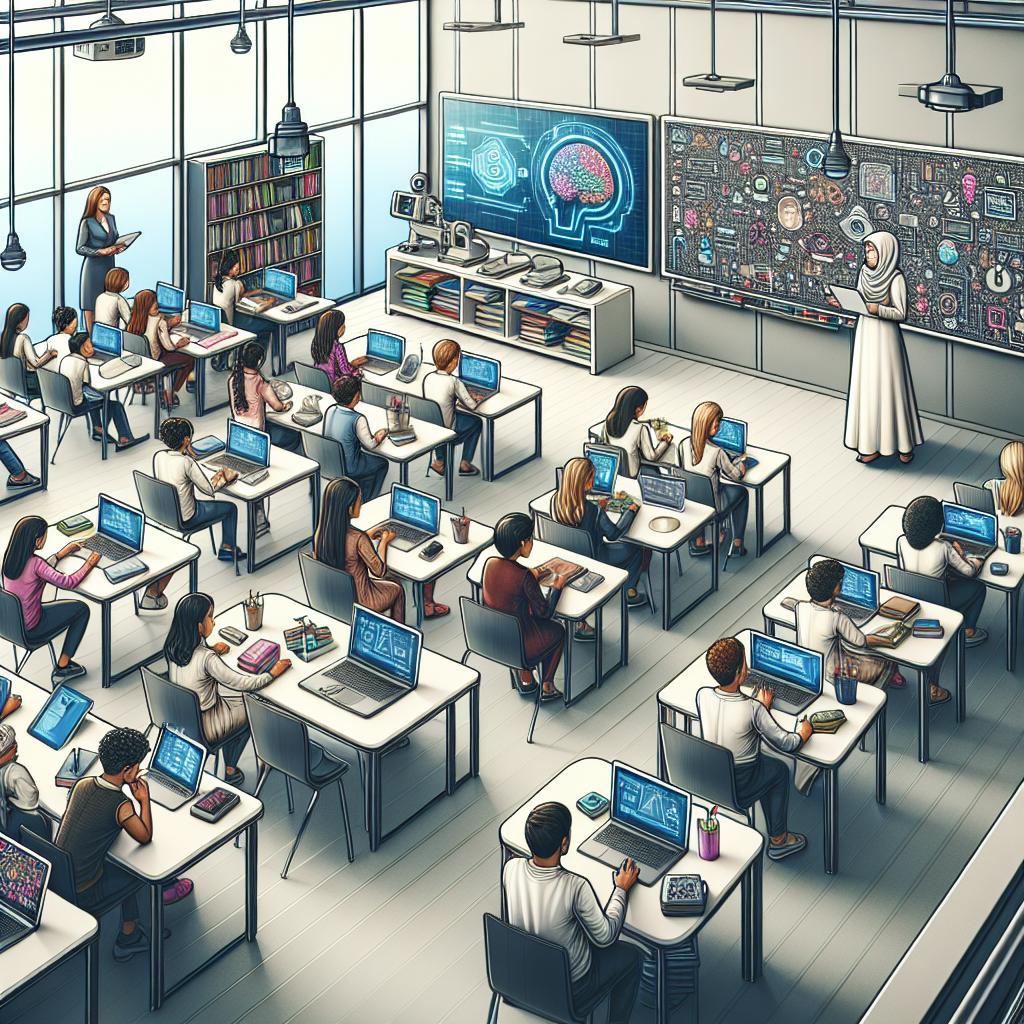
AI's Transformative Role in Education

TABLE OF CONTENTS
- Summary
- Benefits of AI in Education
- Challenges and Risks of AI in Education
- AI Technologies and Their Applications in Education
- The Historical Development of AI in Education
- Case Studies and Real-World Applications of AI in Education
- Conclusion
1. Summary
Artificial Intelligence (AI) is heralding a new era in education by personalizing learning experiences and improving administrative efficiency. By utilizing sophisticated algorithms, AI tailors educational content to meet individual student needs, thus enhancing comprehension and engagement. Moreover, AI tools such as virtual tutors and adaptive assessments revolutionize the interaction between students and teachers, fostering a more dynamic learning environment. However, the integration of AI is not without challenges. Data privacy concerns, potential algorithmic biases, and overreliance on technology are critical issues that educational institutions must address. The report also delves into the historical development of AI in education, beginning in the 1960s with early experiments and evolving through several decades to recent innovations like predictive analytics and gamification. Real-world applications and successful implementations of AI in schools are highlighted, underscoring its significant impact on student outcomes.
2. Benefits of AI in Education
2-1. Personalized Learning Experiences
Artificial Intelligence (AI) significantly enhances personalized learning experiences by tailoring educational content to meet individual student needs. AI algorithms assess each student's performance and adapt the learning materials accordingly, ensuring that students receive resources and feedback that optimize their educational journey. This customization helps improve comprehension and engagement among students, fostering a more effective learning environment.
2-2. Enhanced Student Engagement
AI-driven platforms contribute to enhanced student engagement by making learning more interactive and dynamic. Tools such as virtual tutors and adaptive learning systems capture students' interest, motivating them to actively participate in their studies. This increased engagement is crucial for maintaining student motivation and improving academic outcomes.
2-3. Improved Administrative Efficiency
AI improves administrative efficiency in education by automating routine tasks such as grading, scheduling, and student assessments. This automation allows educators to focus more on teaching rather than administrative duties, contributing to a more productive educational environment. By streamlining these processes, AI enhances the overall efficiency of educational institutions.
2-4. Data-Driven Insights for Educators
AI offers data-driven insights that aid educators in decision-making processes. By analyzing student data, AI can identify learning gaps, predict future performance, and provide educators with actionable insights. This capability enables timely interventions and supports informed teaching strategies, ultimately benefiting student learning outcomes.
2-5. Adaptive Assessments and Feedback
AI enables the development of adaptive assessments that adjust to student performance in real-time. These assessments provide immediate feedback, allowing students to understand their strengths and areas for improvement. The use of adaptive assessments makes the evaluation process more aligned with individual learning styles, thereby enhancing the educational experience for students.
3. Challenges and Risks of AI in Education
3-1. Data Privacy Concerns
The integration of Artificial Intelligence in education raises significant data privacy concerns. With the increasing use of AI tools, a substantial amount of student data is collected, stored, and analyzed. This data often includes sensitive information related to students’ academic performance, learning habits, and personal details. The potential for data breaches and unauthorized access to this information poses risks to students' privacy. Educational institutions must navigate the balance between utilizing AI for personalized learning and safeguarding the privacy of their students.
3-2. Algorithmic Biases in AI Assessments
Algorithmic biases are another critical challenge in using AI for educational assessments. AI systems can inadvertently reflect biases present in the data they are trained on, leading to unfair advantages or disadvantages for particular groups of students. These biases may derive from historical data that does not accurately represent the current or diverse student population. Consequently, biased AI assessments can undermine the credibility of educational evaluations and exacerbate existing inequalities in learning outcomes.
3-3. Overreliance on Technology
Overreliance on AI technology in educational settings is a pressing risk. While AI tools can enhance teaching and learning processes, an excessive dependence on these technologies may diminish critical thinking and problem-solving skills among students. It may also lead educators to rely too heavily on automated systems for instructional decisions, potentially undermining the human element crucial to effective teaching. Educators and policymakers must remain vigilant about maintaining a balanced approach to technology use in classrooms.
3-4. Equity Issues in Access to AI Resources
Equity issues in access to AI resources present a significant challenge in the educational landscape. Not all students have equal access to AI-powered tools and technologies, leading to a digital divide that can exacerbate existing disparities in educational outcomes. Students from underprivileged backgrounds may find themselves at a disadvantage without access to advanced AI resources that enhance learning experiences. Addressing these equity issues is crucial to ensuring that all students can benefit from the advantages offered by AI in education.
4. AI Technologies and Their Applications in Education
4-1. Intelligent Tutoring Systems
AI-powered tutoring systems provide learners with personalized feedback and guidance throughout the curriculum. These systems analyze learners' performance and adapt the instruction to meet their specific needs, enhancing the educational experience.
4-2. Predictive Analytics in Learning
Predictive analytics in education involves using AI to analyze data from students’ past performance to forecast future learning outcomes. This technology allows educators to identify students who may need additional support and customize learning experiences to improve their chance of success.
4-3. Natural Language Processing and Speech Recognition
Natural Language Processing (NLP) and speech recognition technologies enable AI applications in education to process human language effectively. These technologies can provide support in understanding complex texts and facilitate communication in learning environments.
4-4. Gamification and Interactive Learning Tools
Gamification in education involves incorporating game-like elements in learning activities, which enhances student engagement. Interactive learning tools powered by AI can tailor content and challenges to match the learner's pace and preferences, contributing to a more engaging educational experience.
5. The Historical Development of AI in Education
5-1. Early Beginnings of AI in Education (1960s-1970s)
The integration of Artificial Intelligence (AI) in education began in the 1960s and 1970s, marked by early experiments that explored the potential of AI technologies to enhance teaching and learning processes. These initial stages laid the foundation for future advancements in AI within education.
5-2. Evolution of Intelligent Tutoring Systems (1980s-2000s)
The period from the 1980s to the early 2000s saw the emergence and evolution of Intelligent Tutoring Systems (ITS). These systems utilized AI to provide personalized learning experiences, adapting educational content to suit individual student needs, and facilitating improved learning outcomes. This era also witnessed the integration of online learning platforms and adaptive learning systems.
5-3. Recent Innovations and Current Trends (2010s-2020s)
Beginning in the 2010s, AI technologies advanced significantly, enabling the development of AI-powered personalized learning tools and various educational technologies (EdTech). Innovations such as predictive analytics, natural language processing (NLP), and gamification emerged, enhancing the educational landscape. The current trend reflects widespread adoption of AI tools, enabling educators to automate administrative tasks and focus more on teaching. These trends signify a progressive transformation of education, making it more effective and student-centered.
6. Case Studies and Real-World Applications of AI in Education
6-1. Successful Implementations of AI in Schools
The integration of Artificial Intelligence (AI) in schools is revolutionizing the educational landscape. AI technologies are reshaping traditional teaching methods by enhancing learning experiences. Successful implementations include personalized learning systems that cater to individual student needs by analyzing learning patterns and strengths.
6-2. Impact of AI on Student Learning Outcomes
AI is significantly impacting student learning outcomes by providing differentiated learning experiences. This capability allows AI-based platforms to personalize education based on a student's background and performance history. For example, intelligent tutoring systems enable educators to create customized learning plans that adapt to each student's pace and preferences. Personalized feedback mechanisms further enhance the learning process by helping both students and teachers identify areas for improvement.
6-3. Examples of AI Tools Used in Education
Various AI tools are currently employed in educational settings. Notably, AI detectors are utilized to ensure academic integrity and enhance educational outcomes. AI-powered platforms, such as adaptive learning systems, can analyze student performance in real time, providing tailored assessments and feedback that support effective learning. Additionally, AI applications such as virtual assistants and intelligent tutoring systems help streamline administrative tasks and improve overall educational efficiency.
Conclusion
The integration of Artificial Intelligence (AI) into education is a groundbreaking development that offers numerous benefits, including personalized learning experiences and administrative enhancements. AI technologies, such as Intelligent Tutoring Systems, provide individualized feedback and foster improved educational outcomes. Despite these advancements, challenges remain, particularly concerning data privacy, algorithmic biases, and the risk of excessive reliance on technology, which could impede critical thinking skills. Current equity issues also highlight the digital divide as some students lack access to advanced AI resources. It is crucial for educators and policymakers to navigate these complexities by balancing technology use with traditional educational methods. Moving forward, AI could further transform education, facilitating more inclusive and efficient learning environments. Future prospects include refining AI to minimize biases and bridge access gaps, potentially democratizing education on a global scale. Practically, educators can apply AI to customize learning paths, thus enhancing student engagement and improving overall educational effectiveness.