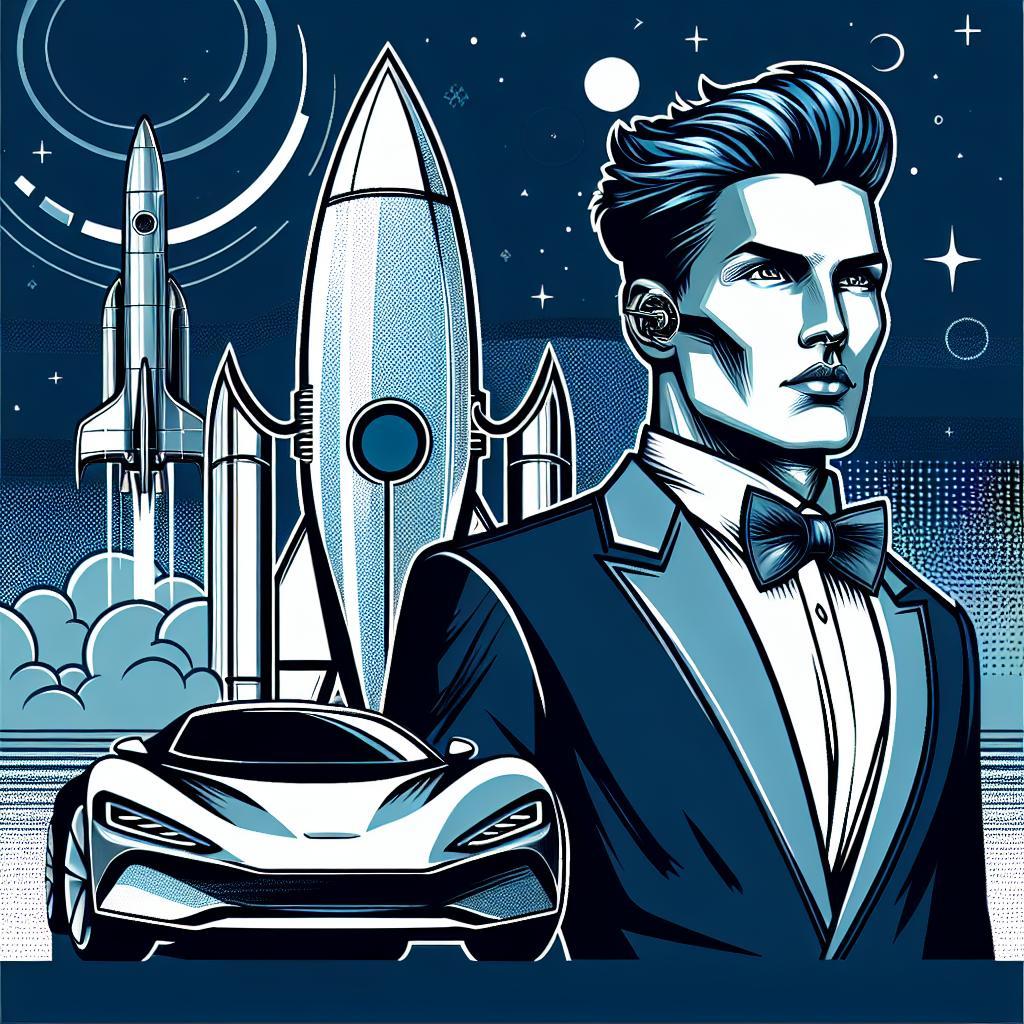
Elon Musk's Technological Revolution

TABLE OF CONTENTS
- Summary
- Early Life and Education
- Business Ventures
- Technological Contributions
- Controversies and Criticism
- Conclusion
1. Summary
Elon Musk has revolutionized multiple industries through his work with SpaceX, Tesla, and Neuralink. His journey, from a challenging upbringing in South Africa to becoming a leading figure in technology, is marked by innovation and perseverance. Musk's influence extends from space exploration through SpaceX, where he aims to make interplanetary life possible, to transforming the automotive industry with Tesla's electric vehicles. His efforts with Neuralink push the boundaries of brain-computer interfaces. Musk's endeavors focus on achieving sustainable energy and promoting technical advancements across sectors. However, his career is also fraught with controversies, including legal challenges and significant public and political involvement, reflecting the complex nature of his impact on modern technology and society.
2. Early Life and Education
2-1. Childhood and Family Background
Elon Reeve Musk was born on June 28, 1971, in Pretoria, South Africa. He comes from a wealthy family; his mother, Maye Musk, is a model and dietitian from Canada, while his father, Errol Musk, is an electromechanical engineer and entrepreneur. Elon has a younger brother, Kimbal, and a younger sister, Tosca. During his childhood, Elon was known to have a challenging relationship with his father, particularly after their parents' divorce in 1980. Elon chose to live with his father, a decision he later regretted. His upbringing was marked by disparities, as the family had wealth, yet faced complexities due to their father's views and political involvement. After experiencing bullying at school, he was hospitalized after a severe beating, which deepened his struggles during that period.
2-2. Educational Journey
Elon Musk attended several schools including Waterkloof House Preparatory School, Bryanston High School, and graduated from Pretoria Boys High School. He was an avid reader and showed a keen interest in computing from an early age, teaching himself programming at the age of ten and selling a video game at twelve. To avoid mandatory military service in South Africa, he applied for a Canadian passport through his mother. Musk initially studied at the University of Pretoria for five months before emigrating to Canada in 1989. He attended Queen's University in Kingston, Ontario, before transferring to the University of Pennsylvania, where he acquired a Bachelor of Arts in Physics and a Bachelor of Science in Economics from the Wharton School. Despite some claims about the timing of his graduation, the degrees were officially awarded in 1997.
3. Business Ventures
3-1. Founding of Zip2
In 1995, Elon Musk, along with his brother Kimbal and Greg Kouri, founded Global Link Information Network, which was later renamed Zip2. The company developed an Internet city guide that included maps, directions, and yellow pages, and it marketed its services to newspapers. Zip2 obtained contracts with major newspapers such as The New York Times and the Chicago Tribune. In February 1999, Zip2 was acquired by Compaq for $307 million, and Musk received $22 million for his 7% share of the company.
3-2. PayPal and eBay
In March 1999, after the Zip2 sale, Musk co-founded X.com, an online financial services and email payment company, using $12 million from his proceeds. X.com was one of the first federally insured online banks, quickly gaining over 200,000 customers. In 2000, X.com merged with Confinity, which was better known for its money-transfer service PayPal. Musk became CEO of the merged company but was ousted later that year due to internal conflicts. In 2002, eBay acquired PayPal for $1.5 billion in stock, with Musk being the largest shareholder, receiving $176 million.
3-3. SpaceX: The Vision for Space Exploration
Elon Musk founded SpaceX in May 2002 with an investment of $100 million of his own money. His vision was to make space travel affordable and accessible. SpaceX's first launch attempt of the Falcon 1 rocket occurred in 2006, which failed. After two more unsuccessful attempts, SpaceX succeeded in launching the Falcon 1 into orbit in 2008. Later that year, SpaceX secured a $1.6 billion contract from NASA for resupply missions to the International Space Station.
3-4. Tesla and the Electric Vehicle Revolution
Musk became involved with Tesla in 2004, investing $6.35 million and becoming the majority shareholder. After escalating conflicts, he took over as CEO in 2008. Tesla's first product, the Roadster, was released in 2008, followed by several successful models including the Model S, Model X, Model 3, and Model Y. Tesla became the most valuable carmaker in the world and reached a market capitalization of $1 trillion in October 2021.
3-5. Neuralink and Brain-Computer Interfaces
In 2016, Musk co-founded Neuralink, a neurotechnology company focused on developing brain-computer interfaces. Neuralink aims to facilitate communication between human brains and computers to treat neurological conditions and enhance human capabilities.
3-6. The Boring Company and Infrastructure Innovation
Musk founded The Boring Company in 2016 to innovate in urban infrastructure and tunnel construction. The company aims to reduce traffic congestion by creating underground transportation systems.
3-7. Hyperloop Concept
In 2013, Musk proposed the Hyperloop, a high-speed transportation system using pressurized pods in low-pressure tubes. This concept has influenced various transportation projects aimed at reducing travel time between major cities.
4. Technological Contributions
4-1. Advancements in Space Technology
Elon Musk founded SpaceX with the ambitious goal of creating a true space-faring civilization. His interest in space exploration dates back to 2001 when he conceptualized the 'Mars Oasis' idea, which aimed to land a miniature experimental greenhouse on Mars. Initially, Musk sought to purchase refurbished intercontinental ballistic missiles (ICBMs) but realized he could build rockets for less, thus leading to the establishment of SpaceX. This venture has sparked significant advancements in rocket technology and has positioned Musk as a leader in the space industry.
4-2. Innovations in Automotive Technology
As the founder and CEO of Tesla, Musk has been instrumental in the development of electric vehicles (EVs). Tesla has revolutionized the automotive industry with its high-performance electric cars, aiming to accelerate the world's transition to sustainable energy. Under Musk's leadership, Tesla has introduced several innovative features in its vehicles, including advanced autopilot capabilities and an extensive supercharger network that enhances EV user experience.
4-3. Development of Renewable Energy Solutions
Musk has also contributed significantly to renewable energy solutions through his role as the largest shareholder of a leading solar systems provider in the United States. His vision includes not only electric vehicles but also sustainable energy solutions that work in harmony with technology advancements, thus promoting a future reliant on renewable resources.
5. Controversies and Criticism
5-1. Public Perception and Media Coverage
Elon Musk's actions and expressed views have made him a polarizing figure. He has faced criticism for making unscientific and misleading statements, including COVID-19 misinformation, affirming antisemitic and transphobic comments, and promoting right-wing conspiracy theories. His ownership of Twitter has been controversial due to significant layoffs of employees, an increase in hate speech, and misinformation posts on the platform.
5-2. Legal Challenges and SEC Issues
In 2018, the U.S. Securities and Exchange Commission (SEC) sued Musk for allegedly falsely announcing that he had secured funding for a private takeover of Tesla. To settle this case, Musk stepped down as the chairman of Tesla and paid a fine of $20 million. Further, he faced investigations regarding possible insider trading related to the sale of Tesla stock.
5-3. Political Involvement and Public Statements
By early 2024, Musk became active in American politics as a vocal and financial supporter of Donald Trump, becoming Trump's second-largest individual donor in October 2024. Additionally, in November 2024, Trump announced Musk's appointment, alongside Vivek Ramaswamy, to co-lead the Department of Government Efficiency (DOGE) advisory board, which aims to reduce excess regulations and wasteful expenditures.
Conclusion
Elon Musk's contributions to industries such as space exploration, automotive technology, and renewable energy underscore his role as a transformative figure in modern technology. The success of SpaceX has reshaped the aerospace industry, making space exploration more economically viable, while Tesla continues to lead the charge toward sustainable transportation. While his influence is undeniable, Musk’s polarizing public persona and controversies, such as his SEC legal issues and controversial Twitter ownership, highlight the broader impacts of such influential figures in society. Despite these challenges, Musk’s ventures continue to push the envelope in technological innovation, offering insights into the potential paths for future development. Looking forward, while Musk’s initiatives are set to further technological advancements, addressing the ethical and social implications remains crucial for harnessing these innovations responsibly and sustainably. His work exemplifies the blend of ambition and innovation essential for progress in our rapidly evolving technological landscape. Suggestions for future exploration could involve more focused ethical frameworks within which technological advancements can proliferate, ensuring accountability and the maximization of benefits across all societal levels.