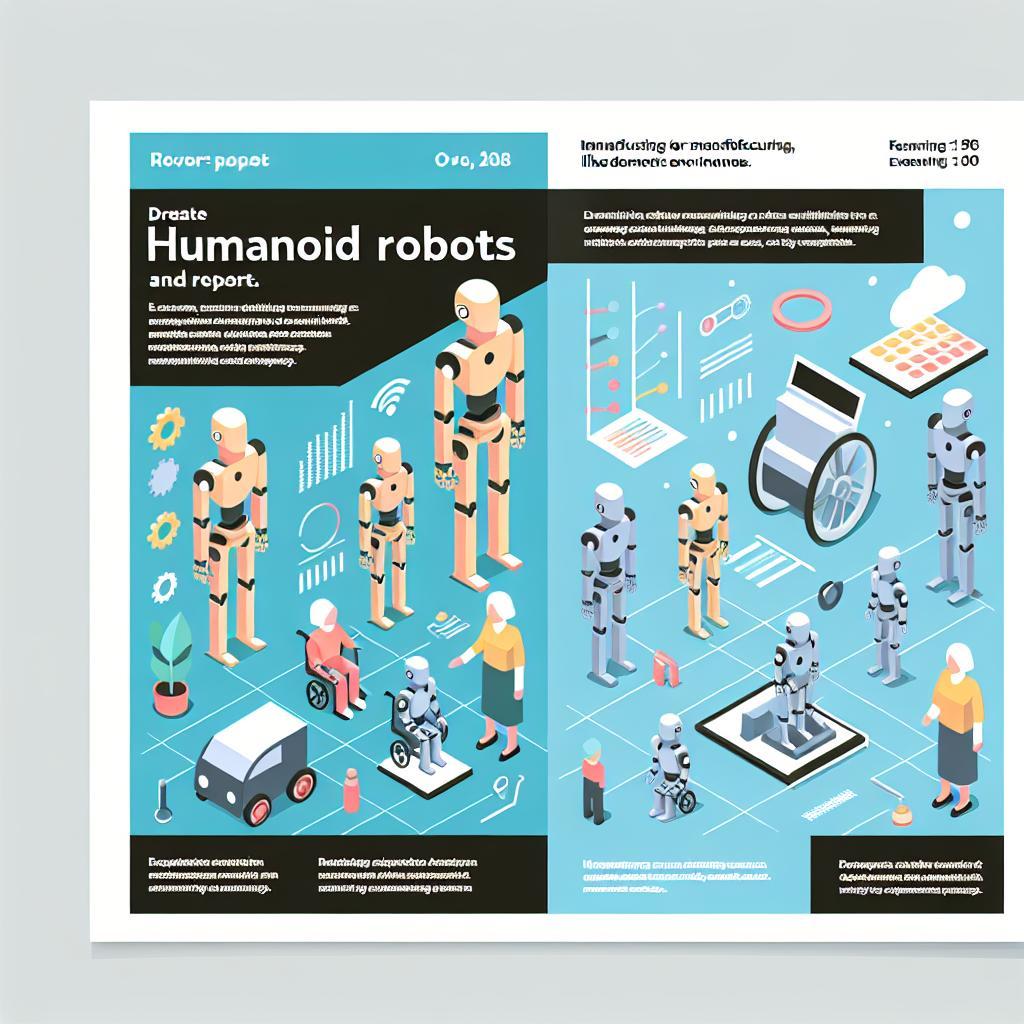
Humanoid Robots: Future Industry Impact

TABLE OF CONTENTS
- Summary
- Historical Context and Definition of Humanoid Robots
- Current Market and Technological Advancements
- Market Projections and Economic Impact
- Applications in Manufacturing
- Challenges and Barriers
- Future Prospects
- Conclusion
1. Summary
This report delves into the evolutionary trajectory, current advancements, and future projections for humanoid robots. It investigates their application in manufacturing, elderly care, and domestic environments, highlighting the technological breakthroughs and economic potentials. Companies like Tesla, Boston Dynamics, and Toyota are leading innovations in this domain. Significant advancements, such as the reduction in LiDAR sensor costs and the integration of AI for robust vision systems, are discussed. The financial projections suggest a substantial market growth, potentially reaching $6 billion by 2035 and possibly escalating to $3 trillion by 2050, driven by market demand and overcoming technical hurdles. The report also addresses various challenges, including battery life, processing power, cost reduction, public acceptance, ethical concerns, and regulatory issues.
2. Historical Context and Definition of Humanoid Robots
2-1. Origin and Evolution of the Term 'Robot'
The term 'robot' originates from the Czech word for 'forced labor' and was first coined in 1921 in Karel Capek’s play R.U.R. (Rossum's Universal Robots). This play showcased early robots that were designed to resemble humans, setting a foundation that resonates in modern culture. The definition of a robot is complex, generally described as a physically embodied machine endowed with intelligence to operate tasks autonomously, sensing and manipulating its environment.
2-2. Significant Historical Robots (e.g., Shakey, ASIMO)
Historically significant robots include Shakey and ASIMO. Shakey, developed in the 1960s by SRI International, was the first mobile robot capable of perceiving and reasoning about its surroundings, marking a revolutionary moment in robotics. ASIMO, introduced by Honda in October 2000, became an international sensation for its humanoid appearance and capabilities, demonstrating advanced movements and interacting with people. ASIMO performed noteworthy tasks such as greeting dignitaries and engaging with audiences, underscoring the advancements in humanoid robotics of that era.
3. Current Market and Technological Advancements
3-1. Advances in Hardware and Software
Recent advancements in humanoid robots are largely attributed to improvements in hardware and software. Innovations such as LiDAR sensors have significantly reduced in size and cost, making previously high-cost technologies more accessible for robotic applications. Additionally, breakthroughs in artificial intelligence have enabled robots to incorporate advanced vision systems for precise image recognition and interaction capabilities.
3-2. Key Players in the Market (Tesla, Boston Dynamics, Toyota, etc.)
Key players shaping the humanoid robot market include major companies such as Tesla, Boston Dynamics, and Toyota. These companies are at the forefront of developing humanoid solutions designed for both industrial and domestic applications. Startups like Figure and Agility Robotics are also emerging with innovative products targeting specific market needs, either currently operational or expected to be deployed soon.
3-3. Recent Innovations and Capabilities
Innovations in the humanoid robot sector focus on enhancing capabilities to meet current market demands. Recent developments include robots such as Digit by Agility Robotics, which are designed for various applications. Estimates suggest a potential market value of at least $6 billion over the next 10 to 15 years, which could address up to 4% of the projected US manufacturing labor shortage by 2030 and 2% of the global elderly care demand by 2035. Furthermore, should design and functionality hurdles be overcome, projections indicate an increase to approximately $154 billion by 2035 in a favorable scenario.
4. Market Projections and Economic Impact
4-1. Market Value Projections for 2030, 2035, and 2050
The humanoid robot market is projected to reach a minimum value of $6 billion within the next 10-15 years, according to Goldman Sachs Research. This market could potentially address 4% of the US manufacturing labor shortage by 2030 and 2% of the global elderly care demand by 2035. In a more optimistic scenario, should challenges related to product design, usability, technology, affordability, and public acceptance be fully addressed, the market could expand dramatically, potentially reaching as high as $154 billion by 2035. Macquarie Research suggests that the humanoid robot market could escalate to a staggering $3 trillion by 2050, driven by increased sophistication and home-based market demand.
4-2. Labor Shortage Alleviation in Manufacturing and Elderly Care
The looming labor crisis, particularly due to aging populations, is a significant driver for the demand for humanoid robots. In the manufacturing sector, it’s projected that the US could face a shortage of 2 million jobs by 2030. Simultaneously, as the baby boomer generation retires, the need for humanoid robots in elderly care becomes pronounced, with predictions that they could help meet 2% of global care needs by 2035. Automakers like BMW and Mercedes-Benz are already interested in humanoid robots to address labor shortages in assembly lines, while companies in the security sector are considering these robots for traditional human roles.
4-3. Potential Market Expansion Scenarios
Various scenarios outline potential expansions of the humanoid robot market. Goldman Sachs presents an ambitious vision where, if overcome the hurdles in technology and public acceptance, the market could exceed $154 billion by 2035. Other analyses predict a market size of up to $3 trillion by 2050. Furthermore, the increasing affordability of technology is anticipated to drive market growth, as the costs of humanoid robots have decreased significantly, by up to 40% in the past year alone. Firms like ADT are moving forward with investments in humanoid robots, indicating a shift towards more widespread adoption in various sectors.
5. Applications in Manufacturing
5-1. Current Use in Automotive Manufacturing
Humanoid robots are increasingly being utilized in automotive manufacturing, particularly in assembly plants and warehouses. The machines are designed in human form, equipped with two arms and two legs, showcasing advanced actuators and sensing technologies powered by artificial intelligence. Significant automotive manufacturers and suppliers, including industry leaders like BMW and Mercedes-Benz, are testing these robots in their facilities, reflecting a strong interest in leveraging humanoid technology to address labor shortages.
5-2. Collaborative Robots in Factories
The trend towards adopting humanoid robots in factories is part of a broader shift towards collaborative robotics. Humanoid robots are designed to work alongside human workers, enhancing efficiency and productivity in manufacturing settings. As companies face pressing labor shortages, the incorporation of humanoids presents a viable solution to maintain production levels and operational efficiency.
5-3. Productivity Enhancements and Cost Reductions
The investment in humanoid robots is also driven by the promise of productivity enhancements and cost reductions. A report by Goldman Sachs highlights that the cost of humanoid robots has decreased by 40 percent over the past year, indicating a trend that can further drive market growth. These reductions in cost, combined with the capability of humanoids to operate in various manufacturing scenarios, forecast a robust market estimated to reach $38 billion by 2035. The expectations include a significant increase in the adoption of next-generation humanoid robots in intralogistics, with Gartner Inc. projecting that 10 percent of new smart robots sold will be humanoids by 2027.
6. Challenges and Barriers
6-1. Technical Challenges (Battery Life, Mobility, Processing Power)
Current humanoid robots face several technical challenges that impede their effectiveness and market adoption. According to research by Goldman Sachs, humanoid robots can typically operate only for short one- or two-hour bursts before needing to be recharged. Improvements are needed, particularly in battery life, to enable machines to work for up to 20 hours on a single charge or to have fast charging capabilities that allow for four to five hours of operation after one hour of charging. Furthermore, while advancements have been made in the areas of mobility and agility, processing power must also see consistent improvements. Current humanoid robots cannot yet master both mobility and cognitive tasks simultaneously, which hinders their practicality. Such deficiencies highlight the need for significant technological advancements.
6-2. Cost Reduction Needs
Cost remains a critical barrier to the widespread adoption of humanoid robots. Industry stakeholders have identified the necessity for manufacturers to reduce production costs by approximately 15-20% annually. This reduction is essential for humanoid robots to become economically viable within a two-year timeframe. Macquarie Research estimates the total hardware costs for early-stage humanoid robots at around $40,000, which includes allocations for sensors, chips, and other critical components. The need to bring prices down in order to align with wage structures, such as that of factory labor, will be pivotal in determining the market’s growth potential.
6-3. Public Acceptance and Ethical Concerns
Public acceptance of humanoid robots is fraught with ethical concerns and fears regarding job displacement. Surveys indicate that there are significant apprehensions surrounding the role of humanoid robots in replacing human workers, especially in areas traditionally staffed by humans. Issues related to privacy, trust, and the ethical implications of robots performing tasks that require emotional intelligence also pose challenges. These concerns need to be addressed comprehensively to gain societal acceptance and ensure that the integration of humanoid robots into daily life is perceived positively.
6-4. Regulatory and Cybersecurity Issues
Regulatory hurdles and cybersecurity issues present significant barriers to the successful adoption of humanoid robots. The complexity of humanoid robots necessitates a careful assessment of safety protocols and regulatory guidelines to prevent mishaps and to define responsibilities should incidents occur. Additionally, as humanoid robots begin to operate in more personal spaces within homes and workplaces, they present new cybersecurity risks that must be proactively managed to protect user data and privacy. Ensuring robust frameworks to handle these concerns will be critical for fostering trust and facilitating market penetration.
7. Future Prospects
7-1. Potential Home Use and Daily Life Integration
According to the insights drawn from Macquarie Group's report on humanoid robots, the integration of these robots into daily home life is anticipated to evolve as technology advances. Currently, humanoid robots, which are designed to interact closely with human environments, face challenges in gaining acceptance beyond the conceptual stage. Despite existing applications such as mini-bots for simple tasks like vacuuming, the sophisticated usage of humanoid robots in homes remains limited. However, advances in robotics and artificial intelligence (AI) suggest a shift towards an era where humanoid robots could significantly benefit households by performing tasks that reduce time spent on housework. Analysts predict that as the technology matures and affordability improves, humanoid robots may become commonplace by 2050, potentially transforming household dynamics similar to how cars have reshaped mobility. Wendy Pan, a machinery analyst at Macquarie Research, posits that humanoid robots could alleviate the workload related to daily chores, enhancing convenience and quality of life.
7-2. Visionaries' Views and Predictions
Influential figures in technology, including Elon Musk, foresee a fundamental transformation in civilization due to the emergence of home-based humanoid robots. Musk's remarks during the unveiling of Tesla's humanoid prototype, Optimus, highlight the potential for these robots to reshape societal norms once they are market-ready. Research from Goldman Sachs indicates a projected market for humanoid robots may reach $6 billion in 10 to 15 years, primarily driven by demand in the industrial sector and eventually extending to elderly care. Analysts predict that innovative developments in related sectors such as electric vehicles (EVs) and autonomous vehicles (AVs) will pave the way for humanoids, enabling manufacturers to efficiently realize their full potential in both industrial and domestic applications. The anticipated evolution from industrial tasks towards household integration will require overcoming various technical complexities, particularly in adapting robots for diverse environments, but ongoing advancements suggest that their acceptance and functionality will increase over time.
8. Conclusion
The transformative potential of humanoid robots spans across crucial sectors, including manufacturing, elderly care, and domestic environments. Main findings indicate robust market growth driven by key players like Tesla and Boston Dynamics, and significant technological advancements. These robots not only promise to alleviate labor shortages but also aim to augment human labor, enhancing quality of life. However, several technical challenges and social acceptance issues must be addressed. Reducing costs and overcoming regulatory hurdles remain pivotal for broader adoption. Future prospects are promising with continuous innovations expected to elevate the role of humanoid robots in society. Practical applicability will significantly depend on addressing public, ethical, and cybersecurity concerns, ensuring these machines benefit human activities on a large scale.