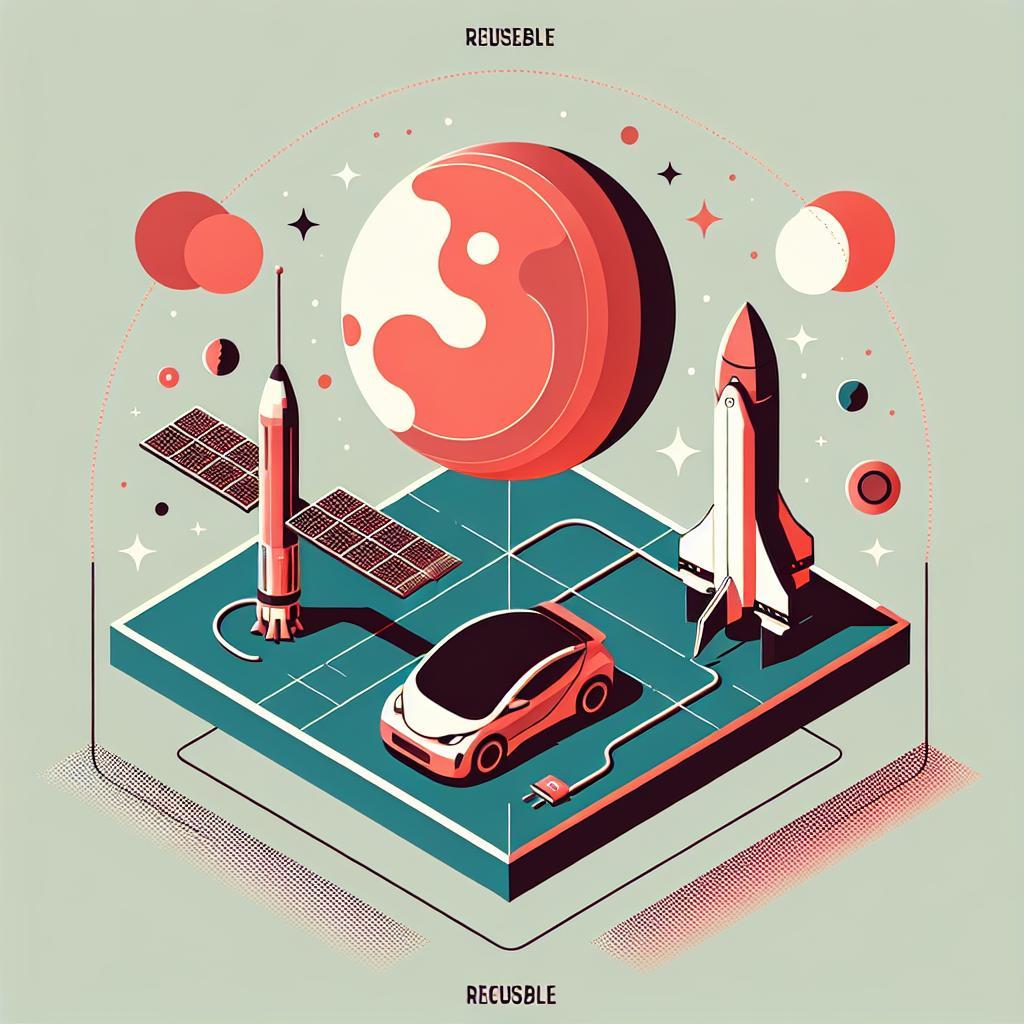
Elon Musk: Transforming Space and Energy

TABLE OF CONTENTS
- Summary
- Elon Musk's Mars Colonization Project
- SpaceX's Revolutionary Role in Space Exploration
- Tesla and Sustainable Innovation
- Conclusion
1. Summary
This report delves into the monumental impact of Elon Musk on space exploration and technological innovation through his pivotal roles at SpaceX and Tesla. The primary focus is Musk's vision for Mars colonization via the advanced SpaceX Starship project and the shift towards sustainable energy with Tesla's innovations in electric vehicles. Key achievements include the development of reusable rockets by SpaceX, making space travel more feasible, and Tesla's breakthroughs in battery technology and self-driving systems, fueling the transition from fossil fuels. Musk's ambitions not only seek to establish a human presence on Mars but also mean to revolutionize terrestrial transportation to create a sustainable future. His leadership style, characterized by bold vision and persistent innovation, is critical to realizing these broader goals.
2. Elon Musk's Mars Colonization Project
2-1. Vision of interplanetary colonization
Elon Musk's vision for interplanetary colonization focuses on establishing a human presence on Mars. He has articulated a bold ambition to make humanity a multi-planetary species, allowing people to wake up on another planet and look back at Earth from afar. This vision is part of a broader strategy to revolutionize space exploration, ensuring that humanity can thrive beyond Earth and safeguard against existential threats to civilization.
2-2. Development of SpaceX's Starship
The development of SpaceX's Starship is central to Elon Musk's plans for Mars colonization. Starship is designed as a next-generation spacecraft capable of transporting both cargo and humans to Mars. Musk has established ambitious goals to accelerate the development of Starship and its associated technologies, enhancing the feasibility of launching missions to Mars. His efforts are aimed at reducing the cost of space travel and making Mars exploration attainable.
2-3. Goal of a self-sustaining Martian society
Musk's ultimate goal for the Mars Colonization Project is to establish a self-sustaining society on Mars, targeting a population of 1 million people by 2050. This vision includes the construction of habitats, production of resources, and creation of an ecosystem that allows human life to flourish independently from Earth. This initiative is not just seen as an adventure, but a vital step in ensuring the long-term survival of humanity in the universe.
3. SpaceX's Revolutionary Role in Space Exploration
3-1. Establishment and milestones of SpaceX
Elon Musk founded SpaceX in 2002, marking the beginning of his ambitious vision for humanity’s space exploration. The establishment of this aerospace enterprise set the stage for groundbreaking advancements in the field. Musk's initiative aimed not only at making space travel achievable but also at rethinking the future of colonization beyond Earth. Over the years, notable milestones have been achieved, including the successful launch of the Falcon 9 spacecraft.
3-2. Impact of reusable rocket technology
One of SpaceX's key technological advancements has been the implementation of reusable rockets. This innovation has drastically reduced the costs associated with rocket launches, enabling more frequent missions and broader space exploration than previously possible. The ability to reuse rocket components has proven to be a game changer in the aerospace industry, facilitating the dream of making space travel more sustainable.
3-3. Achievements in space travel, including ISS docking
SpaceX's Falcon 9 spacecraft achieved a historic milestone by successfully docking with the International Space Station (ISS), becoming the first spacecraft developed and operated by a private entity to accomplish this feat. This monumental event demonstrated the capabilities of SpaceX and highlighted its role in advancing commercial space travel. The successful ISS docking exemplifies the progress and impact SpaceX has made in the realm of space exploration.
4. Tesla and Sustainable Innovation
4-1. Tesla's role in the shift to electric vehicles
Elon Musk's leadership and vision have been pivotal in shaping Tesla into an industry leader in electric vehicles. His belief in electric vehicles stems from a commitment to sustainable energy, marking a significant shift in the automotive industry from fossil fuels to electric power. This transformation reflects Musk's ambition to not just create a successful automotive company, but to enact fundamental change in energy consumption patterns across society.
4-2. Innovation in battery technology and self-driving systems
Musk's approach to innovation at Tesla emphasizes constant iteration and improvement. The company focuses on cutting-edge battery technology to enhance energy efficiency and performance. Additionally, Tesla is at the forefront of developing self-driving systems, aiming to revolutionize how vehicles operate and improve safety on the roads. This relentless pursuit of technological advancement positions Tesla as a leader in innovation within the automotive sector.
4-3. Musk's leadership style and long-term vision
Elon Musk's leadership style is characterized by a unique blend of ambition, innovation, and a commitment to a broader mission. Unlike traditional management theories, his vision for Tesla transcends short-term profits; it reflects a long-term perspective focused on accelerating the world's transition to sustainable energy. This visionary leadership is crucial for Tesla's role in reducing humanity's carbon footprint and promoting a sustainable future.
5. Conclusion
Elon Musk’s endeavors with SpaceX and Tesla underscore a relentless push towards a future where interplanetary habitation and sustainable earthbound practices become achievable. Through SpaceX, Musk has redefined space travel, making it potentially more accessible and affordable through innovative reusable technology and ambitious projects like Starship aimed at Mars colonization. Tesla, meanwhile, spearheads the shift to electric vehicles, significantly impacting global carbon reduction efforts. Notwithstanding technological and logistical challenges in both lunar and terrestrial domains, Musk's leadership and vision provide a guiding force. However, the feasibility of these endeavors still confront issues such as the economic viability of sustainable colonization and the ethical implications of widespread automation in transport. Future developments may hinge on further technological breakthroughs and international collaboration to balance ambition with sustainability, ensuring practical applications extend across societies relativizing our collective carbon footprint and viability of space as a new frontier for humanity.