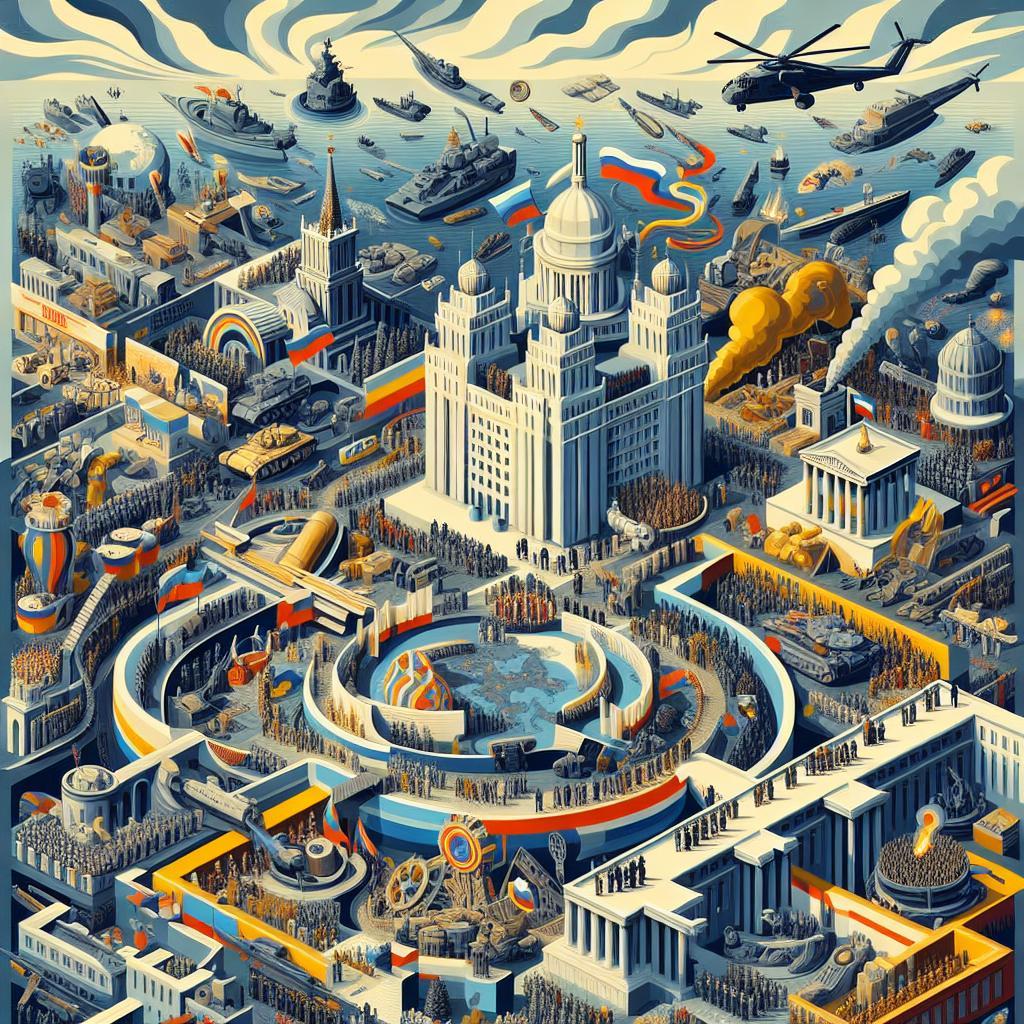
Russia Under Vladimir Putin: Influence in Historical, Political, and Geopolitical Contexts

TABLE OF CONTENTS
- Summary
- Historical Background of Russia
- Vladimir Putin's Political Career and Leadership
- Putin's Foreign Policy and Russia's International Relations
- Key Conflicts and Geopolitical Tensions
- Impact of Putin's Policies on Neighboring Regions
1. Summary
The report titled 'Russia Under Vladimir Putin: Influence in Historical, Political, and Geopolitical Contexts' thoroughly examines the complexities of Russia's leadership under Vladimir Putin. It covers the historical evolution of Russia, Putin's political career, and key geopolitical conflicts involving Russia, including the Russia-Ukraine War and NATO Expansion. Notable events such as the annexation of Crimea and the recent full-scale invasion of Ukraine by Russia highlight the significant impact of Putin's policies on global stability. The analysis further explores Russia's strained relations with the U.S. and its closer ties with China and India. Additionally, the report addresses the widespread implementation of 'Foreign Agent Laws' in neighboring Eurasian countries, reflecting Russia's influence on restricting civil society and democratic norms.
2. Historical Background of Russia
2-1. Geographic and historical overview of Russia
Russia, officially the Russian Federation, spans Eastern Europe and North Asia, making it the largest country by area in the world. It covers eleven time zones and shares borders with fourteen countries. As the world’s ninth-most populous country, it is also the most populous in Europe, with a capital and largest city in Moscow. The second-largest city is Saint Petersburg, known as the cultural capital of Russia.
2-2. Russia's evolution from Kievan Rus to the modern Russian Federation
The historical evolution of Russia began with the emergence of the East Slavs as a recognized group between the 3rd and 8th centuries CE. The first East Slavic state, Kievan Rus', was established in the 9th century and adopted Orthodox Christianity from the Byzantine Empire in 988. Kievan Rus' eventually disintegrated, leading to the rise of the Grand Duchy of Moscow, which expanded significantly and established the Tsardom of Russia by the early 18th century. Following the Russian Revolution in 1917 and the subsequent Civil War, the Russian SFSR became the largest constituent of the Soviet Union, which played a significant role during World War II and the Cold War. After the dissolution of the Soviet Union in 1991, the modern Russian Federation was established under a new constitution.
2-3. Significance of the Soviet Union and its dissolution
The Soviet Union was crucial in shaping Russia's contemporary political and social landscape. It arose from the Russian SFSR and underwent rapid industrialization in the 1930s, leading to significant technological advancements and military strength, particularly noted during World War II. The Cold War era was marked by competition with the United States for global ideological influence. The dissolution of the Soviet Union in 1991 marked the transition from a socialist state to the independent Russian Federation, highlighting the end of its role as a superpower and the beginning of a new era in Russian history.
3. Vladimir Putin's Political Career and Leadership
3-1. Biography and early career of Vladimir Putin
Vladimir Vladimirovich Putin was born on October 7, 1952, in Leningrad, now known as Saint Petersburg, Russia. He is a former KGB officer and has served as both the president and prime minister of Russia. Putin studied law at Leningrad State University, later working as a prorector responsible for external relations. He served 15 years with the KGB, where he rose to the rank of lieutenant colonel before leaving to pursue a political career in Saint Petersburg.
3-2. Putin's terms as President and Prime Minister
Putin first became acting president on December 31, 1999, and was officially elected president in March 2000, serving until 2008. He returned to the presidency in 2012 after serving as prime minister from 2008 to 2012. During his initial presidency, he regained control over Russia's regions and sought to diminish the power of the oligarchs. His leadership has been characterized by significant military actions, including the wars in Chechnya, Georgia, and Ukraine, as well as the annexation of Crimea in 2014.
3-3. Centralization of power and state control over industries
Under Putin's leadership, there has been a marked centralization of political power. The Kremlin has tightened its control over mass media and the internet, and state ownership of key industries has increased. Estimates indicate that the state came to control as much as 70 percent of the Russian economy. Oligarchs have been warned that their positions depend on their loyalty to Putin. This centralization has fostered an authoritarian style of governance with widespread criticisms regarding human rights and corruption.
4. Putin's Foreign Policy and Russia's International Relations
4-1. Changes in Russia-U.S. relations
Under Vladimir Putin's leadership, the relationship between Russia and the United States has seen significant deterioration since late 2013. By this time, the U.S. had canceled a summit, marking the first occurrence since 1960, primarily due to Russia granting asylum to Edward Snowden. The U.S. also considered Russia's actions as obstructionist related to global affairs, particularly regarding Syria, Iran, Cuba, and Venezuela. In response, these nations looked to Russia for support against U.S. policies. The expansion of NATO into Eastern Europe conflicts with Russia's interests, prompting Moscow to adopt a more aggressive stance to influence Eastern Europe, the Caucasus, and Central Asia. After the Russian military intervention in Ukraine in 2014, the relationship between Russia and the West characterized by adversarial dynamics culminated in what some are calling Cold War II.
4-2. Impact of NATO and EU expansions
The expansion of NATO has been a core issue affecting Russia's foreign policy under Putin. NATO's eastward expansion is viewed unfavorably by Russia, as it perceives this as an encroachment on its sphere of influence. In his observations, Putin claims Western assurances that NATO would not expand 'one inch eastward' post-1990 were broken, increasing nationalist sentiments in Russia. Putin's dissent towards NATO expansion became evident as he vehemently opposed NATO's involvement in Eastern Europe. This perceived betrayal contributed to Putin's aggressive policies, which included military interventions in Georgia and Ukraine.
4-3. Russia's relations with China and India
Russia's relationship with China and India has notably evolved under Putin. With China, there has been a significant alignment, especially given the geopolitical shifts leaning towards partnership rather than rivalry. Putin and Chinese President Xi Jinping have fostered stronger ties in areas like military cooperation and economic collaboration. Conversely, Russia's historical relationship with India remains robust, characterized by strong trade connections and strategic partnerships. During Putin's tenure, bilateral trade and collaborations with India have been emphasized, portraying a mutual respect rooted in shared interests on platforms like the UN and BRICS. However, the dynamic with India has shifted as India has established stronger ties with the U.S., illustrating the complexities of Russia's foreign relations.
5. Key Conflicts and Geopolitical Tensions
5-1. Russia-Ukraine conflict and annexation of Crimea
The roots of the Russia-Ukraine conflict can be traced back to the dissolution of the Soviet Union in 1991, leading to Ukraine's independence alongside 14 other states. President Vladimir Putin has long lamented the USSR's collapse, viewing it as a historical tragedy. Ukraine's struggle has been to establish its sovereignty and diminish Kremlin influence, notably marked by the Orange Revolution in 2004 and the Revolution of Dignity in 2014, both aimed at rejecting Russian control. After the ousting of pro-Russian president Viktor Yanukovych in 2014 amid protests, Putin retaliated by annexing Crimea, claiming a Western-backed coup instigated the change in power. Following the annexation, Russia initiated a proxy war in the Donbas region, resulting in 14,000 deaths from 2014 to 2022. After stalled peace negotiations, Russia launched a full-scale invasion of Ukraine on February 24, 2022, leading to widespread military confrontations and significant international attention.
5-2. Military actions in Ukraine and their global implications
Since the start of the full-scale invasion in February 2022, Russian military actions have involved rapid advancements into Ukraine, capturing key cities. However, fierce Ukrainian resistance has resulted in Russia abandoning its initial objective to seize Kyiv. The conflict has not only led to catastrophic casualties, with thousands of civilians and soldiers lost, but also global ramifications including skyrocketing food and energy prices as Ukraine and Russia are key suppliers. Ukraine's ability to export agricultural products has been hindered, exacerbating global food insecurity, while Western sanctions on Russia have led Moscow to cut natural gas exports to Europe, influencing energy markets worldwide.
5-3. NATO’s response and support for Ukraine’s sovereignty
In response to the conflict, NATO has reiterated its commitment to protect its member states while providing military aid to Ukraine. The alliance suspended practical cooperation with Russia after the annexation of Crimea in 2014 but has continued open dialogue. Multiple NATO members, including the U.S. and Canada, have supplied military assistance to Ukraine as part of their collective defense strategies. The ongoing crisis has tested NATO's internal cohesion and its capability to deter further Russian aggression, with the alliance affirming its support for a sovereign Ukraine amidst geopolitical tensions.
6. Impact of Putin's Policies on Neighboring Regions
6-1. Spread of 'foreign agent' laws in Eurasian nations
The introduction of 'foreign agent' laws across various Eurasian countries reflects a concerning trend influenced by Russian policies. Countries such as Georgia and Kyrgyzstan have enacted legislation that mirrors Russia's restrictive measures. In Georgia, the foreign agent law aims to control organizations receiving foreign funding and has led to significant backlash from civil society. Similarly, Kyrgyzstan's law, signed into effect in April 2024, mandates NGOs receiving foreign funds to register, thereby undermining their independence. The situation in Abkhazia, a Russian-occupied province of Georgia, shows further implementation of such laws to consolidate Russian control.
6-2. Effects on civil society and democratic norms
Putin's policies have considerably impacted civil society and the democratic norms in neighboring regions. The 'foreign agent' laws serve as tools to suppress dissent and restrict the activities of civil organizations, thereby stigmatizing them as threats to national interests. In Georgia and Kyrgyzstan, these laws have led to increasing governmental scrutiny over NGOs. Furthermore, in Bosnia and Herzegovina and Serbia, similar proposals have emerged, indicating a coordinated effort to undermine democratic institutions and align with Russian interests, thus jeopardizing the fabric of civil society.
6-3. EU and international community's response
The European Union and the international community's reaction to the spread of 'foreign agent' laws has been one of concern. The EU has continuously engaged in dialogues emphasizing the need to support democratic resilience against authoritarian influences. There are calls for solidarity with affected civil societies, and for broader international responses addressing the implications of these laws on human rights and freedoms in the affected regions. Recognizing the pattern of repressive legislation is crucial for combating the undermining of democratic norms spurred by Russia's tactics in its neighboring countries.