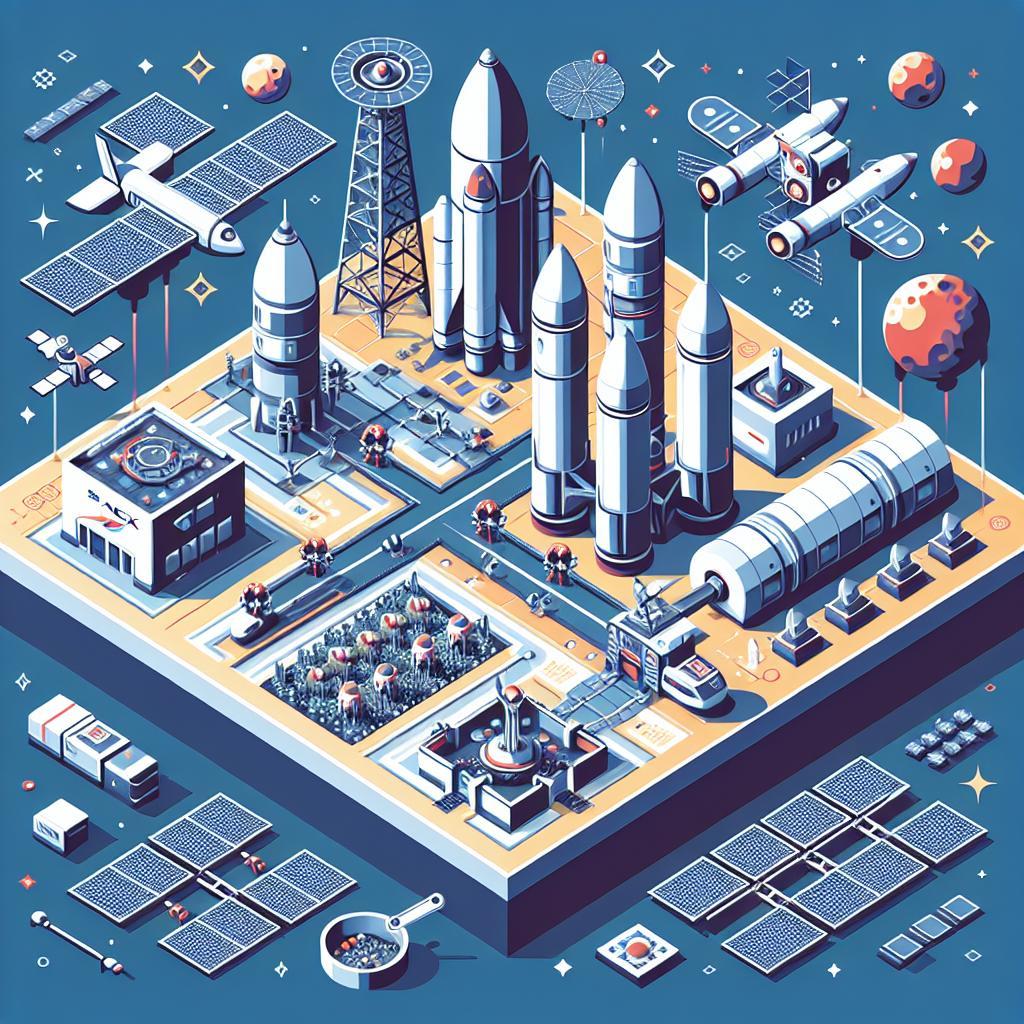
The Impact of SpaceX on Modern Space Exploration and Technology

TABLE OF CONTENTS
- Summary
- Company Overview and Historical Context
- Key Technological Innovations
- Major Achievements and Milestones
- Economic and Industry Impact
- Mars Colonization and Starship Project
- Satellite Internet and Starlink
- Collaborations and Industry Influence
- Conclusion
1. Summary
The report titled "The Impact of SpaceX on Modern Space Exploration and Technology" comprehensively outlines SpaceX's transformative role in the aerospace industry. Founded in 2002 by Elon Musk, the company has achieved significant milestones, including the development of reusable rocket technology, the deployment of the Starlink satellite network, and the ambitious Mars colonization project. By achieving the first successful landing of a Falcon 9 rocket's first stage and initiating numerous cargo resupply missions to the International Space Station, SpaceX has dramatically reduced the costs of space transportation. The report also highlights the profound economic implications of SpaceX's innovations and their extensive collaboration with NASA, underscoring the company's influence on both commercial and scientific space ventures.
2. Company Overview and Historical Context
2-1. History and Founding
SpaceX is a privately funded American aerospace company founded in 2002 by entrepreneur Elon Musk, with headquarters in Hawthorne, California. Musk’s goal was to reduce space transportation costs and enable the colonization of Mars. However, the company's early years (2002-2008) were challenging, with the first three launches failing. SpaceX faced financial difficulties, and Elon Musk invested his own money to keep the company afloat. In 2008, the fourth launch, Falcon 1 Flight 4, successfully reached orbit, marking a turning point for the company. The company’s first rocket, the Falcon 1, was successfully launched in 2008, and since then, SpaceX has developed and launched numerous rockets and spacecraft, including the Falcon 9, Falcon Heavy, Dragon, and Crew Dragon.
2-2. Mission Objectives
Elon Musk founded SpaceX with the ambitious goal of reducing space transportation costs to make space exploration and colonization more achievable. This mission has driven SpaceX’s significant advancements in rocket reusability and cost-effective space travel. For instance, in 2012, SpaceX became the first privately funded company to send a spacecraft, the Dragon capsule, to the International Space Station (ISS). The company has continuously pushed the boundaries by developing reusable rockets, achieving the first successful landing of a Falcon 9 first stage in 2015, and later reusing Falcon 9 first stages numerous times. By accomplishing these feats, SpaceX has significantly reduced the cost of access to space and made space travel more accessible.
3. Key Technological Innovations
3-1. Reusable Rockets
SpaceX has significantly advanced the technology of reusable rockets, aiming to reduce the cost of space transportation. One of their major accomplishments in this area was in 2015 when they achieved their first successful landing of the Falcon 9 first stage. This breakthrough allowed for multiple reuses of the Falcon 9 stages, substantially decreasing the cost and increasing the frequency of space missions. The concept of reusability has been central to SpaceX's strategy, allowing them to lead in the commercial spaceflight industry.
3-2. Falcon 1 and Falcon 9 Development
The development of the Falcon 1 and Falcon 9 rockets marked significant milestones for SpaceX and the broader space exploration sector. Falcon 1, SpaceX’s first orbital rocket, positioned the company as a notable player in the space industry after its successful launch in 2008. The subsequent Falcon 9 became a workhorse rocket, designed to be partially reusable, further setting new standards in spacecraft engineering. Falcon 9’s successful commercial resupply missions to the International Space Station under NASA's Commercial Resupply Services (CRS) program signified a major milestone in commercial spaceflight and propelled SpaceX into a leadership position within the space exploration community.
4. Major Achievements and Milestones
4-1. First Privately-funded Company to Reach Orbit
In 2008, SpaceX achieved a historic milestone by becoming the first privately-funded company to successfully launch a liquid-fueled rocket, the Falcon 1, into orbit. This significant accomplishment marked a new era in commercial spaceflight, demonstrating the feasibility of private enterprise-led space missions.
4-2. Commercial Resupply Missions to ISS
SpaceX developed the Dragon spacecraft, which made history in 2012 as the first privately-developed spacecraft to dock with the International Space Station (ISS). Since this initial achievement, SpaceX has conducted numerous cargo resupply missions to the ISS under a contract with NASA. These missions have been crucial for sustaining the ISS and supporting ongoing scientific research in microgravity.
4-3. Crew Dragon and Commercial Crew Program
SpaceX further extended its capabilities with the development of the Crew Dragon spacecraft. This spacecraft is part of NASA's Commercial Crew Program, which aims to facilitate the transport of astronauts to and from the ISS. By achieving this, SpaceX has not only proven its technical prowess but also significantly reduced the cost of human spaceflight. One of the notable achievements includes the first private mission to the ISS, showcasing the potential for commercial enterprises in human space exploration.
5. Economic and Industry Impact
5-1. Cost Reduction in Space Travel
SpaceX has significantly lowered the cost of access to space through its groundbreaking development of reusable rocket technology. The Falcon 1 was the first privately developed liquid-fueled rocket to reach orbit, paving the way for the Falcon 9 and Falcon Heavy rockets. These have demonstrated remarkable reliability and have introduced the concept of reusability, allowing rockets to be recovered and flown multiple times. This innovation has disrupted traditional aerospace economics by making space travel more cost-effective.
5-2. Economic Implications of Reusability
The technological advancements made by SpaceX, particularly in the reusability of rockets, have had profound economic implications. By reducing the cost of space transportation, SpaceX has reshaped the global space economy. The company’s cost-effective approaches have opened up new opportunities for commercial space ventures. The success of rockets like Falcon 9 and Falcon Heavy has demonstrated that frequent and affordable access to space is achievable, encouraging a surge in space-related commercial activities.
5-3. Commercial Opportunities
SpaceX’s economic strategies and technological innovations have unlocked numerous commercial opportunities within the aerospace industry. The company's advancements in reducing space travel costs have not only made space more accessible but also stimulated growth in commercial space ventures. The commercial space sector has seen increased activity and investment, driven by SpaceX’s achievements and their potential to offer affordable space transportation solutions for various enterprises.
6. Mars Colonization and Starship Project
6-1. Starship Development
SpaceX's Starship project is the cornerstone of Elon Musk's vision for Mars colonization. The spacecraft is designed to be a fully reusable vehicle capable of carrying humans and cargo to various destinations across the solar system. The Starship is capable of transporting up to 100 passengers, facilitating the establishment of a sustainable Mars colony. SpaceX has conducted several test flights, some of which ended in explosions during landing attempts. However, these tests have allowed the company to gather valuable data and refine the Starship's design using a rapid iteration approach.
6-2. Mars Colonization Goals
The ultimate goal of SpaceX is to establish a self-sustaining colony on Mars. This ambition is fueled by the vision of making life multi-planetary and reducing the costs of space transportation. The Mars colonization initiative began in 2002, with Musk founding SpaceX to achieve these objectives. The project envisions Mars as a backup location for humanity and aims to create a habitable environment on the planet.
6-3. Progress and Challenges
SpaceX has made significant progress towards its Mars colonization goals, particularly with the development and testing of the Starship spacecraft. Despite several setbacks, including explosions during test flight landings, the company's incremental approach has yielded valuable insights. Each test provides data that helps improve the design and performance of the spacecraft. The reusable nature of the Starship is a critical component, drastically lowering the cost and making the prospect of Mars colonization more feasible.
7. Satellite Internet and Starlink
7-1. Starlink Constellation
SpaceX has launched the Starlink project, which consists of a constellation of satellites aimed at providing global internet coverage. The Starlink constellation involves deploying thousands of small satellites in low Earth orbit, a feat that SpaceX is actively pursuing. This initiative has already seen the successful deployment of numerous satellites, contributing to SpaceX's pivotal role in advancing satellite internet technology.
7-2. Global Broadband Coverage
The Starlink satellite network aims to provide high-speed internet access across the globe, with a significant focus on reaching remote and underserved areas. By offering global broadband coverage, SpaceX hopes to bridge the digital divide, allowing more individuals, regardless of their location, to access the internet. This global coverage is expected to have far-reaching impacts on education, communication, and economic development in previously disconnected regions.
7-3. Technological and Social Impact
The technological advancements of the Starlink project have been substantial, providing not only faster and more reliable internet access but also inspiring further innovation in satellite technology. Socially, the impact of the Starlink network is profound. By offering high-speed internet to remote areas, SpaceX is contributing to greater educational opportunities, improved healthcare through telemedicine, and enhanced communication capabilities. Furthermore, the success of the Starlink project underscores SpaceX's broader influence on the space industry, showcasing the company's ability to tackle large-scale technological challenges.
8. Collaborations and Industry Influence
8-1. Partnership with NASA
SpaceX has developed a strong partnership with NASA, significantly contributing to various space missions. One of the most notable achievements is the development and successful deployment of the Falcon 9 spacecraft, which became the first private spacecraft to reach and dock at the International Space Station (ISS). This collaboration has been pivotal in advancing cost-effective and frequent space explorations, making space more accessible.
8-2. Participation in Artemis Program
SpaceX actively participates in NASA's Artemis program, which aims to return humans to the Moon by 2024 and establish a sustainable human presence there by the end of the decade. Through this collaboration, SpaceX is tasked with providing critical technology and infrastructure, leveraging its reusable rocket technology and spacecraft development expertise.
8-3. Influence on Global Space Exploration
Elon Musk's vision and the pioneering spirit of SpaceX have influenced the global space exploration industry significantly. SpaceX's reusable rockets, such as the Falcon 9 and Falcon Heavy, have drastically reduced the cost of space travel, opening up new opportunities for commercial spaceflights and scientific missions. The company's initiatives, including the Starship prototype designed for Mars colonization, aim to make deep-space exploration more feasible and frequent. This influence extends to inspiring other private and national space organizations worldwide to push the boundaries of space exploration.
9. Conclusion
SpaceX has fundamentally altered the landscape of space exploration and technology through its pioneering innovations and ambitious objectives. The report underscores the significance of SpaceX’s achievements, such as the successful development of reusable rockets like the Falcon 9, which have considerably lowered the cost of space travel and facilitated more frequent and accessible space missions. These advancements open new commercial and scientific opportunities, positioning SpaceX as a leader in the aerospace sector. Despite challenges like test flight failures, the iterative development of the Starship for Mars colonization exemplifies the company’s resilient approach toward achieving its long-term goals. However, the report acknowledges that the scope of some projects, such as Mars colonization, remains ambitious and fraught with technical and logistical challenges. Continued innovation and strategic collaboration, particularly with entities like NASA, are pivotal for overcoming these hurdles. Looking ahead, SpaceX’s progress promises to influence global space strategy, stimulate further advancements, and expand the practical applications of space technology, thereby reinforcing its vital role in the future of space exploration.