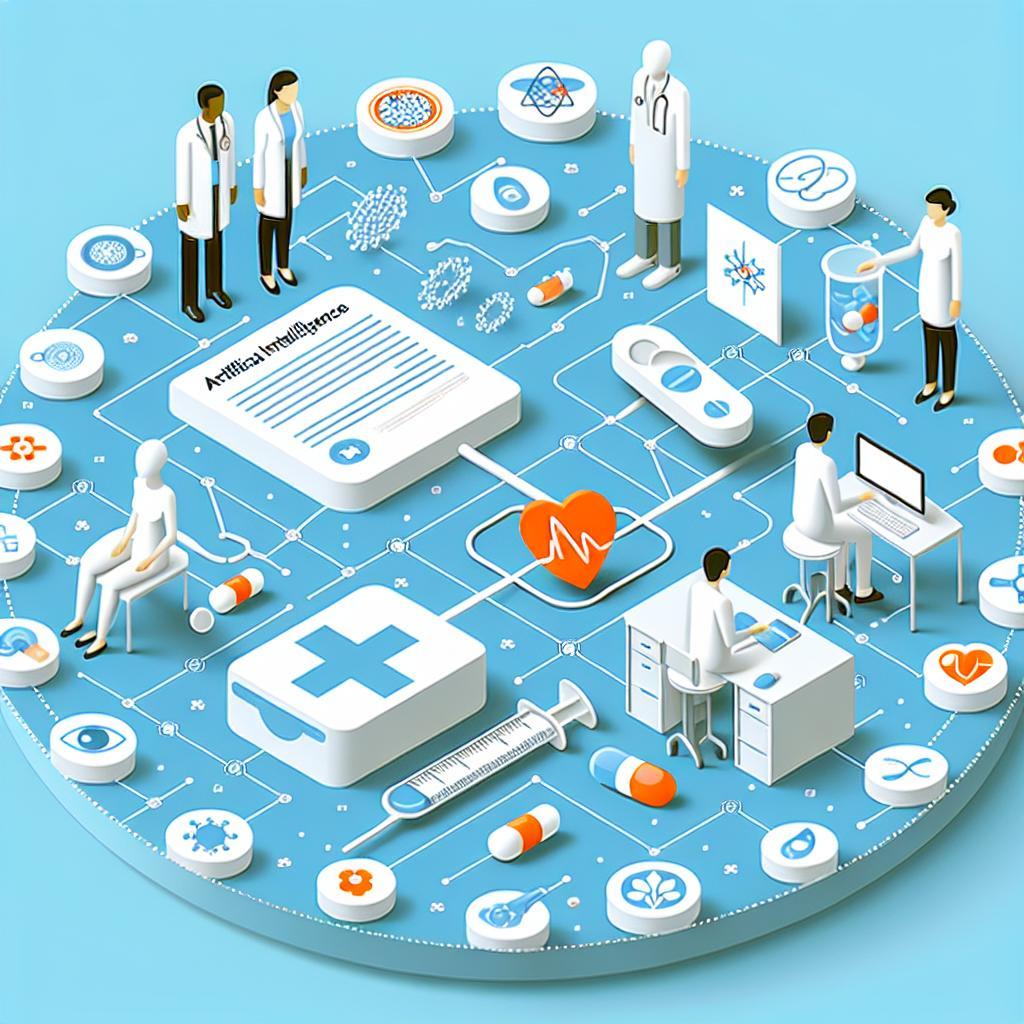
The Impact of Artificial Intelligence in Healthcare: Current Applications and Challenges

TABLE OF CONTENTS
- Summary
- AI in Medical Diagnosis
- AI in Drug Discovery
- Enhancing Patient Experience and Healthcare Delivery
- Challenges in AI Implementation and Data Management
- Collaborative Efforts and Policy Initiatives
- Conclusion
1. Summary
The report titled 'The Impact of Artificial Intelligence in Healthcare: Current Applications and Challenges' explores the transformative effects of AI technologies in medical diagnosis, drug discovery, and enhancing patient care. It includes case studies and technological advancements, such as the GI Genius for colonoscopy, a colposcope for cervical cancer screening, and EEG standardization by Piramidal. The report also highlights AI's role in drug discovery through virtual screening and generative AI research at Rutgers University. Applications in patient experience improvements like robotic surgeries and patient-first tools are also discussed. Challenges such as high development costs, data labeling complexities, and ethical concerns are noted. Collaborative efforts among healthcare organizations, tech companies, and policymakers, exemplified by projects at Kaiser Permanente and regulatory advancements, aim to responsibly integrate AI into healthcare.
2. AI in Medical Diagnosis
2-1. AI-enhanced Colonoscopy with GI Genius
The implementation of artificial intelligence (AI) in medical diagnosis has seen significant advancements, particularly in the realm of colonoscopy. A notable example is the GI Genius system, an FDA-approved intelligent endoscopy module that utilizes deep learning algorithms to enhance polyp detection during colonoscopies. According to OSF HealthCare, the GI Genius tool reviews colonoscopy images in real-time, providing physicians with highlighted areas that may indicate the presence of colorectal polyps. For instance, during a six-month pilot program at Eastland Medical Plaza Surgicenter in Bloomington, Illinois, a reported increase in the adenoma detection rate (ADR) was observed, with OSF's Performance Improvement (PI) team reporting an increase of 5.8% in ADR within the first month. Research indicates that improvements in ADR can significantly lower colorectal cancer risk, with a 14% increase in ADR linked to the use of GI Genius, according to Medtronic, the tool's manufacturer. Dr. Omar Khokhar, a gastroenterologist involved in the pilot, emphasized that while AI serves as an important support tool, it does not replace the clinician's expertise.
2-2. AI in Cervical Cancer Screening
Recent innovations in AI have led to the development of a new colposcope designed to assist in cervical cancer screening. Invented by Joseph Carson, PhD, this device employs AI technology similar to that used in NASA telescopes, capturing multiple images of the cervix to create a detailed topographical map. This 3D visualization helps healthcare providers identify precursors to cervical cancer more effectively. This integration of AI into cervical cancer screening exemplifies the potential of machine learning to enhance diagnostic processes while leveraging principles from various fields, such as space exploration.
2-3. Standardization of EEG Interpretation
Electroencephalography (EEG) technology has been historically fragmented, often requiring specialized knowledge for proper interpretation. The startup Piramidal has developed a foundational model aimed at improving the consistency of EEG outcomes. Their approach focuses on automating the analysis of EEG data, making it easier for healthcare practitioners to identify critical brainwave patterns. This model is designed to function universally across different EEG machines, capturing all relevant data regardless of equipment variations. The goal is to alleviate the workload on clinicians while enhancing the diagnostic capabilities for conditions related to brain disorders. According to co-founders Dimitris Sakellariou and Kris Pahuja, the foundation model for EEG readings they have developed is on track for deployment in hospitals, aiming to improve patient outcomes through streamlined and accessible EEG interpretation.
3. AI in Drug Discovery
3-1. AI in Screening Natural Compounds
Artificial Intelligence (AI) is being leveraged to enhance drug discovery by screening natural compounds found in Africa. Researchers, such as Fidele Ntie-Kang at the University of Buea in Cameroon, are using AI to analyze hundreds of natural compounds derived from Africa's diverse biodiversity. The traditional approach to drug discovery is often complex and lengthy, but with AI, researchers can dramatically accelerate the screening process. AI allows for the virtual screening of millions of compounds within a day, significantly reducing the time needed compared to previous methods, which could take weeks or months.
3-2. Rutgers University Generative AI Research
At Rutgers University, researchers have explored the capabilities of generative AI in modeling basic biological structures and analyzing drug-protein interactions. This research is conducted at the Rutgers Cancer Institute and highlights how generative AI can assist in understanding the molecular dynamics between drugs and their target proteins. Although the technology is still in its early stages, these advancements signal the potential for AI to play a significant role in the biomedical sciences, particularly in cancer research.
3-3. New AI Tools for Understanding Drug-Protein Interactions
Recent developments in AI tools enable a clearer understanding of how drugs interact with proteins. These tools have the ability to model biological interactions and possess the potential to facilitate drug discovery efforts. By using generative AI, researchers are beginning to uncover new ways to optimize the effectiveness of drug compounds while also accelerating the timeline for discovering effective treatments. The integration of AI tools into the pharmaceutical research process is poised to transform how researchers approach drug development.
4. Enhancing Patient Experience and Healthcare Delivery
4-1. Robotic Surgeries
Robotic surgeries have been revolutionized by artificial intelligence, enabling greater precision and control in surgical procedures. These systems allow surgeons to operate via a computer console that provides enhanced views of the surgical site. AI-powered robots help to perform minimally invasive surgeries, which typically result in fewer surgery-related complications, reduced pain, and quicker recovery times for patients.
4-2. Patient-first AI Tools
AI tools that prioritize patient needs are transforming healthcare delivery. These tools offer features such as personalized treatment plans and reminders for medication or appointments. For instance, AI applications can improve the efficiency of patient visits by supporting digital communications and managing healthcare data, ensuring that patients receive timely care tailored to their individual health needs. Moreover, these tools help reduce the administrative burden on healthcare providers, allowing them to focus more on patient care rather than paperwork.
4-3. Global Health Applications in LMICs
In low- and middle-income countries (LMICs), AI is being utilized to address healthcare challenges effectively. Notable applications include the use of AI for disease diagnosis, risk assessment, and outbreak response. For example, AI-supported systems in countries like India have rapidly generated encephalograms, while Rwanda and Nigeria have implemented AI to enhance patient navigation and monitoring of vital signs, respectively. These initiatives exemplify how AI can support healthcare delivery in resource-limited settings, ultimately contributing to better health outcomes and management of health crises.
5. Challenges in AI Implementation and Data Management
5-1. Cost of AI Model Development
The development of AI models in today's market comes with significant costs, often amounting to hundreds of millions of dollars, and projections indicate potential expenses could rise to over one billion dollars in the coming years. A substantial portion of this expenditure is attributed to computing power sourced from specialized chips, predominantly Nvidia GPUs, which may require tens of thousands at a cost of up to $30,000 each. Additionally, companies training AI models face rising costs associated with data labeling, a labor-intensive process crucial for training generative AI models, which demands expert-level knowledge in fields such as healthcare, contributing to escalating expenses.
5-2. Data Labeling Challenges
Data labeling is a crucial step in AI model training, requiring meticulous and complex processes to tag data appropriately for machine learning. The effort involved in labeling specialized data, particularly in fields that demand high levels of expertise like healthcare, has led to increased costs. Companies are often compelled to hire professionals such as medical doctors or scientists for this task, leading to substantial financial burdens. Moreover, re-labeling data to maintain its accuracy over time further exacerbates these challenges, consuming significant resources and effort, with some companies spending up to 80% of their AI budget on related tasks.
5-3. Ethical and Privacy Concerns in AI
The integration of AI tools in healthcare raises significant ethical and privacy concerns. One critical issue is the outsourcing of data labeling, which has attracted criticism due to labor practices, resulting in ethical dilemmas about fair compensation. Furthermore, the sheer volume of data required for AI tools necessitates stringent measures to ensure patient privacy and ongoing monitoring, as the potential misuse of sensitive healthcare data poses risks to patient trust and safety. Ensuring ethical AI deployment is paramount, as any breach of trust can erode confidence in the technology and its applications.
6. Collaborative Efforts and Policy Initiatives
6-1. Regulations and Ethical Frameworks
Current regulations and ethical frameworks surrounding the use of artificial intelligence (AI) in healthcare are being developed at both state and federal levels. States like Utah, Florida, and Colorado have taken significant steps this year, leading discussions on ethical standards and safety in AI implementation. These regulations are seen as models for future federal oversight, as healthcare organizations are encouraged to adopt ethical AI practices. The importance of establishing guidelines for responsible AI usage is underscored by collaborations between stakeholders in anticipation of forthcoming federal policies.
6-2. Collaborations for AI Tools Development
Collaborative efforts in developing AI tools for medical diagnosis are notable. A specific case includes the collaboration between the Performance Improvement team at OSF HealthCare and Dr. Omar Khokhar, which led to the pilot program for GI Genius, an FDA-approved intelligent endoscopy module. This tool utilizes deep learning algorithms to enhance polyp detection during colonoscopies, showcasing the integration of AI in practical healthcare settings. Such collaborations not only help validate the effectiveness of AI applications but also facilitate the practical deployment of these technologies in clinical environments.
6-3. Role of Policymakers in AI Adoption
Policymakers play a critical role in facilitating the adoption of AI in healthcare. Their responsibilities include ensuring that AI technologies are safe, ethical, and beneficial for healthcare delivery. Recent discussions at a G7 conference about AI in healthcare indicate that global leaders are working to address the challenges and implications of AI use in clinical practice. Policymakers are also focusing on developing and deploying frameworks that support innovation while safeguarding patient rights and data privacy, which are essential for the responsible integration of AI into healthcare systems.
7. Conclusion
AI technologies are drastically transforming healthcare by enhancing diagnostic accuracy, speeding up drug discovery, and improving patient care. Critical tools such as GI Genius improve real-time polyp detection, and innovations at Piramidal and Rutgers University contribute significantly to diseases' early detection and treatment methods. Despite remarkable advancements, significant challenges remain, including high development costs, complex data management, and pressing ethical and privacy concerns. Collaboration among entities like Kaiser Permanente and OpenAI, coupled with thorough policy frameworks and ethical guidelines, is essential to address these hurdles effectively. Future research should focus on overcoming these barriers while ensuring data privacy, ethical deployment, and real-world applicability of AI in healthcare, thereby assuring its responsible and beneficial integration into the healthcare ecosystem.