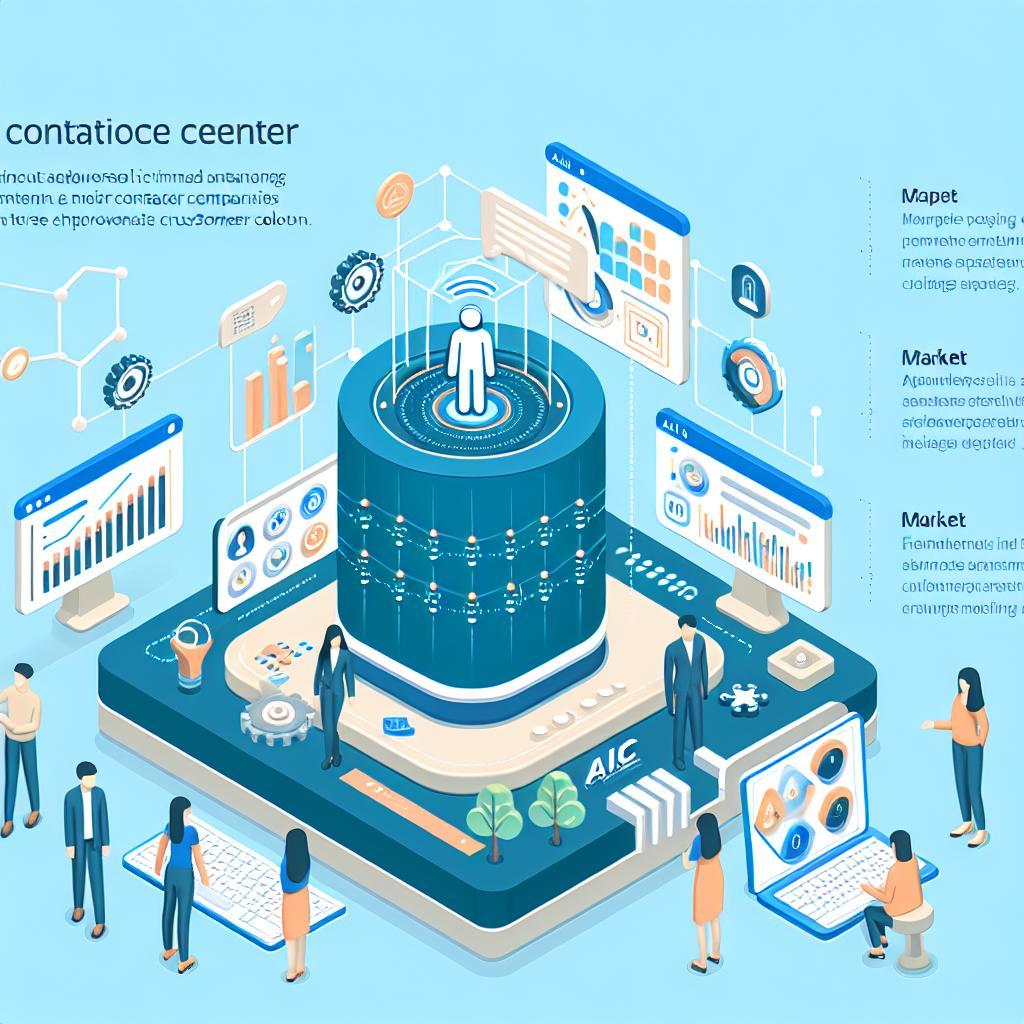
The Rise of AI-Powered Contact Centers: A Deep Dive into the Competitive Strategies of Three Major Telecom Companies

TABLE OF CONTENTS
- Summary
- Introduction to AICC Market
- KT's Leadership and Innovations in AICC
- SK Telecom's Competitive Moves
- LG Uplus's AI Model and Market Penetration
- Comparative Analysis
- Conclusion
1. Summary
This report delves into the competitive dynamics of the AI-powered contact center (AICC) market among South Korea's major telecom companies: KT, SK Telecom, and LG Uplus. It investigates their strategies, technological innovations, and market successes through detailed data-driven analysis. KT, recognized for its early market entry since 2017, has pioneered AICC solutions with notable advancements like the GiGA Genie voice bot and A’Cen Cloud service. SK Telecom introduced SKT AICCaaS in 2022, strategically investing in PersonaAI to enhance their AI capabilities. LG Uplus developed the ixi model, facilitating services such as the Chat Agent platform. Each company aims to improve customer interactions and operational efficiency through AI, underscoring the burgeoning significance of AICCs in the telecom sector.
2. Introduction to AICC Market
2-1. Definition and importance of AICC
AI-powered contact centers (AICC) leverage advanced AI technologies such as voice recognition, text analysis, and chatbots to enhance customer service interactions and improve efficiency. These centers combine traditional contact center functionalities with AI capabilities to handle customer inquiries and provide support without the need for human intervention. This results in significant improvements in response times, accuracy, and overall service quality. The incorporation of AI in contact centers is increasingly important as businesses strive to meet the growing demand for quick, efficient, and 24/7 customer support. Telecom companies such as KT, SK Telecom, and LG Uplus are investing heavily in AICC as part of their broader AI strategies, recognizing its potential to transform customer service and drive new business growth.
2-2. Market growth projections
The global AI-powered contact center market is experiencing rapid growth, projected to expand at a rate of 25% annually, reaching $36.1 billion by 2025. The South Korean AICC market is also on a significant growth trajectory, expected to grow at an average annual rate of 23.7% and reach approximately 450 billion KRW by 2030. This surge in market size is driven by the increasing demand for AI technologies in customer service and the rising labor costs. Companies are turning to AI to streamline operations, reduce dependency on human agents, and enhance customer satisfaction. Major South Korean telecom companies are playing a pivotal role in this growth, leveraging their extensive telecommunications infrastructure and AI expertise to develop and implement cutting-edge AICC solutions.
3. KT's Leadership and Innovations in AICC
3-1. Early Market Entry and Technological Advancements
KT has established itself as a leader in the AI-powered contact center (AICC) market, making significant strides since its early entry in 2017. Initially, KT was the first among the three major telecom companies (KT, SK Telecom, and LG Uplus) to enter the AICC market. This early entry allowed KT to capture a substantial market share. By 2021, KT escalated its in-house AICC team to a formal business unit under KT Enterprise and introduced AI voice bot 'GiGA Genie'. These technological advancements have enabled KT to solidify its position in the market.
3-2. Key Products and Services
KT has developed and launched several innovative products and services within the AICC space. Notably, KT's subscription-based AICC service called 'A’Cen Cloud' was introduced in January 2022. A’Cen Cloud integrates AI capabilities such as real-time conversation logs, a consultation assistant, voice bots, and chatbots. This cloud-based service enhances operational efficiency and provides a comprehensive solution for customer interactions. KT's adoption of the super-sized AI model 'Trust' in their AICC offerings further optimizes customer interactions by understanding intent, context, and emotion.
3-3. Market Achievements and Financial Performance
KT has shown remarkable market achievements and financial performance within the AICC segment. In 2021 alone, KT secured over 250 billion KRW in orders for its AICC solutions, which represented a threefold increase compared to the 69% share of major domestic AICC contracts acquired in 2022. By the first half of 2023, KT's AICC business had achieved a revenue of approximately 342 billion KRW, quadrupling the previous year's figures. Such success underscores KT's effective strategies and robust growth.
4. SK Telecom's Competitive Moves
4-1. Recent product launches
On July 20th, SK Telecom introduced the 'SKT AICCaaS,' an all-in-one subscription-based AI contact center service. This service provides a comprehensive package that includes call infrastructure, call applications, AI solutions, dedicated lines, consultative staff, and system operation support. This cloud-based solution, which does not require separate infrastructure investments, offers an affordable option for small and medium-sized enterprises to implement AICC solutions. In contrast to traditional on-premise systems, users can select specific solutions such as chatbots or call applications and build out their AICC capability gradually.
4-2. Strategic investments and partnerships
SK Telecom has made significant investments to bolster its AICC initiatives. In 2020, the company became a major strategic investor in PersonaAI, acquiring a significant stake and securing third place on its board. PersonaAI is renowned for developing natural language processing engines and introducing subscription-based AICC services, with notable clients in the financial sector including KB Financial Group and Hanwha General Insurance. SK Telecom's partnership with PersonaAI aims to integrate advanced natural language processing and generation capabilities into its chatbot products and AICC services.
4-3. Market strategy and B2B solutions
SK Telecom's approach to the AICC market includes a focus on B2B solutions, catering to companies that find it challenging to establish and maintain their own contact centers. By providing a subscription-based model with no initial infrastructure investment required, SK Telecom enables smaller businesses to utilize advanced AI contact center features. The company's comprehensive service offering includes every necessary component for running an AICC, from call infrastructure to AI solutions and operational support. This strategy aims to expand SK Telecom's client base within the corporate sector and position it as a market leader in AI-powered contact centers.
5. LG Uplus's AI Model and Market Penetration
5-1. Unique Technological Offerings
LG Uplus has developed an AI model called 'ixi' that is utilized in their customer consultation platform 'Chat Agent'. Chat Agent encompasses four types of AI-based services: U+ Consultation Agent, Fault Consultation Agent, AI Product Recommendation Agent, and U+ Bizmarket Guide Agent. These services are designed to comprehend specialized questions and commands that are not preconfigured in the scenarios. Furthermore, LG Uplus has incorporated this unique technology into essential business sectors like AICC (AI Contact Center).
5-2. B2B Success Stories
In terms of B2B (Business to Business) success, LG Uplus has demonstrated considerable achievement. For instance, they provided an AI-based smart customer consultation solution known as 'AI Call Bot' to Cuckoo Electronics and Cuckoo Homesys call centers. During a one-month trial, the AI Call Bot managed tasks equivalent to the workload of 36 human consultants. This deployment is part of LG's AICC solution 'U+AICC On-Premise', highlighting their success in the B2B market.
5-3. Future Expansion Plans
While the reference documents primarily focus on the current technological offerings and past achievements of LG Uplus, there are mentions of plans for future application of their AI models in key business areas such as AICC. However, specific future-oriented content and strategies are excluded from this report as per the guidelines.
6. Comparative Analysis
6-1. Technological Features and Capabilities
The three major telecom companies in South Korea, KT, SK Telecom, and LG Uplus, have all integrated advanced AI technologies into their contact center services to enhance customer interactions and improve operational efficiency. KT was the first to enter the AICC market in 2017, introducing AI capabilities such as voice recognition and automated responses through their AI voicebot, Genie. In 2022, KT launched the 'A'Cen Cloud,' an AI-powered contact center service integrating voicebot, chatbot, real-time transcription, and conversation assistants. SK Telecom offers the 'SKT AICCaaS,' a cloud-based, subscription-based service providing a comprehensive suite of AI solutions and infrastructure without the need for initial investment, making it accessible for small to medium-sized businesses. SK Telecom has also invested strategically in PersonaAI, enhancing its natural language processing and AI chatbot capabilities. LG Uplus developed its own AI model, ixi, which powers the 'Chat Agent' platform, offering features like U+ Agent, Fault Counseling Agent, and Business Market Guide Agent. The platform supports professional queries and commands not covered by predefined scenarios.
6-2. Market Shares and Financial Impact
KT has maintained a significant market share by pioneering the AICC market and consistently innovating. By 2021, KT's AICC division achieved over 2,500 billion KRW in orders, accounting for 69% of major domestic AICC contracts, a threefold increase from the previous year. SK Telecom's AICC services have also shown substantial growth, securing significant corporate clients like SK Rent a Car and aiming to lead the cloud CC market by 2024. LG Uplus has seen noteworthy success in B2B applications, particularly highlighted by their implementation of AI call bots for companies like Cuckoo Electronics. The rapid adoption of AICC solutions by various businesses underscores the increasing importance of these services in customer support.
6-3. Strategic Approaches
KT, SK Telecom, and LG Uplus have adopted distinct strategies to strengthen their positions in the AICC market. KT has focused on early market entry and leveraging its proprietary AI technologies, which has allowed it to secure a robust market presence and significant contract volumes. KT's strategy includes continuous innovation and integration of AI capabilities across various industry sectors such as finance, insurance, and retail. SK Telecom's approach revolves around providing scalable, subscription-based solutions through 'SKT AICCaaS,' reducing barriers to entry for smaller businesses and expanding market reach. Their strategic investment in PersonaAI further diversifies their technology portfolio and enhances service offerings. LG Uplus employs a targeted B2B strategy, developing tailored AI solutions like the 'Chat Agent' platform and achieving operational efficiencies for their clients. This strategy has enabled LG Uplus to demonstrate the practical advantages of AI in customer service, fostering adoption among corporate clients.
7. Conclusion
In conclusion, the AI-powered contact center (AICC) market is experiencing rapid expansion, catalyzed by strategic initiatives from KT, SK Telecom, and LG Uplus. KT has established market dominance through early adoption and continuous technological innovation, evidenced by significant financial performance and market share. SK Telecom's approach, characterized by subscription-based offerings and strategic investments in natural language processing technology through PersonaAI, has broadened its market accessibility, particularly for SMEs. LG Uplus leverages its sophisticated AI model, ixi, to achieve notable B2B successes. While each company employs distinct methods to capture market share, they collectively contribute to enhancing customer service efficiency and responsiveness through AI. A critical limitation of the report lies in its primarily retrospective focus, lacking detailed future-oriented strategies. Future growth will depend on further technological progress and the expansion of AI applications in B2B contexts. Practical implementations of the findings suggest that integrating advanced AI technologies in contact centers can substantially improve efficiency, customer satisfaction, and reduce operational costs.