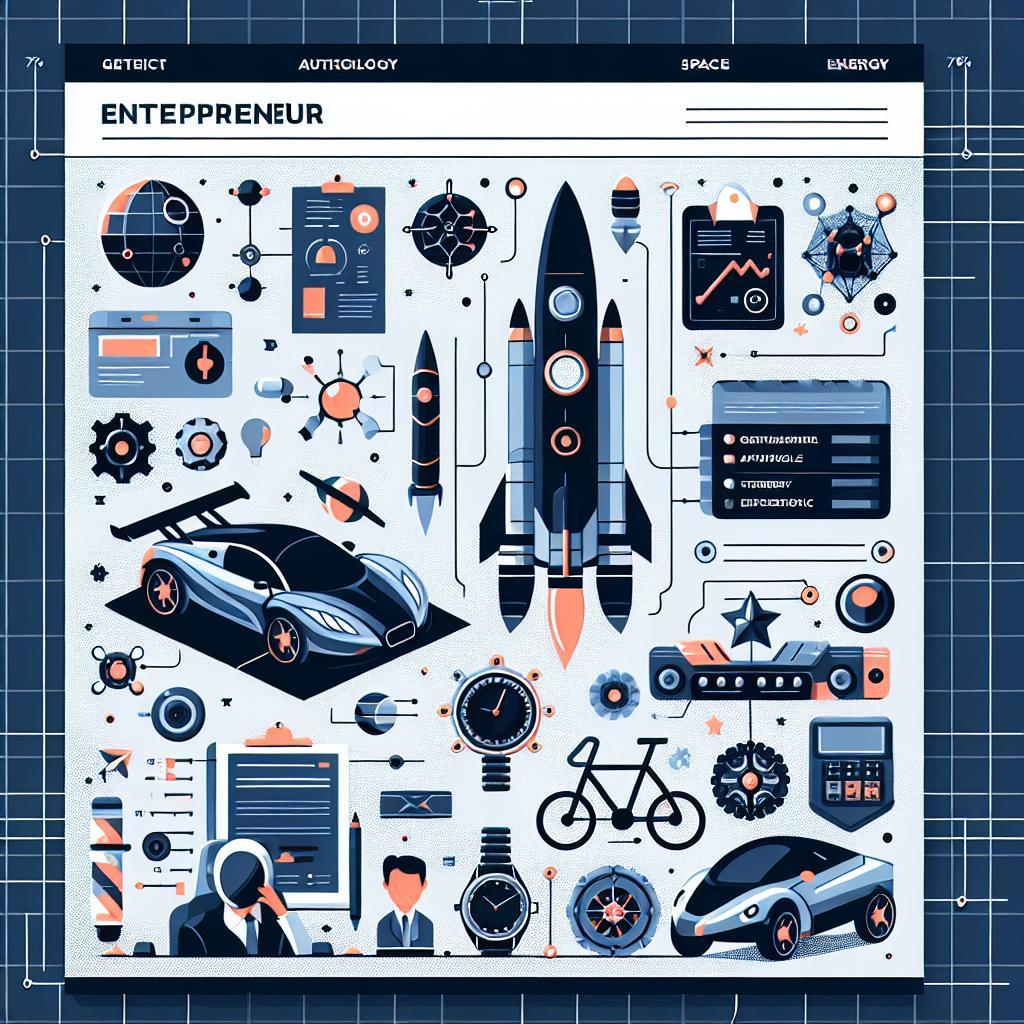
Elon Musk: Innovator Across Multiple Industries

TABLE OF CONTENTS
- Summary
- Early Ventures and Foundations
- Major Companies Founded or Led by Elon Musk
- Achievements and Impact
- Leadership and Management Style
1. Summary
The report titled \
2. Early Ventures and Foundations
2-1. Zip2 and its acquisition by Compaq
In 1995, Elon Musk, his brother Kimbal Musk, and Greg Kouri co-founded an online business directory and city guide software company called Zip2. The company was developed with an investment of $28,000 from their father. Zip2 provided internet maps and directions, making it one of the first companies to offer this service. The company obtained contracts with well-known newspapers such as The New York Times and the Chicago Tribune, which significantly boosted its profile. Despite facing challenges, including Musk's thwarted attempts to become CEO, the company grew rapidly. In February 1999, Compaq acquired Zip2 for approximately $307 million in cash, with Elon Musk receiving $22 million for his 7-percent share.
2-2. X.com's evolution to PayPal and its sale to eBay
In March 1999, Elon Musk co-founded an online financial services and email payment company called X.com with $12 million from his earnings from the sale of Zip2. Initially, X.com was one of the first federally insured online banks and signed up over 200,000 customers within the first months of operation. In 2000, X.com merged with Confinity, a company co-founded by Max Levchin, Peter Thiel, and Luke Nosek, known for its money-transfer service PayPal. Following this merger, PayPal became the focal point of the business due to its popular money-transfer service, leading to the company being renamed PayPal in 2001. In October 2002, PayPal was acquired by eBay for $1.5 billion in stock, with Musk, who was PayPal's largest shareholder holding 11.72% of shares, receiving $175.8 million from the sale.
3. Major Companies Founded or Led by Elon Musk
3-1. Tesla: Advancing Electric Vehicles and Clean Energy
Tesla, co-founded by Elon Musk, is renowned for its role in advancing electric vehicles (EVs) and clean energy solutions. Musk joined Tesla in 2004 and became CEO in 2008. Tesla’s first product, the Roadster, was released in 2008, followed by the Model S in 2012, the Model X in 2015, the Model 3 in 2017, and the Model Y in 2020. The company also offers solar energy products through its acquisition of SolarCity in 2016, creating Tesla Energy. As of 2023, Tesla is valued at approximately $716.06 billion.
3-2. SpaceX: Pioneering Affordable Space Travel
SpaceX, founded by Elon Musk in 2002, focuses on reducing space travel costs and making space exploration more accessible. Notable achievements include the first privately-developed liquid-fuel rocket to reach orbit (Falcon 1 in 2008), the development of the Falcon 9 and Falcon Heavy rockets, and the Dragon spacecraft, which has transported both cargo and crew to the International Space Station. SpaceX also developed the Starlink satellite internet system and aims for missions beyond Earth, including Mars.
3-3. The Boring Company: Innovative Transportation Solutions
Elon Musk founded The Boring Company in 2016 as a response to urban traffic congestion. The company focuses on constructing underground tunnels using innovative, cost-effective tunneling techniques. Notably, it has built a 1.15-mile R&D tunnel in Hawthorne and is working on the Vegas Loop, an underground public transportation system in Las Vegas. The company aims to facilitate high-speed, long-distance travel through its
3-4. Neuralink: Brain-Machine Interface Technology
Neuralink, co-founded by Elon Musk in 2016, aims to develop high-bandwidth brain-machine interfaces to connect the human brain with computers. The technology has potential applications in treating neurological conditions and enhancing human cognitive abilities. In 2023, Neuralink received FDA approval for human trials, marking a significant milestone in its mission to advance neurotechnology.
3-5. OpenAI: Advancements in Artificial Intelligence
Elon Musk co-founded OpenAI in 2015 with the goal of ensuring AI benefits all of humanity. OpenAI conducts research in artificial intelligence with a focus on safety and ethical development. The organization has made significant contributions to the field of AI, including the development of the language model GPT-3. Although Musk is no longer on the board, he remains a supporter of the company's mission.
3-6. X (formerly Twitter): Expanding Social Media Influence
Elon Musk acquired Twitter in 2022 for $44 billion and rebranded it as X in 2023. The acquisition led to significant changes, including staff reductions and policy revisions. Musk aims to transform X into a platform that supports free speech and functions as a digital public square. Despite facing challenges such as declining ad revenue, Musk remains committed to his vision for the platform.
4. Achievements and Impact
4-1. Significant Milestones of SpaceX and Tesla
SpaceX, founded by Elon Musk in 2002, has made notable achievements including the launch of the Falcon 1 rocket in 2008, which was the first privately-funded liquid-fueled rocket to reach orbit. SpaceX has also developed the Falcon 9 and Falcon Heavy rockets, which are known for their cost-efficiency and payload capacity. The company’s Dragon spacecraft has been instrumental in transporting astronauts and cargo to the International Space Station. Tesla, on the other hand, was founded in 2003 and Musk joined in 2004 as a major funder. Tesla is best known for its electric vehicles, including the Roadster in 2008, Model S in 2012, Model X in 2015, and Model 3 in 2017. The Model 3 became the best-selling electric car of all time with an ability to travel 263 miles on a single charge. Tesla's market cap exceeded $755 billion, making it one of the most valuable companies globally.
4-2. Neuralink’s Human Trials Approval
Neuralink, co-founded by Elon Musk in 2016, is a neurotechnology company developing brain-machine interfaces. In May 2023, Neuralink received FDA approval to start testing its brain implants on humans. This came after an initial rejection in 2022 due to safety concerns. The company officially opened its first human trials in September 2023. Neuralink aims to treat severe brain diseases and ultimately enhance human cognitive abilities.
4-3. Musk's Net Worth and Financial Influence
Elon Musk's financial influence extends across multiple ventures. He generated approximately $180 million after the sale of PayPal to eBay for $1.5 billion in 2002. As of 2023, Musk's net worth was valued at $255.2 billion. He owns significant stakes in several companies including a 21% stake in Tesla and 42% in SpaceX, making him one of the richest men globally. Musk also acquired Twitter for $44 billion in 2022, and the social media platform was rebranded to X. Unfortunately, X lost nearly 50% of its ad revenue and its value decreased to about $20 billion in March 2023.
4-4. Philanthropic Efforts and Investments
Elon Musk has been involved in various philanthropic activities. He joined the Giving Pledge in 2012, committing to donate a majority of his wealth to charitable causes. Musk's foundation, established in 2002, provides grants for pediatric research, science and engineering education, renewable energy research, and human space exploration. During the COVID-19 pandemic, Musk donated medical equipment, although some ventilators were deemed unsuitable. He also funded the installation of clean water systems in Flint, Michigan schools. However, he has faced criticism for contributing less than 1% of his total wealth to philanthropy and not fully following through with some pledges.
5. Leadership and Management Style
5-1. Roles and Responsibilities Across Companies
Elon Musk serves multiple leadership roles across various companies he founded or acquired. For instance, as of now, Musk is the CEO and product architect of Tesla, Inc., and the CEO, chief technology officer, and chief designer of SpaceX. At Neuralink, he holds an executive officer position. He also owns and significantly influences X (formerly Twitter) as well as other endeavors like The Boring Company and xAI. Despite his involvement in numerous ventures, Musk delegates day-to-day operations in some companies to key executives, such as Gwynne Shotwell at SpaceX.
5-2. Delegation to Executives
Elon Musk delegates considerable responsibilities to trusted executives to manage his extensive portfolio efficiently. For example, at SpaceX, Gwynne Shotwell serves as the president and chief operating officer, responsible for daily operations. Similarly, after acquiring Twitter, Musk appointed Linda Yaccarino as the CEO to manage its operations. This approach allows him to focus on high-level strategic decisions and engineering aspects across his organizations.
5-3. Controversial Views and Public Perception
Elon Musk's leadership style and public statements have often been the subject of controversy. His outspoken and sometimes unorthodox views have made him a polarizing figure. Critics have pointed out his misleading statements, including those related to COVID-19 and other contentious issues. Musk's management of Twitter has also attracted scrutiny, particularly due to massive employee layoffs and policy changes that increased the presence of misinformation and hate speech on the platform. Despite these controversies, Musk continues to be highly influential in the technological and entrepreneurial space.