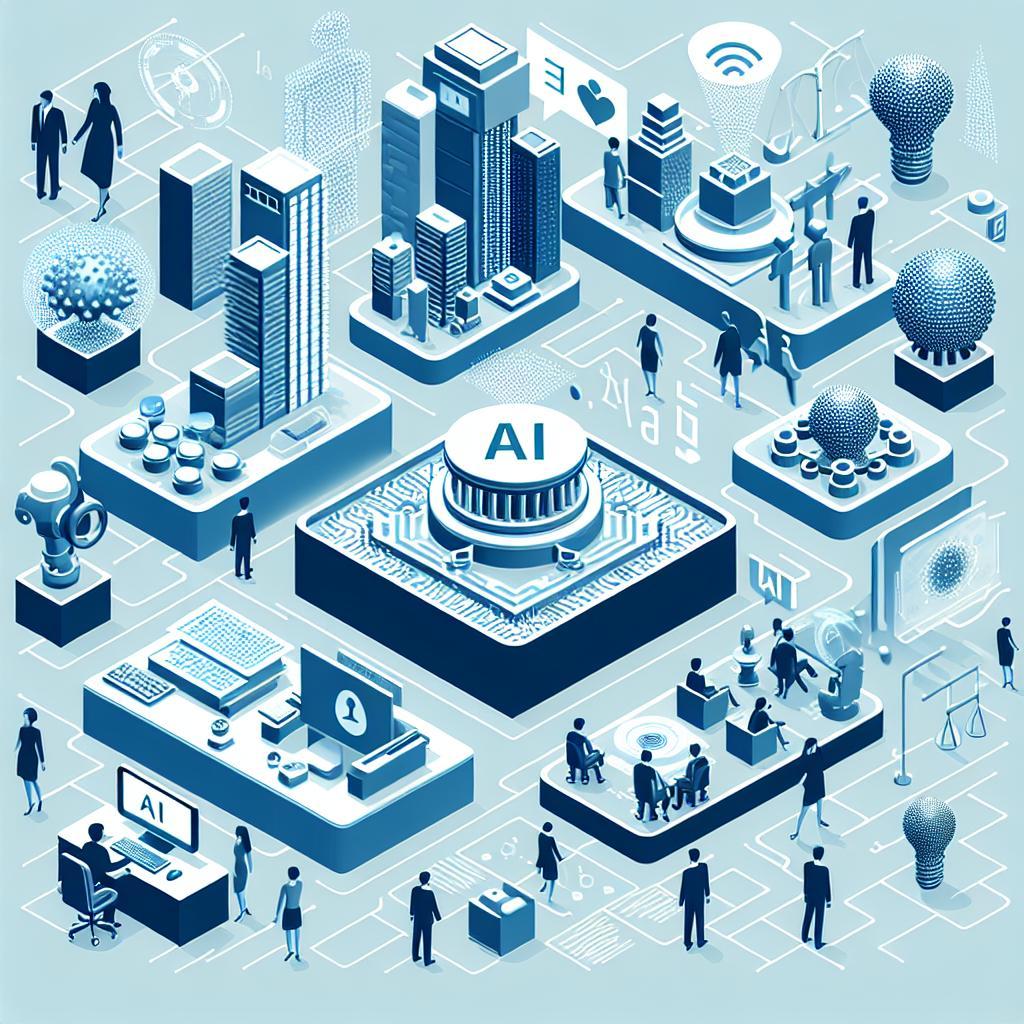
Advancements and Legal Challenges in the AI Ecosystem: A Detailed Exploration

TABLE OF CONTENTS
- Summary
- Customizing Small Open-Source Models
- AI Industry Developments and Innovations
- Corporate Movements and Strategies
- Legal Disputes in the AI Sector
- Notable Personnel Movements
- Strategic Investments and Partnerships
- Product Development and Feature Updates
- AI Recognition and Achievements
- Regulatory and Competitive Reviews
- Semantic Evaluation Research
- Latest Trends in Generative AI
- Carbon Credits in AI Industry
- AI Tools for Businesses
- China’s AI Ecosystem
- Acquisitions and AI Talent Movements
- Diverse AI Tools and Services
- New AI Features for Consumer Products
- Funding and Development in AI
- Global AI Advancements
- Conclusion
1. Summary
The report titled 'Advancements and Legal Challenges in the AI Ecosystem: A Detailed Exploration' delves into the recent advancements and legal challenges within the global AI landscape. Key entities such as Microsoft, OpenAI, Meta, and xAI are highlighted for their innovations and strategic directions. The report covers topics such as technical innovations with Mistral 7B and RAG approaches, strategic moves by companies like Microsoft developing the MAI-1 model, and legal disputes involving copyright infringement against OpenAI and Microsoft. It also addresses AI safety initiatives by OpenAI and Meta, funding trends led by French startups, and notable personnel movements, particularly involving xAI. By examining various case studies, experimental setups, and corporate strategies, the report provides a comprehensive overview of the current advancements and implications in the AI industry, aimed at both industry insiders and stakeholders interested in the evolving AI ecosystem.
2. Customizing Small Open-Source Models
2-1. Overview of Mistral 7B
Mistral 7B is identified as excelling in benchmarks compared to other foundational models such as Meta's Llama-2 7B and Google's Gemma 7B. This superior performance made Mistral 7B a preferred choice for further customizations. The model's strong math and coding capabilities contributed to its excellent performance in specialized tasks.
2-2. Finetuning and Merging Models
The process of finetuning and merging models was utilized to enhance the performance of the Mistral 7B model. A merged model named Stealth 7B v1.1 was created, significantly improving mathematical capabilities while maintaining performance in other tasks. Direct Preference Optimization (DPO) was then applied using Intel’s Orca DPO pairs dataset to create Stealth 7B v1.2, improving technical preferences further and demonstrating minimal performance loss.
2-3. Use of RAG for Performance Improvement
Retrieval Augmented Generation (RAG) was added as an experimental enhancement to improve documentation retrieval and question-answering capabilities. A simple RAG setup was implemented using Llamaindex and the bge-en-base-v1.5 embedding model, which contributed to more consistent benchmarking results, as indicated by a lower standard deviation.
2-4. Benchmarking Against GPT-3.5
A curated set of 50 multiple-choice questions based on Nitro documentation was used for benchmarking. The results indicated that with task-specific training, the customized and finetuned model could achieve performance comparable to GPT-3.5 in domain-specific knowledge. The finetuned model, coupled with RAG, showed more consistent performance, highlighting the potential of this approach for specialized technical needs.
3. AI Industry Developments and Innovations
3-1. OpenAI and Meta Advisory Initiatives
OpenAI has announced the formation of a new advisory committee focused on AI safety and security. This committee includes top leaders such as CEO Sam Altman and will dedicate 90 days to evaluating the company's processes and safeguards. At the conclusion of this period, the committee will present its recommendations to the board and then make them public. Similarly, Meta, led by Mark Zuckerberg, has established an AI advisory council comprising four executives. This council is tasked with guiding Meta's AI strategy and will engage periodically with the company’s management. Meta has committed an additional $5 billion to its AI expenditure beyond initial forecasts and pledged $35 million towards AI projects at the beginning of 2024.
3-2. France Leading AI Funding in Europe
France is emerging as a leader in AI funding within Europe, with French startups raising over $2 billion to date. Prominent examples include Mistral AI, which has secured hundreds of millions in funding, and H, which completed a $220 million seed round. Additionally, Poolside raised $400 million, achieving a $2 billion valuation, to develop cogeneration tools for GenAI developers.
3-3. LinkedIn's AI-powered Career Coach
LinkedIn has introduced an AI-powered career coach that doubles as a resume writer. This tool is integrated into the LinkedIn platform and utilizes a generative model trained on advice from human career coaches, as well as on professional resumes and cover letters. The AI-powered tool aims to assist job seekers by helping them create job application materials and assess their qualifications in comparison to other applicants.
4. Corporate Movements and Strategies
4-1. Microsoft's Development of MAI-1
Microsoft is actively developing its own AI large-language-model technology named MAI-1. According to The Information, MAI-1 consists of 500 billion parameters, placing it between OpenAI's GPT-3, with 175 billion parameters, and GPT-4, which is estimated to have up to 1.76 trillion parameters. The complexity of AI systems tends to improve with the number of parameters, although it also increases the demand for processor power. Mustafa Suleyman, a DeepMind co-founder who joined Microsoft in March 2024 after a $650 million deal to license software from his other venture, Inflection AI, is leading the development team. While the specific use cases for MAI-1 are yet to be fully disclosed, it adds to Microsoft's growing portfolio of AI technologies, which already includes CoPilot, integrated into Windows 11 and the Microsoft 365 suite. Microsoft's investment in OpenAI is currently valued at approximately £10.3 billion.
4-2. Investments in Projects like Phi-3 and WizardLM-2
Microsoft has diversified its AI initiatives beyond MAI-1 with projects like Phi-3 and WizardLM-2. Phi-3 is designed to be more efficient in terms of computing resource usage. WizardLM-2, another advanced AI model, was launched in April but was quickly withdrawn due to non-compliance with Microsoft's 'toxicity testing' policies. These projects exemplify the competitive nature of advancements in AI, with Microsoft taking significant risks to explore various technological avenues.
4-3. Apple’s AI Focus with iOS 18
Apple is also making considerable strides in AI, particularly with its upcoming iOS 18, which will be introduced alongside the iPhone 16 family. Expected to be announced at the WWDC show in June, iOS 18 will reportedly leverage on-device AI, enhancing privacy and security by eliminating the need to send data to cloud servers for processing. This move is expected to significantly impact the AI landscape, emphasizing on-device intelligence and user privacy.
5. Legal Disputes in the AI Sector
5-1. Lawsuit against OpenAI and Microsoft
On June 27, 2024, The Center for Investigative Reporting filed a lawsuit against OpenAI and Microsoft. The lawsuit was filed in the Southern District of New York and alleges copyright infringement. According to the lawsuit, OpenAI used content from the Center for Investigative Reporting without permission or compensation. The news nonprofit, known for producing Mother Jones and Reveal, contends that OpenAI's platforms are trained using human works, particularly journalism, to mimic how humans write and speak. The suit claims that hundreds of thousands, if not millions, of journalistic articles have been used without consent, undermining the nonprofit's standing with the public and potentially diverting user attention and support to the AI tool instead.
5-2. Copyright Infringement Allegations
The lawsuit against OpenAI and Microsoft highlights significant copyright infringement allegations in the AI sector. Monika Bauerlein, the CEO of the Center for Investigative Reporting, expressed that this unauthorized use of their content is immensely dangerous. The lawsuit points out that the AI companies, while competing for consumer attention, have neglected to offer compensation for the content utilized to develop their AI models. This mirrors other ongoing copyright issues in the AI industry, where numerous news organizations are battling similar lawsuits, arguing that their work has been used without permission to commercialize AI. It is noted that while some companies are engaging in litigation, others, like Time magazine, have chosen to partner with AI companies, granting OpenAI access to its archives over the last 100 years.
6. Notable Personnel Movements
6-1. xAI Poaching and Employee Return to OpenAI
Elon Musk launched xAI in the summer of 2023 and recruited several founding members from major tech companies like OpenAI, Google, DeepMind, and Microsoft. Kyle Kosic, an original member of xAI and a former OpenAI engineer, returned to OpenAI in May 2024 after spending 11 months with xAI. Kosic, who served as a full-stack reliability engineer and data scientist at xAI, had previously worked at OpenAI for two years before joining the Musk-led startup. According to xAI's investor presentations, Kosic played a crucial role in automation, scalability, and distributed computing. Despite Kosic's departure, the remaining original xAI team members have stayed with the company.
6-2. Hiring Strategies and Company Valuations
xAI has emphasized its close ties with Elon Musk’s other companies, branding it as part of the 'Muskonomy'. The startup utilizes data from X and Tesla, and collaborates with Neuralink. xAI's primary product, the chatbot Grok, was released in November 2023 and is available to X premium subscribers. Future iterations, Grok 2 and Grok 3, are expected later this year. The company was valued at $24 billion after raising $6 billion in early 2024 and plans to build a data center in Memphis, Tennessee to enhance its computing capabilities. xAI currently has 97 employees and 22 open positions. Salaries for A.I. engineers and researchers at xAI range from $180,000 to $440,000, which are competitive, though some companies offer higher compensation packages to attract talent. OpenAI, in contrast, has about 1,200 employees, indicating a larger operational scale.
7. Strategic Investments and Partnerships
7-1. Microsoft's $1.5 Billion Investment in G42
Microsoft recently announced a $1.5 billion investment in G42, an AI development firm based in Abu Dhabi. This investment is a significant part of Microsoft's strategy to strengthen its position in the AI sector. The deal required careful negotiation due to G42's past connections with companies that have raised concerns among US lawmakers, including its links to Huawei, a Chinese tech giant sanctioned by the US government. The investment also aligns with G42's potential financing of a chip venture led by Sam Altman, chief of OpenAI, which presents an opportunity for Microsoft to further solidify its presence in the AI race.
7-2. Nadella’s Leadership in AI Strategy
Satya Nadella, CEO of Microsoft, has been making strategic moves to assert Microsoft's dominance in the AI field. Under his leadership, Microsoft has not only made significant financial investments in AI, such as the $1.5 billion investment in G42, but also formed substantial strategic partnerships. Nadella's decision to hire Mustafa Suleyman, a renowned AI figure, and invest in other AI startups like Mistral AI, further exemplifies his aggressive approach to solidify Microsoft's leadership in AI. This series of calculated power plays reflects Nadella’s commitment to ensuring Microsoft remains at the forefront of AI innovation.
8. Product Development and Feature Updates
8-1. MongoDB’s Atlas Edge Server and Atlas Stream Processing
MongoDB has made significant strides with the introduction of Atlas Edge Server, now in public preview, and Atlas Stream Processing, which is now generally available. Atlas Edge Server is designed to enhance developers' ability to manage data in remote and network-constrained environments. It offers real-time synchronization, conflict resolution, and disconnection tolerance. This functionality ensures uninterrupted operations even with intermittent connectivity, crucial for applications such as inventory management and point-of-sale systems. Atlas Stream Processing enables developers to build responsive, event-driven applications using MongoDB’s Query API and document model. Key features of the generally available version include production readiness, time series collection support, Kafka support, and least privilege access. These updates significantly improve the developer experience and enhance MongoDB's capabilities in handling complex data structures for stream processing.
8-2. Customer Highlights and Upcoming Features
Customers have praised MongoDB's Atlas Stream Processing for improving productivity and reducing infrastructure costs. Companies like Acoustic and Meltwater have successfully leveraged this tool to process and manage millions of signals efficiently, enhancing customer experiences and operational efficiency. Looking forward to further developments, MongoDB plans to introduce advanced networking support, expand cloud region and provider support, and improve metrics and observability for stream processors. These enhancements aim to deliver a world-class stream processing experience, allowing developers to process high-velocity data, analyze customer data, and perform predictive maintenance more effectively.
9. AI Recognition and Achievements
9-1. Elastic's 2024 Microsoft U.S. Partner of the Year Award
Elastic (NYSE: ESTC) has been awarded the 2024 Microsoft U.S. Partner of the Year title. This prestigious recognition highlights Elastic's innovative use of Microsoft technology in customer solutions, specifically through its Elastic Search AI Platform. Elastic was also a global finalist in the ISV Innovation category from 4,700 entries. The award signifies the strong collaboration between Elastic and Microsoft, focusing on creating advanced AI-driven solutions while maintaining data privacy and security. The recognition will be celebrated during the MCAPS Start for Partners and Microsoft Ignite events.
9-2. Integration with Microsoft Azure AI Services
The Elastic Search AI Platform integrates with Microsoft Azure AI Services, including Azure OpenAI. This integration allows customers to build advanced generative AI applications that improve search accuracy and user experience. Elastic's RAG (retrieval augmented generation) search applications generate relevant search results from proprietary and external data sources, enhancing customer and employee interactions. Moreover, the Elastic AI Assistant offers faster problem resolution with smarter generative AI, tailored to specific business, operational, and security needs. This partnership between Elastic and Microsoft is pivotal in developing transformative GenAI applications that drive innovation and improve productivity while ensuring data security and privacy.
10. Regulatory and Competitive Reviews
10-1. EU Scrutiny of Microsoft-OpenAI Partnership
The European Union (EU) has closely examined the partnership between Microsoft and OpenAI, particularly in terms of its impact on the fast-growing AI market. The EU's antitrust chief stated that after a preliminary review, the $13 billion collaboration did not give Microsoft control over OpenAI on a long-term basis. However, the EU requested additional information regarding exclusivity clauses that might negatively affect competition. Margrethe Vestager, the EU competition commissioner, emphasized the need for transparency around Microsoft's arrangements with OpenAI and other related tactics like "acqui-hires." The study followed concerns arising from a failed boardroom coup against OpenAI's CEO, Sam Altman, where Microsoft played a significant supportive role. Both American and British regulators are also investigating this partnership. Microsoft expressed appreciation for the EU's thorough review and affirmed its willingness to address further queries.
10-2. Global Regulatory Perspectives
The scrutiny of Microsoft and OpenAI’s partnership by the EU represents broader global regulatory concerns regarding major tech collaborations in the AI sector. Apart from the EU, both American and British regulators are investigating the implications of this partnership. These reviews are primarily focused on evaluating how such significant investments and cooperation agreements between leading tech giants may influence market control, competition, and innovation within the industry.
11. Semantic Evaluation Research
11-1. Research Papers from SemEval-2024
The 18th International Workshop on Semantic Evaluation (SemEval-2024) presented various research papers focusing on different semantic evaluation tasks. Several studies showcased innovative approaches in the field, including notable contributions such as 'Classify Human and Generated Text' by Pranjal Aggarwal and Deepanshu Sachdeva, which experimented with classifying AI-generated and human-written texts using models ranging from Logistic Regression to transformers and GPTs. Another significant paper, 'A Simplistic Approach to Textual Relatedness Evaluation Using Transformers and Machine Translation' by Hidetsune Takahashi et al., employed BERT transformer models for evaluating semantic relatedness of sentence pairs across nine languages. In addition, the paper 'Using Flan-T5 for Reasoning Emotion Cause in Conversations' by Nicolay Rusnachenko and Huizhi Liang explored emotion expression in conversations using the THOR approach and fine-tuned models. These contributions highlight the diverse and advanced methodologies employed in recent semantic evaluation research, illustrating the field's continuous evolution.
11-2. Tasks and Innovations in Semantic Evaluation
SemEval-2024 featured a variety of tasks aimed at pushing the boundaries of semantic evaluation. Key tasks included Task 8, which focused on 'Multigenerator, Multidomain, and Multilingual Black-Box Machine-Generated Text Detection' as investigated by Hanh Thi Hong Tran, Tien Nam Nguyen, and Antoine Doucet. Their study revealed that their fine-tuned large-scale language model (LS-LLaMA) outperformed traditional sequence-labeling benchmarks. Furthermore, in Task 1, teams like NRK explored 'Semantic Textual Relatedness' through ensemble learning and domain adaptation techniques, achieving commendable ranks for languages like Algerian Arabic and Amharic. The 'Emotion Cause Reasoning' task by Nicolay Rusnachenko et al. utilized new approaches in emotion detection in conversation by leveraging large language models and reasoning revision techniques. These tasks not only reflect the complexity and challenge inherent in modern semantic evaluation but also demonstrate significant advancements in the methodologies applied to solve these challenges.
12. Latest Trends in Generative AI
12-1. Meta, Amazon, and OpenAI’s Projects
Meta has restructured its Reality Labs division into 'Wearables' and 'Metaverse' units, focusing on VR/AR hardware and virtual environments, respectively. Despite layoffs, Meta is heavily investing in AI, unveiling five new AI models, including Chameleon for mixed-modal understanding and JASCO for text-to-music generation. The Meta Large Language Model Compiler is also a noteworthy project, featuring pre-trained models for code optimization tasks built on Code Llama and trained on 546 billion tokens of LLVM-IR and assembly code. Amazon, on the other hand, is developing an AI chatbot named 'Metis' intended to compete with ChatGPT, leveraging a new foundational model to provide advanced conversational capabilities. OpenAI has delayed the rollout of its advanced Voice Mode initially planned for late June, needing more time to meet launch standards.
12-2. Open LLM Leaderboard and AI Security Measures
The Hugging Face Open LLM Leaderboard v2 represents a significant advancement in evaluating language models, introducing six new benchmarks like MMLU-Pro and GPQA to test advanced reasoning and knowledge capabilities. This version also includes normalized scoring for fairer comparisons and a new interface by Gradio for faster user interactions. Collaborative efforts with EleutherAI enhance reproducibility, and the leaderboard now features community-voted models. In terms of AI security, researchers have made strides by eliminating matrix multiplication in LLMs, significantly reducing the environmental impact and operational costs of AI systems while maintaining performance. This method demonstrates the potential for more efficient and sustainable AI deployments.
13. Carbon Credits in AI Industry
13-1. Microsoft’s Carbon Removal Credits Purchase
This week, Microsoft committed to purchasing eight million carbon removal credits, marking the largest ever carbon dioxide removal transaction. This is part of Microsoft's goal to be climate neutral by 2030 and carbon negative by 2050. Microsoft's initiative goes beyond CO2 emission reductions to actual removal of CO2 to meet the Paris climate accord COP21 goal of limiting warming to 1.5 degrees. The company is addressing the challenge of insufficient emissions reductions by investing heavily in carbon removal.
13-2. Innovation in Carbon Credit Market
The carbon removal market is expected to grow significantly, with McKinsey estimating it could reach $1.2 trillion by 2050. Morgan Stanley estimates the market for carbon credits will reach $100 billion by 2030 due to stricter government taxes on carbon emissions and advancements in technology. Projects like Tracer aim to improve the market's transparency and liquidity by using smart contracts to provide high-quality carbon removal credits from multiple sources. This innovation helps large buyers like Microsoft ensure the quality and persistence of carbon removal credits, making them more comparable and tradable.
14. AI Tools for Businesses
14-1. Nvidia’s AI Tools for Business
Nvidia recently unveiled new software tools aimed at simplifying the integration of artificial intelligence systems into business operations. These tools are specifically designed to assist in the execution of AI applications, also known as inference, which is an area where Nvidia's chips are not yet dominant. The tools facilitate the modification and deployment of various AI models on Nvidia hardware, making it easier for businesses of all sizes to incorporate foundation models like OpenAI's GPT-4 into their work. According to Joel Hellermark, CEO of Sana, a maker of AI assistants for companies, Nvidia is expanding its presence in this sector significantly. Ben Metcalfe, a venture capitalist and founder of Monochrome Capital, compared the tools to buying a ready-made meal, as opposed to purchasing ingredients separately. This makes it easier for less tech-savvy companies to leverage Nvidia's GPUs without needing extensive technical expertise. ServiceNow, which provides software for technical support inside large businesses, used Nvidia's tools to create a 'copilot' designed to assist in solving corporate IT problems. Nvidia has partnered with industry giants like Microsoft, Alphabet Inc's Google, and Amazon, which will offer these tools as part of their cloud computing services. Other notable partners providing models include Google, Cohere, Meta, and Mistral. However, OpenAI, its financial backer Microsoft, and Anthropic are notably absent from the list. These tools are part of Nvidia's existing software suite, costing $4,500 annually per Nvidia chip when used in private data centers, or $1 per hour in cloud data centers, offering a potential revenue boost for the chipmaker.
14-2. Partner Collaborations
To extend the reach and usability of its new AI tools, Nvidia has formed partnerships with several leading tech companies. Microsoft, Alphabet Inc's Google, and Amazon will integrate Nvidia's tools into their cloud computing services, making them more accessible to a broader range of companies. These alliances are crucial for Nvidia to expand its market presence and offer comprehensive AI solutions across different industries. Apart from cloud service providers, companies like Google, Cohere, Meta, and Mistral are also collaborating with Nvidia to offer models that can be used with these new tools. These collaborations indicate a significant step towards creating an ecosystem where businesses can easily adopt and leverage advanced AI technologies. However, it is worth noting that some major players in the AI foundation model space, such as OpenAI and Anthropic, are not part of this collaboration. These strategic collaborations underscore Nvidia's commitment to making AI tools more accessible and user-friendly, thus enabling a wider adoption of AI technologies in various business applications.
15. China’s AI Ecosystem
15-1. Investment Trends
China's generative AI landscape includes a mix of established tech platforms, social media companies, and many well-financed start-ups. Despite challenges, these new market entrants backed by large technology company investors and key venture capitalists, boasting $1 billion valuations and solid industry pedigrees, have gained significant traction. Leading companies like Zhipu AI, MiniMax, Baichuan AI, Moonshot AI, 01.AI, StepFun, and Model Best are driving forward. Important domestic VCs like Sinovation, the ZhenFund, Shenzhen Venture Capital, and Shunwei Capital continue to invest in the sector, alongside major players like Alibaba and Tencent. Regulatory conditions have also begun to stabilize, with the Cyberspace Administration of China (CAC) approving more than 40 large language models (LLMs) and over 1,000 AI-driven applications.
15-2. Enterprise Adoption of AI
Enterprise adoption of AI in China is on the rise, with companies like Baidu and Alibaba reporting significant revenue from generative AI applications. Baidu’s ERNIE Bot has over 200 million users with 85,000 enterprises using its cloud platform, and Alibaba’s Qwen model is used by 90,000 enterprises. The major Chinese players are leveraging both proprietary and open-source models for business applications. Companies are experimenting with different LLMs and are not locking into a single provider, resulting in diversified use of AI models across different applications. However, access to advanced GPUs and regulatory challenges remain significant hurdles. Chinese firms are also focused on benchmarking their AI models against global leaders like GPT-4 and may catch up by mid-2024.
16. Acquisitions and AI Talent Movements
16-1. Amazon’s Acquisition of Adept AI
Amazon has recently acquired Adept AI, a startup which received a $350 million investment in 2023. The acquisition includes the co-founder and CEO of Adept, David Luan, who was previously the Vice President of Engineering at OpenAI, along with his co-founders Augustus Odena, Maxwell Nye, Erich Elsen, Kelsey Szot, and several other employees. While Adept AI will continue to operate as an independent company, Amazon will use part of Adept’s technology under a non-exclusive license.
16-2. Strategic Implications
Amazon is looking to strengthen its AI capabilities, particularly in enhancing its voice assistant Alexa, which is facing competition from technologies like ChatGPT. David Luan and his team’s expertise aligns with Amazon’s goal of developing practical AI solutions. According to Rohit Prasad, a longtime Amazon executive, the addition of Adept's technology will accelerate Amazon's roadmap toward building digital agents that can automate software operations. This move mirrors a similar strategy by Microsoft, which recently hired executives from Inflection AI. The acquisition is happening at a time when tech giants are in a race to expand their AI infrastructure, and regulators are closely scrutinizing deals between large tech companies and AI startups.
17. Diverse AI Tools and Services
17-1. AI Innovations by Companies like 1minAI and Lalal.ai
A variety of innovative AI tools and services have been introduced by companies like 1minAI and Lalal.ai. 1minAI offers an all-in-one tool that integrates top AI models such as ChatGPT, Gemini Pro, Llama, and Mistral AI. This tool provides users with a multitude of AI functionalities without the need for multiple subscriptions, presenting considerable financial and organizational benefits. On the other hand, Lalal.ai focuses on enhancing audio quality with its Voice Cleaner tool. This tool allows users to remove background noise from voice memos or videos, isolate vocals, and separate various instruments from a song to aid in resampling or editing.
17-2. ChatGPT Integration in Apple Products
Apple has integrated ChatGPT into its iOS 18, iPadOS 18, and macOS Sequoia as part of the Apple Intelligence framework. This integration is not based on financial transactions between Apple and OpenAI but focuses on enhancing user experience with AI-powered features. Apple’s CEO, Tim Cook, revealed this initiative during the WWDC24 keynote, emphasizing the company's goal to enrich lives with powerful, user-friendly products. Furthermore, Apple's announcement led to a significant reaction from Elon Musk, who threatened to ban Apple devices from his companies over security concerns.
18. New AI Features for Consumer Products
18-1. Google Pixel 9 AI Features
Google is set to introduce advanced AI features in its upcoming Pixel 9 series. The new AI tools to be included are Pixel Screenshots, Add Me, and Studio. Pixel Screenshots will allow users to search through their screenshots and ask questions about the content within the pictures. This is somewhat similar to Microsoft's Recall, but with a focus on user privacy since it only captures chosen screenshots. 'Add Me' will make it possible to include someone in a group photo even after it has been taken, marking an upgrade from the Pixel 8's 'Best Take' feature. The 'Studio' tool will enable users to create new images or stickers by describing what they want, akin to Apple's Image Playground. These features are part of the larger 'Google AI' suite, which also includes Circle to Search and Gemini.
18-2. Microsoft and Apple’s Competing Technologies
Microsoft's Recall technology, which faced backlash and recent redaction due to privacy concerns, aimed to automatically capture screenshots of all user activities. Apple’s Image Playground, on the other hand, focuses on allowing creative image manipulation, similar to the upcoming Studio feature by Google. These developments underscore the competitive dynamics in AI technology advancements among leading tech companies. Each is striving to outdo the other by introducing user-centric AI features while grappling with privacy and ethical considerations.
19. Funding and Development in AI
19-1. SuSea’s $50 Million Series B Funding Round
SuSea, the parent company behind the AI-powered search engine You.com, is on the verge of completing a $50 million Series B funding round. This investment, led by venture capital firm Georgian and supported by existing investors, aims to boost SuSea’s valuation to a range of $700 million to $900 million. The funding is targeted at enhancing You.com’s position in the AI assistant market, which has seen significant growth since the introduction of ChatGPT. SuSea intends to leverage the funds to strengthen its platform's focus on productivity and internet search through its AI assistant capabilities.
19-2. AI Assistant Solutions and Market Position
You.com, operational since 2020, has garnered over one billion users but faces stiff competition from tech giants like Microsoft and Google. To address these challenges, CEO Richard Socher, formerly the chief scientist at Salesforce, highlights the AI assistant's unique abilities to generate text and code and sift through technologies to provide accurate answers. Additionally, You.com offers a premium subscription at $15 per month, which is lower than the $20 charged by competitors like OpenAI. Despite a decline in visitor numbers and app downloads, You.com has seen a five-fold increase in annual recurring revenue from both consumer and business-to-business subscriptions since January 2024. The company's focus on AI assistant solutions has positioned it as a noteworthy player in the market amidst ongoing investments in AI-driven ventures.
20. Global AI Advancements
20-1. Patent Filings and Venture Capital Trends
The global AI landscape is significantly marked by patent filings and venture capital trends. According to recent data, patents in AI are predominantly led by China, which filed six times more patents than the United States for AI inventions such as chatbots. Specifically, between 2014 and 2023, China filed 38,000 generative AI applications, compared to the United States' 6,200 applications during the same period. The major contributors to these patent filings include notable companies like ByteDance, Alibaba Group, and Microsoft. Additionally, South Korea, Japan, and India are also prominent in AI patent filings, ranking third, fourth, and fifth respectively. The United States has seen a remarkable rise in venture capital funding, accumulating $55.6 billion in Q2 of 2024 driven by AI developments, which is a 47% increase from Q1 of 2024.
20-2. Innovative AI Projects by Major Players
Prominent technology companies are spearheading innovations within the AI sector with notable projects and strategic partnerships. Microsoft Corporation has introduced specialized AI chips like the Microsoft Azure Maia AI Accelerator and the Microsoft Azure Cobalt CPU, catering specifically to AI tasks and general-purpose compute workloads. Microsoft's continued investment in its Azure Quantum Elements platform highlights its commitment to accelerating scientific discovery through AI. The platform offers capabilities such as Generative Chemistry and Accelerated DTF, significantly reducing research timelines. OpenAI, leading in AI innovations, closed a deal with Thrive Capital bringing its valuation to $80 billion and announced a groundbreaking partnership with Apple to integrate ChatGPT into iOS, iPadOS, and macOS. Furthermore, Anthropic, a key competitor in the AI landscape, launched Claude 3.5 Sonnet, which surpassed previous versions in performance metrics. Anthropic has also initiated a new evaluation ecosystem for AI models to enhance safety level assessments and develop robust AI infrastructure.
21. Conclusion
The AI ecosystem is witnessing rapid advancements and facing significant legal challenges that will shape its future trajectory. Key findings include the successful customization of small open-source models like Mistral 7B, Microsoft's substantial investments in AI, and notable industry developments such as LinkedIn's AI-powered career coach. Legal issues, particularly the copyright lawsuits against OpenAI and Microsoft, underscore the urgency for clear ethical guidelines and regulatory frameworks. Strategic investments and collaborations—like Microsoft's $1.5 billion deal with G42 and partnerships with various AI startups—highlight the competitive nature and strategic maneuvers within the tech industry. The conclusions emphasize the importance of continuous research, ethical practices, and collaboration to address these challenges. Future prospects suggest a trend toward integrating AI with heightened privacy and efficiency, as seen in Apple's on-device AI with iOS 18, Microsoft’s investments in AI tools for businesses, and the ongoing development of Nvidia's AI software tools. These advancements will significantly impact real-world applications, notably in enterprise AI adoption in China, streamlined business operations, and enhanced consumer products.