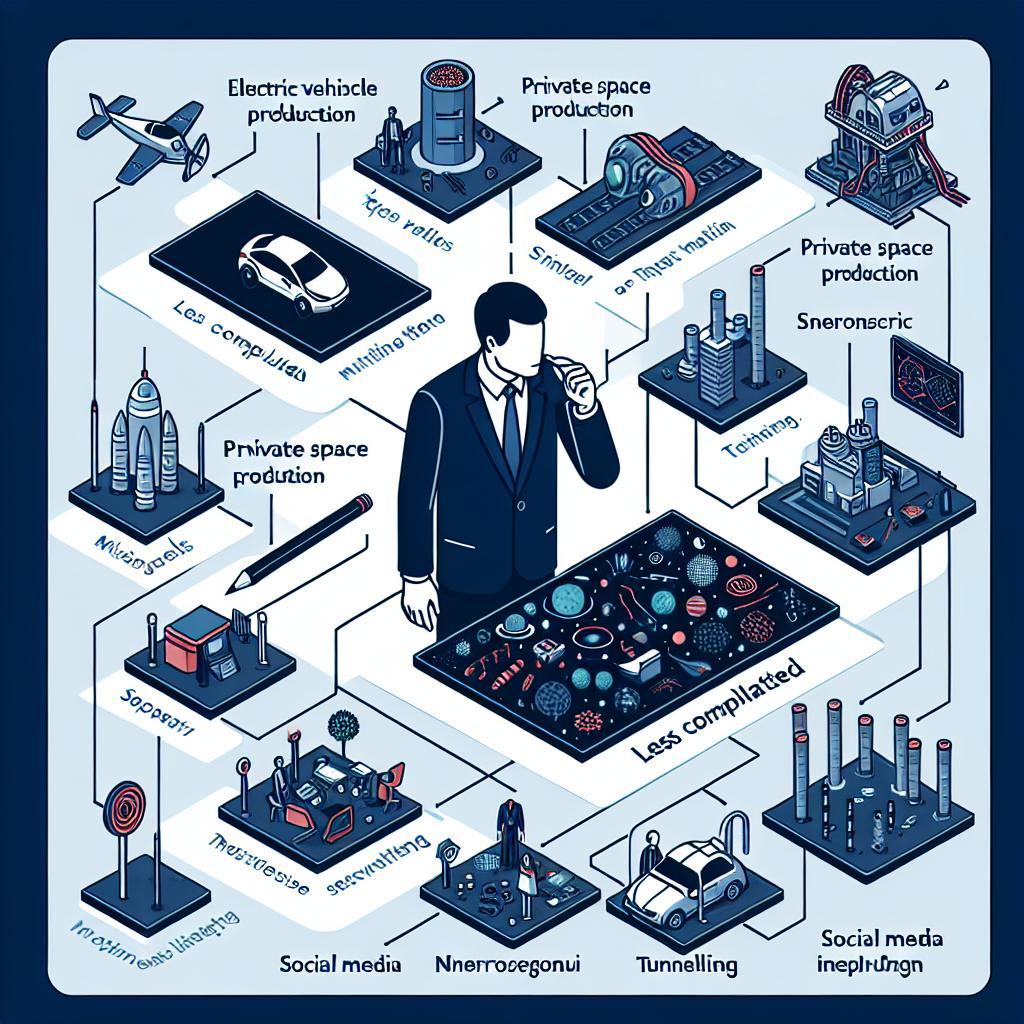
Elon Musk: Tech Visionary and His Portfolio of Companies

TABLE OF CONTENTS
- Summary
- Overview of Elon Musk's Business Portfolio
- Historical Accomplishments and Influence
- Industry Impact and Technological Innovations
- Management and Operational Challenges
- Conclusion
1. Summary
This report provides an extensive overview of Elon Musk's various business ventures and their impact across numerous industries. It discusses key companies under his direction, such as Tesla, SpaceX, Neuralink, The Boring Company, and X (formerly Twitter). The report explores Musk's entrepreneurial journey, the founding and development of these companies, and their specific goals and products. Highlights include Tesla's pioneering electric vehicles and sustainable energy solutions, SpaceX's breakthroughs in space travel and satellite internet through Starlink, Neuralink's advancements in brain-machine interfaces, The Boring Company's innovative tunneling projects, and the rebranding and strategic changes at X. Additionally, the report covers Musk's early ventures with Zip2 and X.com, and his substantial investments in SolarCity and OpenAI, emphasizing his role in advancing technology across multiple fields.
2. Overview of Elon Musk's Business Portfolio
2-1. Establishment of Tesla
Elon Musk co-founded Tesla in 2003, aiming to accelerate the world's transition to sustainable energy. Initially serving as a co-founder, investor, and board member, he took over as CEO in 2008. Tesla's first product, the Roadster, debuted in 2008, followed by the Model S sedan in 2012 and the Model X SUV in 2015. With the acquisition of SolarCity in 2016, Tesla became the world's first vertically-integrated sustainable energy company. Other significant releases include the Model 3, the Tesla Semi, Cybertruck, and Model Y.
2-2. Foundation and Progress of SpaceX
Founded in 2002 by Elon Musk, SpaceX is a spacecraft manufacturer and space launch provider. SpaceX's Falcon 1 was the first privately developed liquid fuel rocket to reach orbit in 2008, and the company made history in 2017 by re-flying both a Falcon 9 rocket and a Dragon spacecraft. The Falcon Heavy became the most powerful operational rocket with its first flight in 2018. SpaceX is also known for its Starlink satellite internet constellation and its goal of making humans multi-planetary with missions to Mars.
2-3. Developments in Neuralink
Neuralink, co-founded by Elon Musk in 2016, is a neurotechnology company developing brain-machine interfaces. Its goal is to create ultra-high bandwidth brain-computer interfaces to connect human brains with computers. The company aims to help people with paralysis and invent technologies that could expand human capacities and community integration. Recent advancements include devices tested on pigs and monkeys, and the company has received FDA approval for human trials.
2-4. The Boring Company's Innovations
Elon Musk founded The Boring Company in 2016 to address urban congestion through tunnel construction and all-electric public transportation systems. Known for creating rapid point-to-point transportation, the company has built a 1.7-mile R&D tunnel in Hawthorne and the Vegas Loop public transportation system under the Las Vegas Convention Center.
2-5. Acquisition and Rebranding of Twitter to X
Elon Musk acquired Twitter in 2022 for $44 billion, rebranding it to X. He made significant changes, including firing over 80% of staff, altering content policies, and introducing subscription services. As of March 2023, Musk admitted that Twitter had lost about half of its value. Linda Yaccarino from NBCU was appointed as the CEO to manage day-to-day operations.
2-6. Introduction to xAI
Founded in 2023, xAI is Elon Musk's latest venture aimed at creating an alternative to OpenAI's ChatGPT and other A.I. chatbots. xAI's mission is to 'understand the true nature of the universe,' employing former engineers and scientists from leading companies like OpenAI, DeepMind, Google, Microsoft, and Tesla. The company aims to address A.I. safety and advance artificial intelligence research.
3. Historical Accomplishments and Influence
3-1. Founding of Zip2 and X.com (PayPal)
Elon Musk co-founded Zip2 in 1995 alongside his brother Kimbal and Greg Kouri. The company developed an internet city guide with maps, directions, and yellow pages, and successfully marketed it to newspapers like The New York Times and Chicago Tribune. Compaq acquired Zip2 for $307 million in 1999, providing Musk with $22 million for his 7% share. In 1999, Musk co-founded X.com, an online financial services and email payment company. X.com merged with Confinity in 2000 to form PayPal, a highly popular online payment system. Musk initially served as CEO but was eventually replaced by Peter Thiel. PayPal was acquired by eBay for $1.5 billion in stock in 2002, netting Musk $176 million from his shares.
3-2. Musk’s Education and Early Life
Elon Musk was born on June 28, 1971, in Pretoria, South Africa. He lived primarily with his father after his parents' divorce. Musk attended various schools in South Africa and developed an interest in computing and video games at a young age. At 12, he sold a BASIC-based game called Blastar for approximately $500. After moving to Canada in 1989, he attended Queen's University before transferring to the University of Pennsylvania. He earned two degrees: a Bachelor of Arts in Physics and a Bachelor of Science in Economics from the Wharton School. Musk moved to California to pursue a Ph.D. at Stanford University but left the program after two days to pursue business ventures.
3-3. Investments in SolarCity and OpenAI
Elon Musk co-founded SolarCity in 2006, aiming to accelerate mass adoption of solar energy. SolarCity became a leading provider of solar energy services in the United States and was acquired by Tesla in 2016 for $2.6 billion, becoming Tesla Energy. In December 2015, Musk co-founded OpenAI, a nonprofit research company dedicated to advancing digital intelligence to benefit humanity. OpenAI focuses on ensuring that artificial general intelligence (AGI) benefits all of humanity and is aligned with human values and goals.
3-4. Wealth Accumulation and Net Worth
Elon Musk’s wealth has grown primarily through his stakes in several influential companies. After selling Zip2 and PayPal, he used the proceeds to fund new ventures, including SpaceX, Tesla, Neuralink, and The Boring Company. As of July 2024, Musk’s net worth is estimated by Forbes to be $221 billion, making him one of the wealthiest people in the world. Musk's continuous investments and entrepreneurial endeavors, notably in electric vehicles, space exploration, neurotechnology, and tunneling, have significantly contributed to his wealth. His portfolio includes Tesla, SpaceX, Neuralink, The Boring Company, and X (formerly Twitter), among others.
4. Industry Impact and Technological Innovations
4-1. Automotive Advances through Tesla
Tesla, founded in 2003, has revolutionized the automotive industry with its electric vehicles (EVs). Initially focused on sports cars with the Roadster, Tesla expanded its lineup to include the Model S sedan, Model X SUV, and the more affordable Model 3, which became the best-selling plug-in electric car worldwide. As of 2022, Tesla’s annual revenue was $81.5 billion, and it employed approximately 127,855 people. Despite facing lawsuits and government scrutiny, Tesla has maintained its position as a leader in the battery electric vehicle market, with an 18% global market share.
4-2. Clean Energy Initiatives
Tesla’s commitment to clean energy extends beyond automotive advancements. Through Tesla Energy, a subsidiary formed after acquiring SolarCity in 2016 for $3.2 billion, the company produces energy storage devices and solar panels. SolarCity, initially founded by Elon Musk’s cousins, was known for its customer-friendly door-to-door sales model of leased solar energy systems. Tesla Energy aims to create sustainable and renewable energy solutions, furthering Musk’s vision of a sustainable energy civilization.
4-3. Space Exploration and Telecommunications via SpaceX
SpaceX, established in 2002, aims to reduce space transportation costs and eventually colonize Mars. It is a spacecraft manufacturer, satellite communications company, and launch service provider. SpaceX achieved groundbreaking milestones, including the successful launch of the Falcon1 rocket in 2008 after initial failures, and it became the first private company to send a spacecraft to the International Space Station. As of 2022, SpaceX had over 13,000 employees and an annual revenue of $4.6 billion. The company’s Starlink subsidiary, which provides satellite internet coverage to over 60 countries, had over 1 million subscribers by the end of September 2023.
4-4. Brain-Machine Interface via Neuralink
Neuralink, founded in 2016, focuses on developing implantable brain-machine interfaces (BMI). The company aims to create devices that facilitate communication with phones and computers via implants in the human brain. Neuralink achieved significant milestones, including FDA approval for human trials in 2023. The company's early projects included a 'sewing machine' device for implanting threads into the brain. Neuralink employs approximately 300 people and has secured millions in funding for its neurotechnology advancements.
4-5. Tunnel Construction Techniques from The Boring Company
The Boring Company, founded in 2017, seeks to address traffic congestion issues through the construction of tunnels. Initially a subsidiary of SpaceX, it became a separate corporation in 2018. The company’s first major project was at the Las Vegas Convention Center, with two parallel tunnels opened in 2021 featuring Tesla vehicles. The Boring Company aims to make tunneling financially feasible for widespread intra-city transit systems. The company employs approximately 200 people and had an annual revenue of around $2.7 million as of its last financial reporting.
4-6. Artificial Intelligence Research with xAI
xAI, founded in 2023, is Elon Musk’s latest venture into artificial intelligence, aiming to provide an alternative to existing AI solutions like OpenAI’s ChatGPT. The company’s goal is to develop AI capable of advanced mathematical reasoning. xAI brings together experts from Google Research, Microsoft Research, and DeepMind, and focuses on creating an AI product that adheres to safety and ethical standards in AI development.
5. Management and Operational Challenges
5-1. Musk's Management of Multiple Companies
Elon Musk manages at least six companies: Tesla, SpaceX, The Boring Company, Neuralink, X (formerly Twitter), and xAI. With each company engaged in distinct industries, managing them poses significant challenges. Musk has stated that his days are long and complicated with a demanding schedule. In a leadership event in May, he mentioned that he regularly works 80 to 100 hours a week and tries to allocate specific days to focus on individual companies to manage his time better.
5-2. Time Allocation and Strategic Planning
Musk's approach to time management involves dividing his schedule such that he dedicates specific days to each company. This strategy helps him focus intensely on one company at a time, despite the complex and demanding nature of running multiple enterprises. For SpaceX, Musk relies heavily on Gwynne Shotwell, the company's president and COO, to manage day-to-day operations so he can concentrate on strategic planning and technological development. Similarly, for X, he appointed Linda Yaccarino as CEO to help manage the company's operations, allowing him to focus on broader strategic issues.
5-3. Innovation Amidst Controversy
Musk's companies are known for their innovative approaches and groundbreaking technologies across automotive, aerospace, tunneling, biotech, and artificial intelligence industries. However, his management style and decision-making processes have often been subject to criticism and controversy. For instance, Musk's acquisition of Twitter (now X) and the subsequent significant changes, including mass layoffs and revamping of content policies, have drawn widespread scrutiny. Despite these controversies, Musk continues to push forward with his vision to create transformative technologies and solutions.
6. Conclusion
Elon Musk's diverse portfolio of innovative companies underscores his transformative influence in areas spanning from automotive and clean energy to space exploration and artificial intelligence. Tesla's achievements have redefined the EV market and sustainable energy, while SpaceX has made space travel more accessible and aims for interplanetary colonization. Neuralink is pioneering neurotechnology with significant potential in medical applications, and The Boring Company offers novel solutions to urban congestion. The rebranding of Twitter to X and the creation of xAI illustrate Musk's ongoing commitment to cutting-edge technology and ethical AI development. These ventures, though not without controversy and challenges, highlight Musk's relentless drive to push the boundaries of what's possible. Looking ahead, the success of these enterprises could pave the way for significant technological advancements and industry paradigms. However, future research could benefit from deeper analysis into the practical applications and broader societal impacts of these technologies.