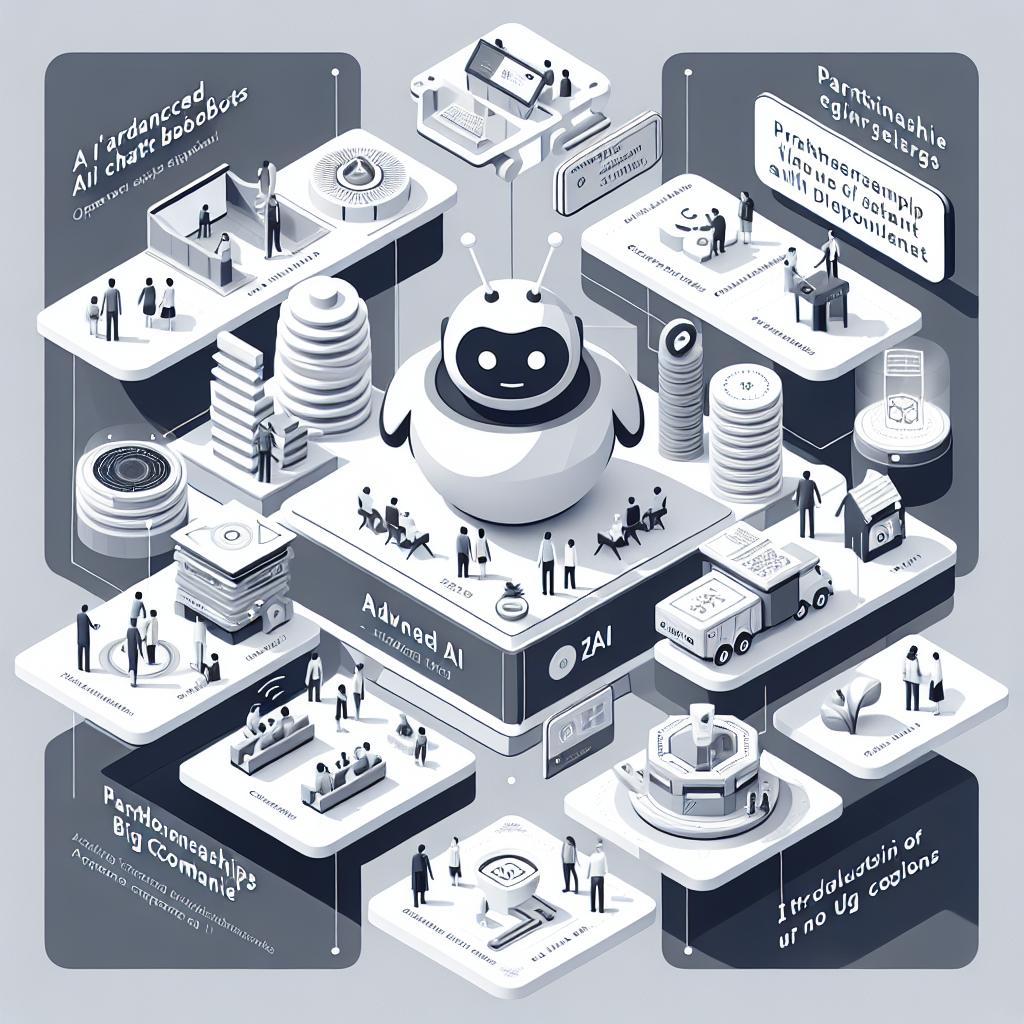
The Expansion and Controversies of ChatGPT: Key Developments and Partnerships by OpenAI

TABLE OF CONTENTS
- Summary
- Introduction to ChatGPT and Its Adoption
- Major Developments and New Features
- Partnerships and Collaborations
- Challenges and Controversies
- Competitive Landscape in Generative AI
- Conclusion
1. Summary
This report provides a comprehensive examination of ChatGPT, OpenAI's AI chatbot, covering its milestones, partnerships, and controversies up to June 2024. It highlights significant adoption rates among Fortune 500 companies, key partnerships like those with Apple and Microsoft, and the introduction of models such as GPT-4o and GPT-4 Turbo. The report also discusses the internal leadership changes, legal battles, and issues around the voice feature Sky that mimicked Scarlett Johansson's voice, leading to its suspension. Overall, the report aims to delineate OpenAI’s impact on the generative AI landscape, emphasizing strategic collaborations and ongoing technological and ethical challenges.
2. Introduction to ChatGPT and Its Adoption
2-1. History and Evolution of ChatGPT
ChatGPT, OpenAI’s text-generating AI chatbot, was launched in November 2022. Initially designed to hyper-charge productivity through writing essays and code with short text prompts, it evolved rapidly. By 2024, OpenAI introduced GPT-4o, a new flagship omni model for ChatGPT featuring voice and vision capabilities. It replaced older models and became the default free model. However, the introduction of GPT-4o was complicated by an issue where one of its voices, Sky, sounded similar to Scarlett Johansson’s voice in the movie “Her,” leading to its suspension. Additionally, ChatGPT's features continued to expand, with the rollout of a Mac desktop app and collaborations with significant partners like Apple, integrating ChatGPT into Siri and other applications across iOS, iPadOS, and macOS without requiring a ChatGPT or OpenAI account.
2-2. Adoption Among Fortune 500 Companies
Since its release, ChatGPT has seen remarkable growth and adoption, becoming a key tool for over 92% of Fortune 500 companies. Its popularity has driven significant revenue growth for OpenAI. Strategic deals have further solidified its position in the enterprise market. For instance, OpenAI signed a major deal with PwC to cover 100,000 users, making PwC the company's largest customer. Furthermore, OpenAI partnered with top publishers like The Atlantic and Vox Media, allowing the use of their content within ChatGPT, and inked deals with technology giants like Apple, integrating ChatGPT functionalities into their ecosystems. This widespread adoption highlights ChatGPT's versatility and effectiveness in various corporate settings, making it an indispensable tool for large enterprises.
3. Major Developments and New Features
3-1. Launch of GPT-4 and GPT-4o
OpenAI introduced GPT-4o as the new flagship model for ChatGPT in 2024. GPT-4o, which includes advanced voice and vision capabilities, quickly became the default free model for ChatGPT users. Despite its advanced features, the introduction of GPT-4o was not without issues. OpenAI had to pause the deployment of one of its voices, Sky, following allegations that it mimicked Scarlett Johansson's voice from the movie 'Her'.
3-2. Introduction of GPT-4 Turbo and Multimodal API
During OpenAI's first developer conference, OpenAI DevDay, several updates were announced, including GPT-4 Turbo and the multimodal API. GPT-4 Turbo offers enhanced capabilities over GPT-4, such as better writing, logical reasoning, and math skills. The multimodal API allows for integration of multiple input types, including text and images, thereby broadening the utility of the AI.
3-3. GPT Store and Integration with Platforms
OpenAI launched the GPT Store in January 2024, enabling users to create and monetize custom versions of GPT. Apple's WWDC 2024 event announced the integration of ChatGPT, powered by GPT-4o, into Siri and other Apple applications, enhancing the functionality of iOS, iPadOS, and macOS. Additionally, in June 2024, the MacOS desktop app was released, allowing users more seamless interaction with ChatGPT via keyboard shortcuts and the ability to upload files from their desktop environment.
4. Partnerships and Collaborations
4-1. Deals with The Atlantic, Vox Media, and PwC
The Atlantic and Vox Media have entered into licensing and product partnerships with OpenAI. These agreements enable OpenAI to use the publishers' current content to generate responses in ChatGPT, with relevant citations included. Vox Media plans to leverage OpenAI’s technology for 'audience-facing and internal applications,' while The Atlantic is developing a new experimental product called Atlantic Labs. Furthermore, OpenAI has signed a substantial deal with PricewaterhouseCoopers (PwC), which will cover 100,000 users and make PwC OpenAI’s largest customer to date. PwC is also the first partner to sell OpenAI's enterprise products to other businesses.
4-2. Collaboration with Apple to Enhance Siri
At Apple's WWDC 2024, it was announced that Siri will be enhanced by integrating ChatGPT, a development that will become part of Apple's broader generative AI push known as 'Apple Intelligence.' The integration, powered by GPT-4o, will enable Siri to offer more detailed and contextually relevant responses by linking commands and understanding context. For more complex requests, Siri can direct users to ChatGPT for more thorough answers. This collaboration aims to enable Siri to handle tasks such as writing emails, providing better contextual responses, and integrating with other Apple applications. The ChatGPT integrations are set to launch with iOS 18, iPadOS 18, and macOS Sequoia later this year and will be free to use without needing to create an account.
4-3. Partnerships with Reddit and News Corp
In May 2024, OpenAI and Reddit announced a partnership that provides OpenAI with access to Reddit’s real-time, structured content for use in ChatGPT. This collaboration aims to bring new AI-powered features to Reddit users and moderators. Additionally, OpenAI has signed a multi-year agreement with News Corp. which permits OpenAI to display content from its outlets within ChatGPT. These partnerships are pivotal for OpenAI, as they integrate diverse content sources to enhance the quality and relevance of ChatGPT’s responses.
5. Challenges and Controversies
5-1. Internal Drama and Leadership Changes
OpenAI has faced significant internal upheavals, notably marked by the departure of co-founder and longtime chief scientist Ilya Sutskever. His exit followed the dissolution of the Superalignment team, which was responsible for ensuring the alignment of AI development with human values and safety. This internal drama raises concerns about the stability and direction of OpenAI’s leadership. Furthermore, former OpenAI board member Helen Toner disclosed that the board was unaware of ChatGPT’s impending launch until it was publicly announced in November 2022. Toner also alleged that CEO Sam Altman provided inaccurate information regarding the company’s safety processes and did not disclose his involvement in the OpenAI Startup Fund.
5-2. Lawsuit from Alden Global Capital
OpenAI is currently embroiled in a lawsuit filed by Alden Global Capital-owned newspapers, including the New York Daily News and the Chicago Tribune. The lawsuit alleges that OpenAI, along with Microsoft, engaged in copyright infringement by using millions of copyrighted articles without permission or compensation to train ChatGPT and Microsoft's Copilot. This legal challenge follows a similar lawsuit filed by The New York Times last year, underscoring ongoing concerns about the ethical and legal implications of using copyrighted material for AI training.
5-3. Controversies Surrounding Voice Features
One of the more high-profile controversies surrounds the introduction of ChatGPT's voice features, particularly the voice known as ‘Sky’. After its demo, users pointed out that Sky's voice closely resembled Scarlett Johansson’s voice in the movie 'Her’. This led to allegations of unauthorized imitation, causing OpenAI to pause the use of Sky while addressing these concerns. The House Oversight Subcommittee on Cybersecurity, Information Technology, and Government Innovation has invited Scarlett Johansson to testify about this controversy, highlighting broader concerns about deepfake technology and its implications. Additionally, OpenAI's plans to roll out an advanced Voice Mode feature were delayed due to lingering issues, further complicating the rollout of these new capabilities.
6. Competitive Landscape in Generative AI
6-1. OpenAI’s Position Among Major Tech Companies
OpenAI, a leading player in the generative AI sector, has achieved significant growth and visibility, particularly through its strategic partnerships. These partnerships include major tech companies, most notably Microsoft and Apple. Microsoft's extensive investments in OpenAI have bolstered both companies' standings in the AI field. Specifically, Microsoft invested $13 billion in OpenAI, focusing on the latter's cloud services, which are integral to training and operating large language models (LLMs). Furthermore, the relationship is mutually beneficial, with OpenAI utilizing Microsoft's cloud infrastructure to support its AI operations. Additionally, OpenAI's collaboration with Apple is poised to expand its reach even further by integrating ChatGPT into Apple's next generation of iPhones. This partnership could potentially catalyze new revenue streams for Apple, such as increased device sales and higher advertising revenues. Although both Microsoft and Apple are key allies, these partnerships underscore OpenAI's reliance on other companies for critical cloud services and market access.
6-2. Impact of Partnerships with Microsoft and Other Tech Giants
The partnerships between OpenAI, Microsoft, and Apple have substantial implications for the landscape of generative AI. OpenAI's relationship with Microsoft has been pivotal, with Microsoft's financial and infrastructural support playing a crucial role in OpenAI's expansion and operational capacity. The partnership with Apple takes this a step further by possibly integrating OpenAI's AI technology into billions of Apple devices, enhancing both companies' positions in the AI market. This collaboration is expected to significantly enhance Apple's AI capabilities, particularly with an anticipated upgrade to Siri, transforming it into a more sophisticated virtual assistant. These partnerships also present a complex dynamic between competition and collaboration among tech giants, as each company seeks to leverage the others' strengths while advancing their own strategic interests.
6-3. Strategies by Competitors in the AI Race
While OpenAI, Microsoft, and Apple are closely collaborating, their respective strategies in the AI race highlight different approaches and competitive edges. Microsoft has diversified its investments across various AI startups, including a significant capital injection into Inflection, a rival AI company. This move indicates Microsoft's effort to build and control its AI models independently of OpenAI. Apple, on the other hand, has been late to the AI game but intends to leverage its vast user base and trusted brand to integrate advanced AI capabilities into its products. Despite these efforts, Nvidia emerges as a potential leader in the generative AI sector. Nvidia's dominance is underpinned by its focused role in providing essential GPU hardware for AI applications, embodying a more specialized strategy compared to the multi-faceted approaches of Microsoft and Apple. Consequently, while the partnerships and individual strategies of OpenAI, Microsoft, and Apple reflect a collaborative yet competitive market, Nvidia's consistent innovations in GPU technology position it as a key player with a unique competitive advantage.
7. Conclusion
The findings elucidate OpenAI's strategic moves and the pivotal role of ChatGPT in revolutionizing AI interaction, particularly through collaborations with industry giants like Apple and Microsoft. Despite these advancements, OpenAI faces substantial challenges, including internal disagreements and legal disputes that could impede its progress. These issues underscore the complexity and dynamic nature of the generative AI market. The future success of OpenAI hinges on continuous innovation, solidifying partnerships, and effective leadership. While promising, these challenges highlight the necessity for resilience and adaptability in the highly competitive AI industry. Moreover, addressing the ethical and legal implications of AI technology will be critical for sustainable growth and public trust in OpenAI's developments.