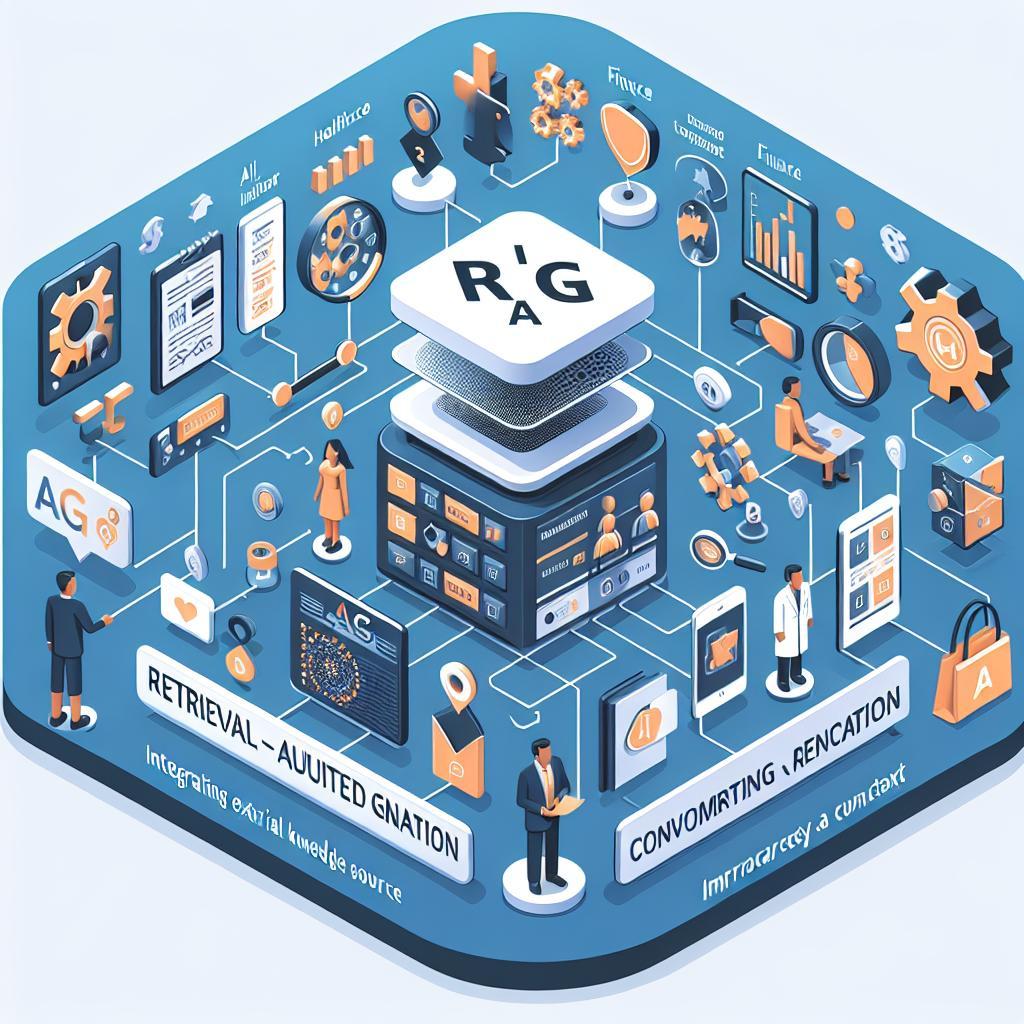
Enhancing AI Accuracy and Context: Understanding Retrieval-Augmented Generation (RAG)

TABLE OF CONTENTS
- Summary
- Introduction to Retrieval-Augmented Generation (RAG)
- Mechanisms and Workflow of RAG
- Applications of RAG
- Technological Frameworks and Practical Implementations
- Challenges and Considerations in RAG
- Advancements and Future Directions
- Conclusion
1. Summary
The report titled 'Enhancing AI Accuracy and Context: Understanding Retrieval-Augmented Generation (RAG)' provides a detailed examination of Retrieval-Augmented Generation (RAG), an advanced AI technique that enhances the capabilities of large language models (LLMs) by incorporating external knowledge sources. The purpose of the report is to explore how RAG improves AI-generated responses in terms of accuracy, relevance, and contextual richness. Key findings include the motivations behind RAG, such as overcoming the limitations of static LLMs, and the mechanisms like neural retrieval processes and RAG pipeline stages. The report also highlights various applications of RAG in sectors such as customer support, healthcare, finance, and personalized learning, emphasizing its transformative potential. Additionally, technological frameworks like NVIDIA NeMo and the challenges involved, such as complexity and data quality maintenance, are discussed. The advancements and future directions in RAG, including the RAG 2.0 model and significant research contributions, are also covered.
2. Introduction to Retrieval-Augmented Generation (RAG)
2-1. Definition and Core Concepts of RAG
Retrieval-Augmented Generation (RAG) is an advanced artificial intelligence (AI) technique designed to enhance the capabilities of large language models (LLMs). Traditional LLMs generate text based on pre-existing datasets, but they can struggle to provide accurate, up-to-date, and reliable information. RAG addresses this limitation by integrating external data sources, ensuring that responses are precise and current. The core components of RAG include: 1. Large Language Models (LLMs): These AI models, such as GPT-3 or GPT-4, are trained on extensive datasets to generate human-like text. 2. External Knowledge Bases: These are authoritative and frequently updated data sources, including databases, APIs, and document repositories. 3. Information Retrieval Mechanism: This component retrieves relevant information from external sources based on the user's query, feeding the most pertinent and up-to-date data into the LLM.
2-2. Motivations Behind RAG Development
The main motivation behind developing Retrieval-Augmented Generation (RAG) is to overcome the limitations of traditional large language models (LLMs). Clients often possess extensive proprietary documents, such as technical manuals, and require specific information extraction from a vast amount of content. Traditional LLMs rely on static training data, which can become outdated and may not cover all necessary information. RAG enhances LLMs by allowing them to access and integrate external knowledge bases in real-time. This ensures the AI can provide more accurate, specific, and fresh information, improving reliability and usefulness. A notable issue with models like OpenAI’s GPT-4 is the 'Lost In The Middle' phenomenon, where the model forgets content located towards the middle of its contextual window. RAG mitigates this by indexing paragraphs and retrieving only the most relevant ones for the query, significantly enhancing the quality and context of generated responses without information overload.
3. Mechanisms and Workflow of RAG
3-1. Neural Retrieval Process
Neural retrieval is a type of information retrieval model that uses neural networks to match queries to relevant documents by encoding them into dense vector representations. Having been trained on large datasets of text, these models can understand the semantic context, moving beyond traditional keyword matching. The core processes involve vector encoding, semantic matching, and advantages such as understanding context, dealing with long queries, and handling multilingual data. However, challenges include significant computational power, dependency on training data quality, and the need to keep representations current, especially for dynamic content.
3-2. RAG Pipeline Stages
The RAG pipeline integrates a retriever model with a language model to leverage external knowledge. The stages include: 1. Ingestion - breaking down documents into smaller chunks for better retrieval accuracy; 2. Retrieval - utilizing mechanisms like vector, graph, or SQL databases to find relevant data based on semantic similarity or structured relationships; and 3. Synthesis/Response Generation - combining retrieved data with user queries to generate context-aware responses. The retriever can employ methods like Approximate Nearest Neighbors for efficient data retrieval. Distinct database choices and chunking sizes impact retrieval precision and overall system effectiveness.
3-3. Evaluation Metrics for Retrieval and Generation
Evaluation metrics for RAG systems are critical for assessing their effectiveness. Retrieval metrics include context precision, context recall, and context relevance—evaluating how accurately and comprehensively the system retrieves relevant information. Generation metrics involve groundedness (faithfulness), answer relevance, semantic similarity, and answer correctness—ensuring the generated responses are accurate, contextually appropriate, and factual. End-to-end evaluation methods measure overall performance by combining these metrics, providing a comprehensive view of the system’s accuracy and utility.
4. Applications of RAG
4-1. Customer Support
Retrieval-Augmented Generation (RAG) is particularly beneficial in customer support scenarios. By referencing up-to-date product manuals, FAQs, and support documents, RAG ensures that the responses provided to customers are accurate, relevant, and timely. This integration of real-time information retrieval enhances the capacity of AI systems to address customer queries effectively, increasing user satisfaction and trust.
4-2. Healthcare
In the healthcare sector, RAG significantly improves the delivery of up-to-date medical information. By accessing current research papers, medical databases, and guidelines, AI systems using RAG can provide accurate and current medical advice. This capability is crucial in healthcare, where the latest information can have substantial impacts on patient outcomes and medical practices.
4-3. Finance
The finance industry benefits from RAG's ability to deliver precise financial advice and information. By referencing real-time market data and financial reports, AI systems can offer accurate and timely financial insights. This enhances the decision-making process for financial professionals and helps in providing reliable advice to clients based on the most recent data available.
4-4. Personalized Learning
RAG is also a powerful tool in personalized learning environments. By sourcing reliable information from textbooks, academic journals, and educational websites, it can assist students with accurate and current educational content. This approach ensures that learners receive the most relevant information, tailored to their individual educational needs, thereby enhancing the overall learning experience.
5. Technological Frameworks and Practical Implementations
5-1. Integration with APIs
Integrating RAG systems with APIs is fundamental for accessing external data sources. APIs facilitate seamless communication between the RAG system and various databases or knowledge bases. They enable dynamic data retrieval, which enriches the RAG's responses with up-to-date information. This integration is crucial, as it allows RAG systems to remain relevant and accurate by continuously pulling in the latest data available. For instance, using APIs can help customer service applications by providing precise and contextually appropriate answers to user queries.
5-2. Customizing and Fine-tuning
Customizing and fine-tuning RAG systems are essential steps in their implementation. Fine-tuning involves adjusting the RAG model to fit specific application needs, which can significantly enhance the relevance and accuracy of the generated responses. This process might include integrating proprietary data sources or modifying the retrieval mechanisms to better suit the task at hand. Additionally, platforms like NVIDIA's NeMo provide frameworks that support the customization and fine-tuning of RAG systems, enabling developers to optimize performance for specific use cases such as customer support, financial analysis, or personalized recommendations.
5-3. Platform-based Setups like NVIDIA's NeMo
Setting up a RAG system can be streamlined using platforms like NVIDIA's NeMo. These platforms offer comprehensive frameworks designed to build and customize RAG systems efficiently. For example, NVIDIA's NeMo provides tools for integrating RAG with tailored databases or knowledge bases, ensuring access to the most relevant information. Additionally, NeMo comes with sample applications that demonstrate RAG in action, which can be modified according to the specific needs of the user. This platform-based setup helps in reducing the complexity of building RAG systems and allows for practical and scalable implementations across various industries.
6. Challenges and Considerations in RAG
6-1. Complexity and Latency Issues
Retrieval-Augmented Generation (RAG) inherently involves the integration of both retrieval and generation models, which adds layers of complexity. This heightened complexity requires careful tuning and optimization to ensure that both components work seamlessly together. One major issue that arises from this complexity is latency. The retrieval step, which involves fetching relevant data from external sources, can introduce delays. This latency can be particularly problematic in real-time applications where timely responses are crucial. For example, the retrieval step can be time-consuming when accessing large knowledge bases or databases, thus slowing down the overall response generation process.
6-2. Maintaining Data Quality and Updates
Another significant challenge in RAG systems is ensuring the quality and currency of the data used. RAG relies on external data sources to provide up-to-date and relevant information, but this dependency on external data comes with risks. If the data sources are outdated or contain inaccuracies, the RAG system can generate incorrect or misleading responses. This challenge necessitates ongoing efforts to maintain and update data sources to ensure that the generated content is reliable. For example, RAG systems that are integrated into customer service applications must frequently update their databases with the latest product information, user manuals, and policies to provide accurate answers.
6-3. Addressing Bias and Fairness
Bias and fairness are critical considerations for RAG models, much like other AI systems. RAG models may inherit biases present in the training data or the retrieved documents, potentially resulting in biased or unfair outputs. This can degrade user trust and compromise the system's reliability. For instance, a RAG system used in healthcare may inadvertently favor certain demographics over others if the underlying data sources contain inherent biases. Addressing these issues requires implementing mechanisms to detect and mitigate biases actively and ensuring that the model's outputs are fair and equitable across different user groups.
7. Advancements and Future Directions
7-1. Latest Developments in RAG Systems
According to the documentation, one of the notable advancements in Retrieval-Augmented Generation (RAG) systems is the RAG 2.0 model. This iteration aims to improve upon the initial RAG design by incorporating more efficient retrieval mechanisms and better context handling. Additionally, the Neural Retrieval method has seen significant enhancements. Neural retrievers, which use neural networks to match queries to relevant documents, have been optimized for better performance and reduced computational costs. They can understand the context and capture semantic relevance, which traditional keyword-based systems struggle with. These improvements have been facilitated by better encoding techniques and training on massive multilingual datasets. Moreover, hybrid models combining the strengths of Graph and Vector Databases have been proposed, although practical implementations for such hybrids are still under exploration. Leveraging multiple retrievers and ensembling RAG systems has also been highlighted as a substantial upgrade to improve text generation, which involves combining outputs of several RAG models and refining them for better accuracy.
7-2. Selected Research Papers and Studies
The documentation lists several key research papers that have contributed to the advancements in RAG systems. Notable papers include 'Retrieval-Augmented Generation for Knowledge-Intensive NLP Tasks', which introduces the framework and evaluates its effectiveness in complex queries, and 'Active Retrieval Augmented Generation', which explores dynamic retrieval strategies to adapt to different query complexities. 'MuRAG: Multimodal Retrieval-Augmented Generator' extends RAG capabilities to include multimodal data sources like images and tables. 'Hypothetical Document Embeddings (HyDE)' proposes a new embedding method to improve retrieval accuracy. 'RAGAS: Automated Evaluation of Retrieval-Augmented Generation' offers an evaluation framework for assessing RAG system performance. Other significant studies address issues like choosing optimal retrieval granularity ('Dense X Retrieval: What Retrieval Granularity Should We Use?') and tackling biases to generate more balanced outcomes ('Corrective Retrieval Augmented Generation'). These papers collectively underscore the diverse approach researchers are taking to augment, optimize, and validate RAG systems.
8. Conclusion
Retrieval-Augmented Generation (RAG) represents a major advancement in artificial intelligence by combining retrieval-based and generative models to deliver more precise and context-aware responses. This technology is poised to revolutionize various industries, as evidenced by its applications in customer support, healthcare, finance, and personalized learning. The significance of RAG lies in its ability to provide accurate, up-to-date information by integrating external knowledge sources in real-time, thereby overcoming the limitations of traditional LLMs. However, several challenges need to be addressed for RAG to achieve optimal performance. These include managing the complexity and latency of integrating retrieval and generation models, maintaining data quality and updates, and addressing biases to ensure fairness and reliability. Moving forward, ongoing research and innovations, such as the development of RAG 2.0 and hybrid models, will likely enhance the effectiveness and applicability of RAG systems. Practical frameworks like NVIDIA NeMo also facilitate the efficient setup and deployment of RAG systems. By addressing current limitations and leveraging future advancements, RAG holds the potential to significantly improve the accuracy and reliability of AI applications across diverse fields.