The Impact of AI Copilots on Data Transformation and Workplace Productivity

TABLE OF CONTENTS
- Summary
- Introduction to AI Copilots
- Data Transformation with AI Copilots
- AI Copilots in the Workplace
- Microsoft Copilot: Advancing Learning and Leadership
- Conclusion
1. Summary
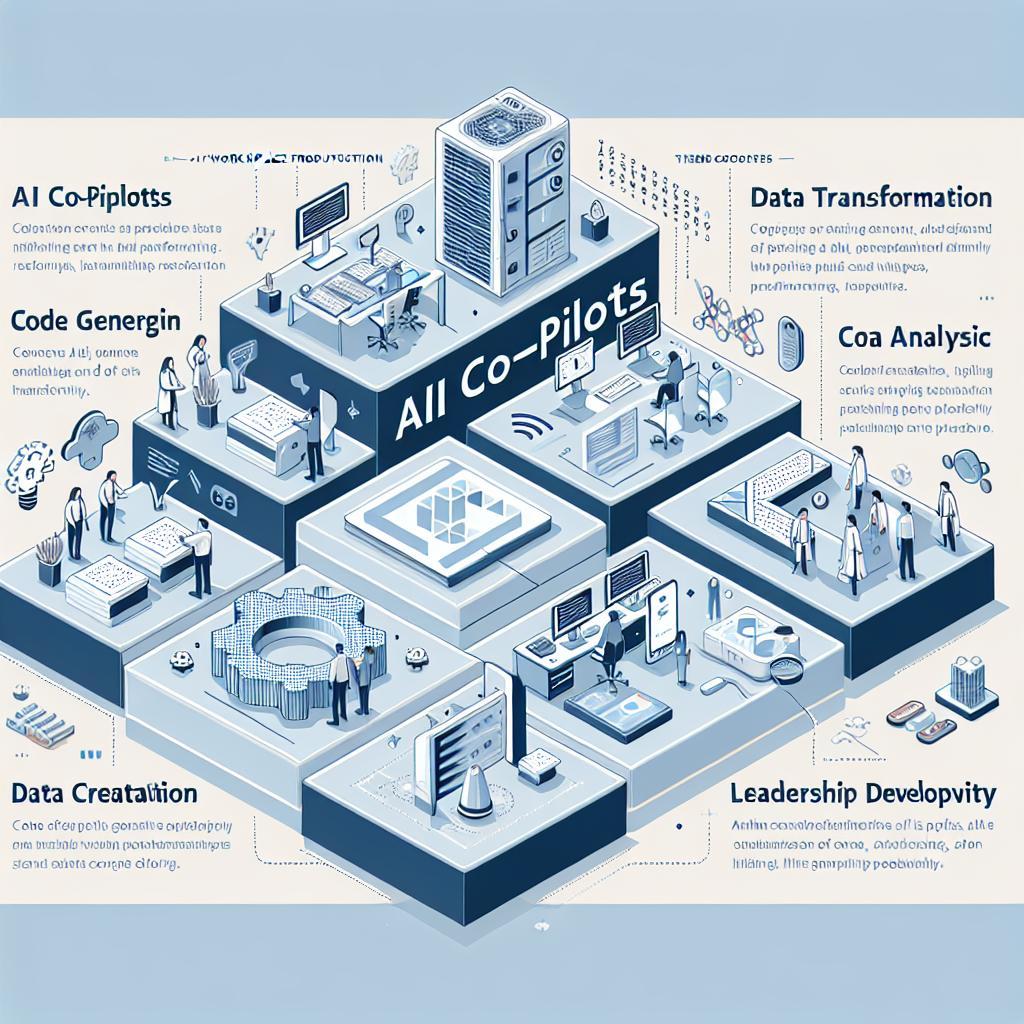
The report titled 'The Impact of AI Copilots on Data Transformation and Workplace Productivity' delves into how AI copilots, such as Github Copilot and Microsoft Copilot, are revolutionizing tasks related to data transformation and workplace productivity. The primary focus is on generative AI tools, their integration, and best practices. Key findings include the significant productivity improvements observed in programming and data-related tasks, the role of AI copilots in various sectors, and the categorization of AI copilots based on their applications. The report emphasizes their utility in code generation, data analysis, content creation, and leadership development, acknowledging the challenges and considerations necessary for effective implementation.
2. Introduction to AI Copilots
2-1. Definition and role of AI copilots
AI copilots are advanced artificial intelligence systems designed to assist users with various tasks by leveraging large language models (LLMs) to process and respond to user inputs in a manner similar to human interaction. They enhance user experiences and support decision-making processes, thus boosting productivity across multiple domains. AI copilots are integrated into different applications and environments, providing considerable value by automating, augmenting, or assisting specific functions. This technology has seen rapid adoption across diverse sectors, such as finance, healthcare, and retail planning, highlighting its transformative potential.
2-2. Overview of generative AI tools
Generative AI tools like Github Copilot and Microsoft Copilot exemplify the capabilities of AI copilots. These tools use massive datasets to train LLMs, enabling them to make educated predictions and provide useful suggestions in their respective fields. Github Copilot, for instance, has been reported to improve productivity by more than 50%, with adoption by over 50,000 businesses including a third of the Fortune 500. These tools are particularly effective in programming due to the structured nature of code, allowing large language models to excel. Additionally, various AI copilots support different applications beyond code generation, such as data analysis, content creation, and workflow automation. However, the implementation of AI copilots comes with necessary challenges and considerations, such as ensuring human oversight and adapting to the specific requirements of each domain.
3. Data Transformation with AI Copilots
3-1. Limitations of Traditional Data Transformation Approaches
Traditional data transformation approaches have significant limitations. The two primary methods currently in practice fail to provide clean, trusted, and timely data for analytics and AI. Legacy ETL products, such as Informatica and Alteryx, were designed for a different era. They face issues including reliance on proprietary formats, scalability problems, and extensibility limitations. As they often need to resort to SQL pushdown or generate inefficient code for platforms like Apache Spark to scale, these approaches fall short in the modern landscape. Additionally, manual code development, although powerful, suffers from non-standardization over time, limited tooling support, and accessibility challenges for non-coders.
3-2. Productivity Gains with AI Copilots
The integration of AI copilots has shown substantial productivity gains, particularly in programming and data-related tasks. GitHub Copilot, for example, claims over 50% productivity improvement and has been adopted by more than 50,000 businesses, including a third of the Fortune 500 companies. AI copilots enable the automation of repetitive tasks, democratize access to data-related processes, and enhance productivity for data users across the board. They provide tools that allow data engineers, analysts, and scientists to focus on more complex and valuable tasks, resulting in significant efficiency improvements.
3-3. Integration and Functionality of Copilot Plugins
Copilot plugins are an essential feature that supports AI copilots' integration with cloud data platforms. They enable the use of standard formats like Python and SQL to develop code and run pipelines without closed dependencies, avoiding vendor lock-in. Copilot plugins make developing standards and frameworks accessible to all data users through both code and visual interfaces. These integrations ensure that the entire lifecycle—from development to deployment and observability—is covered, improving overall data handling and transformation processes significantly. The AI copilots operate as AI companions, providing native support for platforms such as Databricks and Snowflake, making data users more productive without needing to understand the underlying complexity of the platforms.
4. AI Copilots in the Workplace
4-1. Categorization of AI Copilots
AI copilots are categorized into four types: Specialized GPT Apps, AI Chatbots, AI Assistants, and Full AI Copilots. 1. **Specialized GPT Apps**: These use models like OpenAI’s ChatGPT for specialized tasks. They are easy to set up and effective for niche tasks, but limited by the scope of data they are trained on and the API interfaces they utilize. 2. **AI Chatbots**: Focused on customer support, these handle routine inquiries using preexisting documentation. They reduce workload on support staff but are limited in handling complex requests. 3. **AI Assistants**: These can execute actions based on user commands, such as scheduling or controlling smart devices. While they boost productivity by automating tasks, they are dependent on the compatibility of APIs. 4. **Full AI Copilots**: Offering comprehensive solutions, these understand context, anticipate needs, and provide tailored advice. They require deep integration with data platforms and sophisticated API interactions, making them resource-intensive to develop.
4-2. Applications in Customer Support, Task Execution, Advisory Services, and Code Generation
AI copilots are used in various applications across different roles and areas: 1. **Customer Support**: AI Chatbots manage high volumes of customer inquiries by scanning databases of user manuals and FAQs to provide relevant information quickly. They significantly reduce the workload on human support staff. 2. **Task Execution**: AI Assistants enhance productivity by automating routine tasks such as scheduling appointments, controlling smart devices, and initiating workflows. For example, smartphone AI assistants like Siri and Alexa fall into this category. 3. **Advisory Services**: Full AI Copilots help in complex decision-making by providing strategic insights and predictive assistance. They integrate deeply with internal and external data platforms to offer comprehensive action delivery. GitHub Copilot, which assists in code generation, is an example, improving developer task completion by 55%. 4. **Code Generation**: AI copilots like GitHub Copilot assist developers by making predictions and providing advice during coding, streamlining the software development process.
4-3. Best Practices for Integration and Human Oversight
Effective integration and human oversight are crucial for maximizing the benefits of AI copilots. 1. **Select Appropriate AI Copilot**: Choose a copilot that fits the specific needs, such as language understanding or data analysis. Research different technologies to find the best match. 2. **Start With Targeted Pilots**: Deploy AI copilots in areas most likely to benefit from improved efficiency, like customer support or project management. This approach helps in assessing impact and addressing challenges on a manageable scale. 3. **Consider Hands-On Training and Scenario Testing**: Train staff to interact with AI copilots as collaborative partners. Encourage critical evaluation of AI suggestions and use regular scenario testing to ensure reliability and precision. 4. **Balance Speed With Human Creativity**: Employ AI copilots for tasks requiring speed and accuracy, while human professionals focus on creativity, problem-solving, and strategic thinking. This balance maintains innovation and enhances overall productivity.
5. Microsoft Copilot: Advancing Learning and Leadership
5-1. Applications in Learning and Leadership
The Everyday AI podcast episode highlights the transformative impact of Microsoft Copilot in corporate learning and leadership. Microsoft Copilot offers a game-changing approach to accessing and utilizing corporate and personal data within the Microsoft ecosystem, enabling enterprise leaders to effectively differentiate and leverage data. By harnessing Copilot, organizations can accelerate the creation of learning materials, workshops, and simulations, thus empowering leaders to navigate challenging situations, improve team understanding, and set clear expectations.
5-2. Impact of Generative AI on Corporate Data and Material Development
The transformative role of generative AI is emphasized in the speed and efficiency of material development and the ability to simulate and iterate quickly. Copilot facilitates the acceleration of creating learning materials and simulations, critical for leadership development. Leaders can utilize Copilot's capabilities to summarize information, generate content, and automate routine tasks, thereby focusing on more strategic initiatives. This results in improved decision-making processes and enhanced team understanding.
5-3. Challenges and Opportunities in Leveraging AI Tools
Despite its vast potential, the episode also discusses the challenges in leveraging generative AI tools like Microsoft Copilot. Key hurdles identified include skilling, adoption, and the need for leaders to embrace the rapid pace of technological change. However, the podcast emphasizes the importance of personal responsibility for growth and provides practical tips to address these challenges, thereby empowering leaders to navigate the evolving landscape of AI confidently. It highlights the need for effective integration and human oversight to maximize the benefits of AI tools and mitigate potential risks.
6. Conclusion
AI copilots, including Github Copilot and Microsoft Copilot, have showcased remarkable effectiveness in improving productivity and efficiency in data transformation and workplace activities. These tools leverage Generative AI to automate mundane tasks, enabling professionals to focus on more complex and strategic endeavors. The main takeaway is the transformative impact these tools have, with Github Copilot boosting programming productivity by over 50% and Microsoft Copilot accelerating material development for corporate learning and leadership. Nonetheless, potential challenges such as the need for human oversight and domain-specific adaptations must be addressed to fully harness their benefits. Future prospects suggest even broader applications as AI technology continues to evolve. Practically, organizations adopting AI copilots can anticipate streamlined operations and enhanced strategic capabilities, provided they integrate these tools thoughtfully and maintain a balance between automation and human creativity.