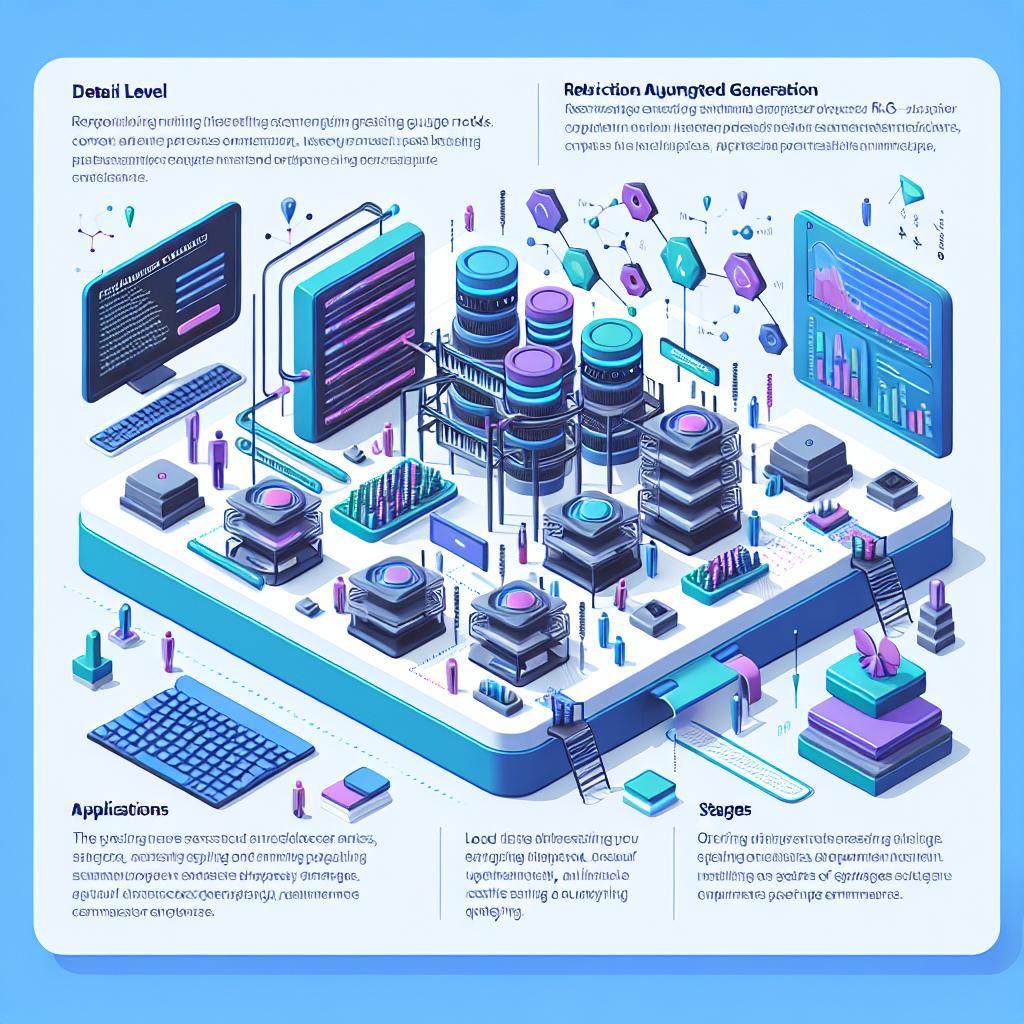
Understanding Retrieval-Augmented Generation (RAG): Concepts, Processes, and Applications

TABLE OF CONTENTS
- Summary
- Introduction to Retrieval-Augmented Generation (RAG)
- Stages of RAG
- Use Cases of RAG
- Advanced Topics in RAG
- Components of RAG Systems
- RAG Evaluation and Customization
- Benefits of Using RAG
- Conclusion
1. Summary
The report titled "Understanding Retrieval-Augmented Generation (RAG): Concepts, Processes, and Applications" provides a comprehensive analysis of the RAG methodology. It explains the high-level concepts, stages, applications, and advanced topics related to RAG. The key components and processes of RAG, including Loading, Indexing, and Querying, are discussed in detail. The report outlines how RAG systems retrieve relevant information from external sources and incorporate it into the generated responses to enhance language model outputs. Significant advantages of RAG include its ability to incorporate up-to-date knowledge and improve the accuracy and contextual relevance of language generation without retraining the models. The use cases highlighted include prompting, question-answering, chatbots, and AI agents. Furthermore, the report covers advanced customization options like custom agents, multi-modal applications, fine-tuning, and various evaluation methods, showing how RAG can be tailored to specific needs and evaluated for performance.
2. Introduction to Retrieval-Augmented Generation (RAG)
2-1. Definition of RAG
Retrieval-Augmented Generation (RAG) is a technique that enhances language model outputs by incorporating external knowledge. Instead of relying solely on pre-trained weights, RAG retrieves relevant information from a corpus of documents and uses this information to inform and enrich the generated responses. By doing so, RAG overcomes limitations of traditional language models which might not have access to the most up-to-date or specific data. The core idea behind RAG is to blend generative capabilities with retrieval-based strategies to achieve more accurate, contextually relevant, and informed outputs.
2-2. Core Components and Processes
The core components and processes of RAG are detailed in the documented source materials as follows: 1. **Loading Stage**: This involves the ingestion or loading of data into the system. Data can be fed from various external sources such as databases, documents, or other repositories. 2. **Indexing Stage**: Once the data is loaded, it is indexed, typically by transforming the data into dense vector embeddings using models such as BERT. The indexing mechanism allows the system to organize and store information in a way that supports efficient retrieval operations. 3. **Querying Stage**: When a query is made, the system retrieves relevant information from the indexed data. This retrieval process can employ various techniques such as vector similarity searches to identify and fetch the most pertinent data chunks. 4. **Combining Data for Generation**: The retrieved information is combined with the user's query to form an enriched prompt. This enriched prompt is then used by the language model to generate the final output. This ensures the generated text is both context-aware and factually accurate. 5. **Neural Retrieval**: Neural retrievers are a key part of RAG, encoding both queries and documents into high-dimensional vectors and computing their similarity. This allows for more semantically relevant matches compared to traditional keyword-based methods. 6. **Advantages and Disadvantages**: RAG provides the benefit of incorporating external knowledge without necessitating the retraining of language models. However, it is dependent on the quality and comprehensiveness of the retriever's knowledge base. Ensuring up-to-date and unbiased data in the retriever remains a challenge. These stages illustrate the systematic approach RAG employs to enhance the capabilities of language models by integrating external knowledge bases effectively.
3. Stages of RAG
3-1. Loading
The Loading stage is the initial phase in Retrieval-Augmented Generation (RAG). During this stage, raw data is ingested into the system. The data can come from various sources such as documents, databases, APIs, or any other structured or unstructured data repositories. This stage involves processes like data extraction and metadata tagging, ensuring that the information is ready for subsequent indexing. This process is critical to set the foundation for efficient indexing and querying.
3-2. Indexing
The Indexing stage involves organizing the ingested data into a structured format that allows for efficient retrieval. In RAG, indexing often includes embedding the data items into a high-dimensional vector space, which is suitable for similarity search. Techniques like vector stores are used to store these embeddings, enabling quick and accurate retrieval during the querying phase. Indexing plays a crucial role in reducing the retrieval time and enhancing the performance of the language models by making relevant information easily accessible.
3-3. Querying
The Querying stage is where the actual retrieval process occurs. Based on the user's query, the system searches through the indexed data to find the most relevant information. This stage may involve multiple steps like receiving the query, transforming it into a suitable format, and searching the vector space or other indexed structures to fetch the best matches. The retrieved information is then used to augment the language generation process, providing more context, accuracy, and relevance to the generated output. This stage is integral for making RAG systems effective in real-world applications by integrating external knowledge seamlessly.
4. Use Cases of RAG
4-1. Prompting
Prompting involves the utilization of RAG models to generate contextually accurate responses based on specific input prompts. By leveraging external knowledge bases, RAG enhances the quality and relevance of the generated outputs. This approach is particularly useful in scenarios where detailed and contextual information is crucial for the responses.
4-2. Question-Answering
RAG models excel in question-answering tasks by integrating large-scale external knowledge sources. This capability allows for precise and accurate answers to user queries. The process involves retrieving the most relevant information from external databases and generating coherent and contextually appropriate answers, thereby improving the overall effectiveness of question-answering systems.
4-3. Chatbots
Chatbots powered by RAG benefit from the integration of external knowledge which significantly enhances their conversational abilities. RAG-enabled chatbots can provide more informative and accurate responses by pulling relevant information from a wide array of external sources. This not only improves user satisfaction but also makes the interactions more dynamic and contextually relevant.
4-4. Agents
Agents utilizing RAG can perform tasks with a higher degree of accuracy and contextual understanding. These agents are capable of fetching pertinent information from external databases, allowing them to execute complex queries and provide sophisticated responses. This makes RAG an indispensable tool in developing reliable and efficient AI agents.
5. Advanced Topics in RAG
5-1. Custom agents
Custom agents in Retrieval-Augmented Generation (RAG) refer to specially designed instances that perform specific functions based on queries. These agents can be customized to integrate with various query engines and pipelines, enhancing the retrieval process. For instance, the creation of OpenAI agents incorporates function call specifications and controlled reasoning loops to streamline data extraction and handling tasks efficiently.
5-2. Multi-modal applications
Multi-modal applications in RAG encompass the use of diverse data types such as text, images, and videos. Advanced multi-modal agents can process these varying data forms to provide richer contextual responses. Examples include integrating GPT-4V for image reasoning and combining text embeddings with CLIP image embeddings to develop robust retrieval models able to handle complex queries spanning multiple data modes.
5-3. Fine-tuning
Fine-tuning in RAG involves adjusting pre-trained language models to improve performance on specific tasks. Techniques in this domain include fine-tuning for better structured outputs, knowledge distillation for accuracy, and the use of gradient-based methods to enhance the response quality of LlamaIndex. Fine-tuning helps in optimizing models for narrower applications like text-to-SQL translation and creating sophisticated embeddings.
5-4. Evaluation methods
Evaluation methods in RAG are critical for assessing the performance and accuracy of retrieval-augmented models. Techniques include the use of BEIR Out of Domain Benchmarks, relevancy evaluators, and context relevancy evaluations. These methods ensure that the RAG systems provide reliable and contextually appropriate results, paving the way for further refinements and performance assessments using labeled datasets and structured benchmarks.
6. Components of RAG Systems
6-1. Embeddings
The document titled 'High-Level Concepts (RAG)' emphasizes the role of embeddings in RAG systems. Embeddings are pivotal for transforming textual data into numerical representations that machines can understand. Retrieval Enhanced Generation utilizes various types of embeddings such as Qdrant FastEmbed, Text Embedding Inference, and others like OpenAI Embeddings, CohereAI Embeddings, NVIDIA NIMs, etc., to efficiently query and retrieve relevant information from external knowledge bases. These embeddings play an essential role in ensuring accurate context retrieval, which is integral for RAG's optimal performance.
6-2. Data connectors
Data connectors in RAG systems facilitate the seamless ingestion of diverse data sources into the system for indexing and query processing. According to 'High-Level Concepts (RAG)', these connectors include various modules such as Directory Readers, MongoDB Readers, Chroma Readers, Google Docs Readers, Twitter Readers, and many others. These connectors ensure that data from multiple sources can be read, processed, and stored effectively, thus enabling RAG systems to incorporate a rich assortment of information for query processing.
6-3. Docstores
The 'High-Level Concepts (RAG)' document explains that Docstores are a critical component in RAG systems, designed to store and manage documents efficiently. Examples include DynamoDB Docstore, Redis Docstore+Index Store, MongoDB, Firestore, and Azure Table Storage. These Docstores provide the necessary infrastructure to store large volumes of data and enable quick retrieval, making it easier for RAG systems to fetch and use relevant information during the querying stage, thereby enhancing the overall retrieval performance.
7. RAG Evaluation and Customization
7-1. Evaluation methods
The document on 'High-Level Concepts (RAG)' provides detailed insights into various evaluation methods used for RAG. These include different evaluators such as the Embedding Similarity Evaluator, the Answer Relevancy and Context Relevancy Evaluations, and the Faithfulness Evaluator. Additionally, there are detailed guides on benchmarking LLM evaluators on specific tasks such as MT-Bench and HotpotQADistractor demos. These methods focus on assessing different aspects of retrieval and generation to ensure the relevance and accuracy of the results produced by RAG models.
7-2. Customization examples
According to the document 'High-Level Concepts (RAG)', there are numerous customization examples provided, showcasing how RAG can be tailored to specific needs. Examples include building customized agents like the OpenAI Assistant Agent, OpenAI Agent with Query Engine, and Controllable Agents for RAG. There are also examples of customizing streaming for Chat Engines and completion prompts for specific applications. Customization is further illustrated with tools like OpenAI Assistant Agent, which allows users to build agents around specific query pipelines, and the OpenAI Agent with Tool Call Parser.
7-3. Cookbooks
The document referenced contains several cookbooks to guide users through various aspects of RAG implementation. These include advanced retrieval cookbooks for building agents, cookbook examples like mixedbread Rerank Cookbook, and specific task-oriented guides such as the MistralAI Cookbook and Anthropic Haiku Cookbook. These cookbooks provide step-by-step instructions and tips for implementing RAG in different contexts, ensuring users have comprehensive resources for customizing and optimizing their RAG models.
8. Benefits of Using RAG
8-1. Leveraging external knowledge
Retrieval Augmented Generation (RAG) allows a language model (LLM) to leverage knowledge that is not necessarily within its internal weights by providing it access to external knowledge bases. This capability significantly enhances the LLM's ability to generate informed and relevant responses. According to the reference document, RAG achieves this by retrieving relevant information from a large corpus of documents and using that information to inform the generation process. This makes RAG particularly valuable in scenarios where specific, accurate, and timely information is needed but not present within the LLM's training data.
8-2. Preventing information overload
One core advantage of RAG is its ability to prevent information overload during the model's processing of the input. By creating an index for every paragraph in the document and only retrieving the most pertinent paragraphs in response to a query, RAG helps ensure that the LLM is not overwhelmed with unnecessary data. This approach was highlighted in the document as a significant improvement over traditional methods where entire documents are fed into the model, which often leads to suboptimal results due to the 'Lost In The Middle' phenomenon. Thus, by focusing only on the most relevant chunks of information, RAG enhances the quality and coherence of the generated responses.
8-3. Improving response context
RAG substantially improves the context of the responses generated by the language model. By combining selected data segments from the database with the user's initial query, RAG creates an expanded prompt that enriches the LLM's context. This method facilitates a response that not only accurately reflects the queried information but also integrates seamlessly with the existing context. According to the reference document, this process involves steps such as information retrieval from a vector database, combining data, and generating a text response that is context-aware. Therefore, RAG ensures that the answers provided by the LLM are contextually precise and relevant, making it an effective tool for applications like virtual assistants and other tools needing real-time access to specific information.
9. Conclusion
The exploration of Retrieval-Augmented Generation (RAG) underscores its profound impact on enhancing language models by integrating external knowledge bases. By combining stages such as Loading, Indexing, and Querying, RAG effectively augments the context and factual accuracy of generated responses. Key findings show that RAG can significantly benefit use cases like chatbots, question-answering, and AI agents. However, the method's dependence on the quality and currency of the external knowledge sources remains a challenge. Further research is essential to optimize and scale RAG systems for broader applications. Future prospects include advanced customization through improved indexing and querying techniques, integration with multi-modal data, and enhanced evaluation methods to ensure robust and reliable performance. Practical applications of RAG span various domains, providing a structured approach for efficiently utilizing external knowledge without necessitating model retraining, thus paving the way for more informed and contextually aware AI systems. Despite its current limitations, RAG's ability to prevent information overload and improve response context makes it a promising tool in NLP advancements.