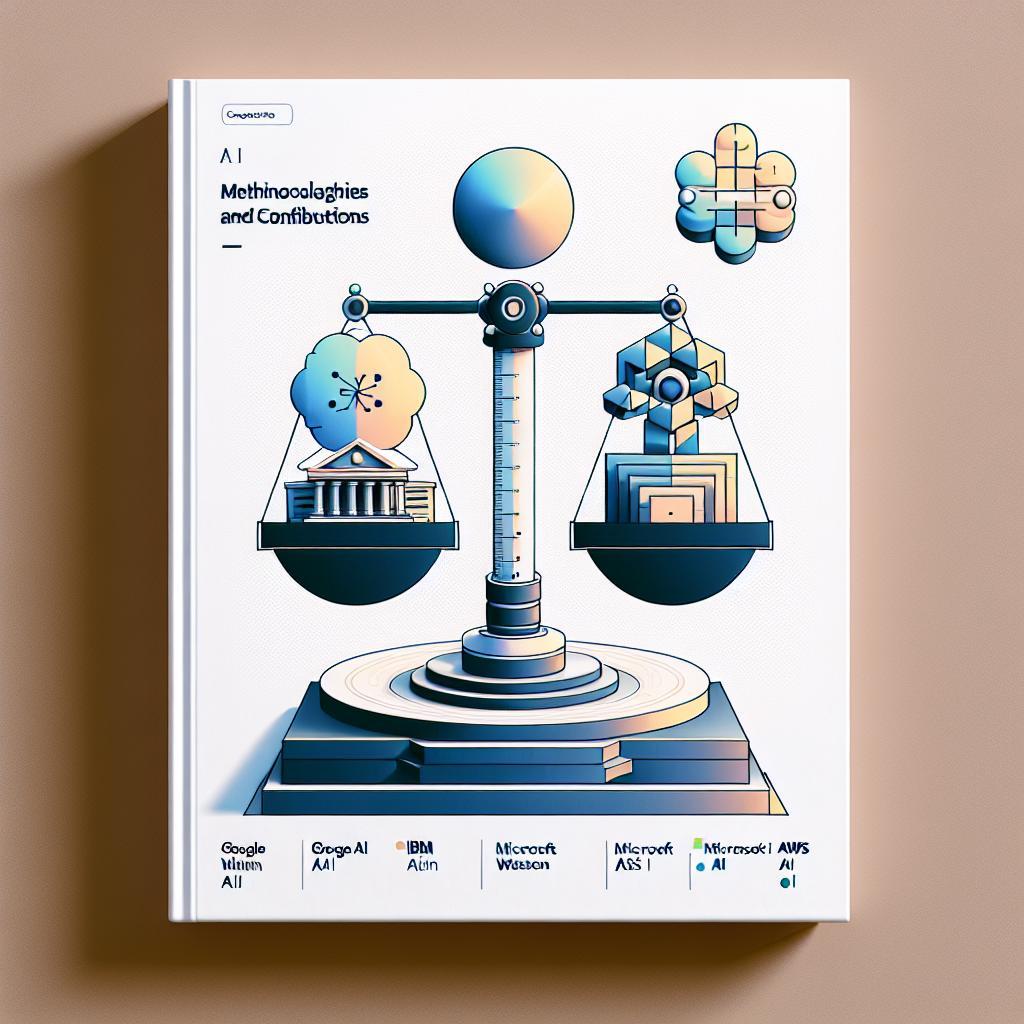
Comparative Analysis of Leading AI Research Institutes and their Tools: OpenAI vs. Google DeepMind

TABLE OF CONTENTS
- Summary
- Introduction to Leading AI Research Institutes
- Major Innovations and Contributions
- Comparative Analysis of OpenAI and Google DeepMind
- Leading AI Tool Developers and Their Impact
- Conclusion
1. Summary
This comprehensive report compares the methodologies, achievements, and contributions of the leading AI research institutes, OpenAI and Google DeepMind. It delves into the unique approaches of each organization, highlighting significant innovations like OpenAI's GPT-3 and Google DeepMind's AlphaFold. Additionally, the report examines the broader implications of their work across various industries. The summary includes a comparative analysis of key AI tools developed by other major players, such as Google AI's TensorFlow, IBM Watson's tools, Microsoft Azure AI's services, and AWS AI's Amazon SageMaker, focusing on their impacts on sectors like healthcare, finance, and customer service. The purpose is to underscore the transformative effect of these AI advancements on real-world applications and industry practices, offering a structured insight into how these organizations are shaping the future of AI technology.
2. Introduction to Leading AI Research Institutes
2-1. OpenAI: Mission and Approach
OpenAI is dedicated to creating safe and beneficial artificial intelligence (AI) while aiming for widespread accessibility of its innovations. Founded in December 2015 by Elon Musk, Sam Altman, and others as a nonprofit research company, OpenAI's initial goal was to promote and develop friendly AI for the benefit of humanity. The organization emphasizes transparency and collaborative development. OpenAI's efforts are characterized by a focus on general artificial intelligence (AGI) models that can perform a wide range of tasks. This can be seen in projects such as the GPT (Generative Pre-trained Transformer) series, particularly GPT-3, which showcased significant advancements in natural language understanding and generation. Additionally, OpenAI has delved into reinforcement learning, training AI agents to master complex games and robotic tasks.
2-2. Google DeepMind: Mission and Approach
Google DeepMind, a subsidiary of Alphabet, focuses on developing AI that mimics human learning and reasoning. Founded in 2010 by Demis Hassabis, Shane Legg, and Mustafa Suleyman, DeepMind was acquired by Google in 2014. This acquisition allowed DeepMind to leverage the vast resources of its parent company to drive research and operational capabilities. DeepMind's approach emphasizes solving real-world problems through AI technologies, prominently through reinforcement learning. A hallmark achievement of DeepMind is AlphaGo, an AI program that defeated a world champion in the game of Go, demonstrating the potential of AI in strategic thinking. Further, DeepMind has made critical advancements in healthcare, like AlphaFold, which has revolutionized protein folding predictions. These efforts underscore DeepMind's overarching mission to apply AI to a diverse range of high-impact practical problems.
3. Major Innovations and Contributions
3-1. OpenAI’s GPT Series and Reinforcement Learning
OpenAI has been at the forefront of AI research with its notable contributions in the development of the GPT (Generative Pre-trained Transformer) series. These models, including the well-known GPT-2 and GPT-3, have set new benchmarks for natural language understanding and generation. GPT-3, in particular, is capable of generating human-like text, answering questions, and performing language translation, boasting 175 billion parameters, making it one of the largest and most powerful language models publicly available. Moreover, OpenAI's exploration into reinforcement learning has led to substantial successes such as training AI agents to master complex games like Dota 2 and robotic tasks, showcasing the potential of AI in both virtual and physical realms.
3-2. Google DeepMind’s AlphaGo and AlphaFold
Google DeepMind has made remarkable strides, especially with its high-impact projects like AlphaGo and AlphaFold. AlphaGo gained international attention in 2016 when it defeated the world champion Go player Lee Sedol. This victory was a significant milestone, demonstrating the capacity of AI to handle tasks requiring deep strategic thinking through deep learning and reinforcement learning techniques. Further advancing in the field of biological research, DeepMind’s AlphaFold project revolutionized the prediction of protein folding, making significant contributions to understanding diseases and accelerating drug discovery processes. These innovations underscore DeepMind's focus on applying AI to solve complex, real-world problems.
4. Comparative Analysis of OpenAI and Google DeepMind
4-1. Research Focus and Methodologies
OpenAI and Google DeepMind have distinct approaches and objectives in their artificial intelligence research. OpenAI focuses on creating safe and beneficial AI with an emphasis on widespread accessibility. It promotes transparency and collaborative development. Key milestones include the release of Gym in 2016 for reinforcement learning, GPT-2 in 2018, and GPT-3 in 2020, which showcased advanced text generation capabilities. In 2019, OpenAI transitioned to a capped-profit model with significant investment from Microsoft. In contrast, Google DeepMind, a subsidiary of Alphabet, aims to mimic human learning and reasoning. Founded in 2010 and acquired by Google in 2014, DeepMind has achieved breakthroughs such as AlphaGo in 2016, which defeated a world champion in the game Go, and AlphaFold in 2020, which revolutionized protein folding prediction. DeepMind leverages Alphabet's vast resources to drive its research and operational capabilities.
4-2. Industry and Research Impact
Both OpenAI and Google DeepMind have significantly influenced the AI landscape through their innovative research and real-world implementations. OpenAI's GPT-3 has revolutionized natural language processing, impacting areas such as customer support, content creation, and code generation. Projects like ChatGPT serve as advanced conversational agents for businesses, and DALL-E creates unique images from textual descriptions, valuable in creative industries. DeepMind has focused on high-impact problems. AlphaFold's accurate protein structure predictions assist in understanding diseases and developing new treatments. DeepMind's AI in healthcare aids in diagnosing complex medical conditions, and its algorithms help predict acute kidney injury. Additionally, DeepMind has applied AI to improve energy efficiency in data centers. Both organizations contribute extensively to academic research, producing numerous papers and open-source tools. OpenAI's advancements in reinforcement learning have been demonstrated in training AI agents for complex games and robotic tasks. DeepMind has excelled in applying AI to diverse practical problems, showcasing the potential for strategic decision-making and solving real-world challenges.
5. Leading AI Tool Developers and Their Impact
5-1. Google AI: TensorFlow and Google Cloud AI
Google AI is known for developing TensorFlow, a comprehensive open-source machine learning framework that supports a wide range of tasks such as training deep neural networks and deploying AI applications. In addition, Google Cloud AI offers a suite of AI and machine learning services, including the Google Cloud Machine Learning Engine, Vision AI for image analysis, and the Natural Language API for text analysis. Notable achievements include breakthroughs in natural language processing with BERT and advancements in computer vision.
5-2. IBM Watson: Watson Studio and Watson Natural Language Understanding
IBM Watson provides robust AI tools such as Watson Studio, an integrated development environment for building, training, and deploying machine learning models, and Watson Natural Language Understanding for analyzing text and extracting metadata like sentiments and concepts. Watson has revolutionized sectors such as healthcare through Watson for Oncology, which helps oncologists make data-driven treatment decisions, finance with AI-driven fraud detection, and customer service with AI chatbots enhancing customer interactions.
5-3. Microsoft Azure AI: Azure Machine Learning and Cognitive Services
Microsoft Azure AI offers Azure Machine Learning, a cloud-based service for developing, training, and deploying machine learning models, and Azure Cognitive Services, which includes APIs for vision, speech, language, and decision-making functions. Azure AI has significantly impacted industries such as healthcare by predicting disease outbreaks, retail by enhancing customer experiences with AI-powered chatbots, and manufacturing by optimizing production processes through predictive maintenance.
5-4. AWS AI: Amazon SageMaker
AWS AI, a provider of scalable AI solutions, offers Amazon SageMaker, a managed service that simplifies building, training, and deploying machine learning models. Other key services include AWS Rekognition for image and video analysis, and AWS Comprehend for natural language processing. AWS AI has influenced several sectors, such as financial services through fraud detection and risk management, media through automated content moderation, and healthcare by enhancing patient care with AI-driven data analysis.
5-5. OpenAI: GPT-3, DALL-E
OpenAI is renowned for GPT-3, a state-of-the-art language model that can generate human-like text. Another notable tool is DALL-E, which creates images based on textual descriptions. OpenAI Gym is used for developing and comparing reinforcement learning algorithms. OpenAI's tools have set new benchmarks in natural language processing and creative AI, impacting various fields, including healthcare, education, and entertainment, by providing advanced AI solutions and fostering innovation.
6. Conclusion
The report underscores the pivotal roles of OpenAI and Google DeepMind in advancing artificial intelligence, emphasizing the groundbreaking innovations each institute has produced. OpenAI’s GPT-3 has set new standards in natural language processing, profoundly influencing diverse areas such as customer support, content generation, and creative industries. Meanwhile, Google DeepMind’s achievements with AlphaGo and AlphaFold highlight AI's potential in strategic thinking and biological research, significantly impacting healthcare by improving disease understanding and drug discovery processes. While the advances are impressive, the report also notes limitations, such as the computational resources required for these models and the need for ongoing regulatory oversight to ensure ethical AI deployment. Future prospects include further integration of AI into critical sectors and continued collaboration between research entities to maximize the technology's benefits. Practical applicability is evident as these AI tools are increasingly used to enhance industry efficiencies and develop innovative solutions to complex problems.