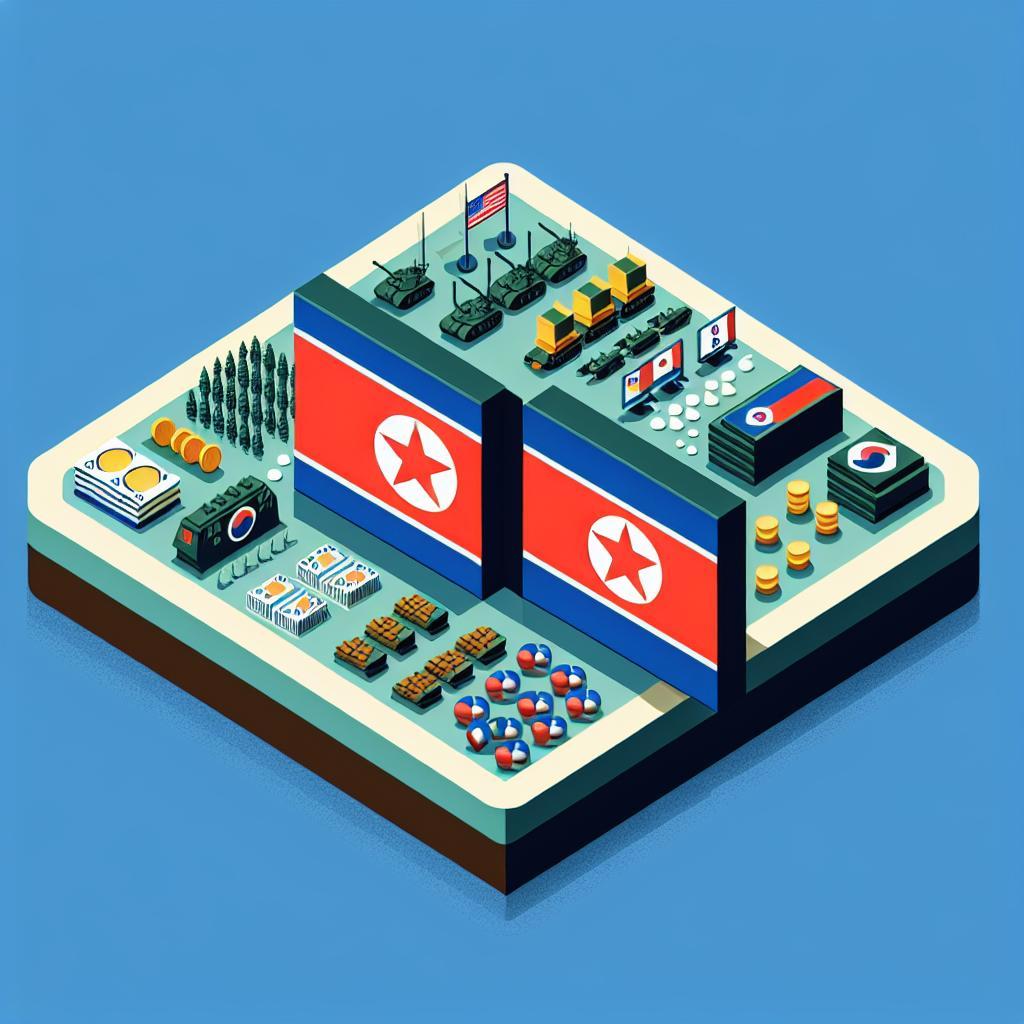
Current State of Relations Between North Korea and South Korea: Economic and Military Dynamics

TABLE OF CONTENTS
- Summary
- Geopolitical Tensions
- Economic Conditions in North Korea
- South Korea’s Economic and Political Response
- Global Impact and North Korea's International Relations
- Conclusion
1. Summary
This report delves into the current state of relations between North Korea and South Korea, focusing on their economic and military dynamics. Covering recent military activities, defensive measures, international reactions, and economic conditions, the report illustrates the complexity of interactions between the two nations. The heightened military activities of North Korea, spearheaded by Kim Jong Un, have led South Korea to reinforce its defensive capabilities in collaboration with the United States. Economically, North Korea faces significant challenges due to sanctions and the COVID-19 pandemic, relying heavily on its alliances with Russia, China, and Iran. Conversely, South Korea has implemented economic measures to counteract North Korean threats while engaging in international diplomacy to seek a unified response to the nuclear threat posed by its northern neighbor.
2. Geopolitical Tensions
2-1. Recent Military Activities by North Korea
North Korea conducted a major military exercise on May 30, involving 600-millimeter 'super-large' multiple rocket artillery units. Photographs showed North Korean leader Kim Jong Un observing the demonstration from a runway in Pyongyang’s Sunan area. According to the official mouthpiece of North Korea's ruling Workers' Party, Rodong Sinmun, the missiles 'accurately hit an island target' 226 miles away. This exercise was a direct response to recent American-led air drills with South Korea near the Demilitarized Zone. Additionally, North Korea has been perfecting reentry technology, targeting capability, and solid-fuel missiles that will enhance its nuclear capabilities, as stated in 'War on the Rocks'. Kim Jong Un has publicly designated South Korea as North Korea's 'primary enemy' and has called for 'war preparations' since early 2023, further escalating tensions.
2-2. South Korea's Defensive Measures
In response to North Korea's aggressive military posturing, South Korea has bolstered its defensive measures significantly. The increased American-led air drills near the heavily fortified Demilitarized Zone were partly a show of strength and partly a deterrent against potential North Korean aggression. The South Korean government continues to prioritize military preparedness as a cornerstone of its national defense strategy. Furthermore, the U.S.-Korean alliance has been working to improve its deterrence posture by enhancing ballistic missile defenses, increasing trilateral cooperation with Japan, and developing strategies to counter the advancing threats from North Korea.
2-3. International Reactions and Involvement
The international community has closely watched the escalating tensions on the Korean Peninsula. In particular, the recent missile barrages and military exercises by North Korea have drawn strong reactions from the United States and its allies. The U.S. has described North Korea's actions as 'a show of force' and warned of the serious consequences if provocations continue. Russia and China have remained significant players in the background, with North Korea strengthening its alliances with these major powers. North Korean-Russian ties have particularly deepened, with North Korea supplying artillery and missiles to Moscow in exchange for food and oil. Despite these alignments, the global community, including the United Nations, continues to condemn North Korea's missile tests and call for de-escalation and dialogue to manage the risks of heightened conflict.
3. Economic Conditions in North Korea
3-1. Impact of COVID-19 and Sanctions
The impact of COVID-19 and international sanctions has significantly strained North Korea's economy. Sanctions imposed by various countries and international entities due to North Korea’s nuclear ambitions have limited its economic growth. The COVID-19 pandemic further exacerbated these economic vulnerabilities by disrupting trade and reducing the already minimal foreign investments. These combined pressures have resulted in considerable economic hardships for North Korea, including shortages of food and essential goods, further isolating the nation economically.
3-2. Trade Relationships and Economic Alliances
North Korea's trade relationships and economic alliances are a crucial aspect of its economic strategy. The country has turned to adversarial states of the U.S.—principally Russia, China, and Iran—as alternative economic partners. For instance, following increasing sanctions, Russia has become pivotal by importing North Korean weaponry and providing economic support in return. Similarly, China remains a significant trade ally despite international pressures, facilitating North Korea’s access to essential goods and technologies. These alliances have helped North Korea mitigate some of the international sanctions' effects but have created a dependency on these few partners.
3-3. Internal Economic Stability and Challenges
North Korea faces numerous internal challenges that affect its economic stability. The country struggles with inefficient state-run industries, limited access to modern technology, and frequent natural disasters that hinder agricultural output. Despite attempts to maintain a controlled economy, inefficiencies and resource misallocation have led to periodic economic crises. Recent partnerships, particularly with Russia and China, have provided some relief but have not resolved fundamental structural issues within the economy. Internally, the government has to continually manage scarce resources amidst growing public dissatisfaction and maintain stability through strict political control.
4. South Korea’s Economic and Political Response
4-1. Economic Measures and Policies
In recent months, South Korea has implemented various economic measures in response to the heightened tensions with North Korea. These measures include increasing sanctions on North Korean businesses and individuals involved in missile development and other military activities. Additionally, South Korea is working closely with international partners to impose stricter financial restrictions on North Korea, aimed at curtailing its ability to fund military operations. The South Korean government has also increased its defense budget to enhance military preparedness and safeguard national security.
4-2. Political Stance and International Diplomacy
South Korea's political stance towards North Korea remains firm and resolute. The South Korean administration, in collaboration with global allies, continues to engage in diplomatic efforts to address the nuclear threat posed by North Korea. South Korea has participated in multiple international summits and bilateral meetings to discuss the issue, emphasizing the need for a unified global response. The South Korean government also supports the enforcement of United Nations Security Council resolutions aimed at pressuring North Korea to denuclearize. Recently, South Korean officials have reiterated their commitment to peace and stability in the region, while also highlighting the importance of maintaining a strong defensive posture.
5. Global Impact and North Korea's International Relations
5-1. North Korea's Alliances with Russia, China, and Iran
North Korea has developed strengthened military-technical cooperation with Russia, alongside China and Iran. This alliance has been instrumental for Russia following its increased isolation due to the ongoing war in Ukraine. Specifically, North Korea has been accused of selling weapons to Russia, including approximately 5,000 containers of weaponry which potentially carried up to 2.3 million rounds of 152-millimeter shells and 400,000 rounds of 122 mm artillery shells. Additionally, Russia has reportedly deployed around 50 North Korean ballistic missiles in Ukraine. These military supplies have allowed Russia to maintain its aggression in Ukraine, even as it faces a depletion of its own resources.
5-2. Implications for Global Security
The military-technical partnerships between Russia and countries like North Korea, China, and Iran have significant implications for global security. These alliances enable Russia to maintain its military campaigns and mitigate the impact of international sanctions. In January 2024, North Korea fired hundreds of artillery rounds into the sea near its contested border with South Korea and conducted an intermediate-range ballistic missile test. This escalation threatens both South Korean security and U.S. interests in the region. Moreover, North Korea's strengthened military capabilities, bolstered by Russian and Chinese support, could exacerbate tensions on the Korean Peninsula and challenge international stability.
5-3. Strategic Developments
The alliances between Russia and North Korea, China, and Iran have led to several strategic developments. For example, following North Korea's arms supply to Russia, there have been discussions about further military cooperation, including the potential for Russia to assist North Korea in developing its space satellite program. In November 2023, North Korea successfully launched a military reconnaissance satellite, attributed to Russian expertise, which could enhance its surveillance capabilities over U.S. and South Korean military activities. This growing cooperation not only benefits the countries involved but also positions them as key players challenging the existing global order.
6. Conclusion
The strained relationship between North Korea and South Korea remains a significant geopolitical issue influenced by military provocations, economic hardships, and international alliances. Key findings detail North Korea's aggressive military advancements under Kim Jong Un and its economic dependencies on allies like Russia, China, and Iran. Meanwhile, South Korea employs a combination of defensive and diplomatic measures to navigate the tensions, leveraging its alliance with the United States. The report highlights that while North Korea faces internal economic instability exacerbated by sanctions and the pandemic, its alliances provide some relief. Furthermore, the international community, including the United Nations, continues to call for de-escalation and dialogue. The principal limitation of the report is its focus on recent events, which may overlook long-term historical contexts and future developments. Future research could benefit from exploring the broader implications of these alliances and the potential paths toward peaceful resolution. Understanding these dynamics is crucial as the situation on the Korean Peninsula poses ongoing risks to global security and stability.