Leveraging Retrieval Augmented Generation (RAG) for Enhanced AI Solutions

TABLE OF CONTENTS
- Summary
- Introduction to Retrieval Augmented Generation (RAG)
- Applications and Use Cases of RAG
- Technical Implementation of RAG
- Challenges and Limitations
- Case Studies and Real-World Examples
- Conclusion
1. Summary
The report, titled "Leveraging Retrieval Augmented Generation (RAG) for Enhanced AI Solutions," examines the implementation, benefits, and challenges of RAG technology. Originating from Facebook AI and spearheaded by Patrick Lewis in 2020, Retrieval Augmented Generation (RAG) aims to enhance Large Language Models (LLMs) like GPT-3 by integrating information retrieval, yielding contextually accurate and factually consistent outputs. The report outlines the historical development of RAG, its operational mechanisms, and its applications across various industries such as customer service, content creation, legal research, and business intelligence. It highlights different frameworks and tools like LangChain and Streamlit used in building RAG-based systems and reviews the technical implementation and real-world examples, including a case study on the Databricks Certified Generative AI Engineer Associate Beta Exam.
2. Introduction to Retrieval Augmented Generation (RAG)
2-1. Definition of RAG
Retrieval Augmented Generation (RAG) represents a paradigm shift in natural language processing by combining information retrieval with generative language models. Developed by Facebook AI researchers led by Patrick Lewis in 2020, RAG integrates the retrieval of relevant external knowledge sources with the generative capabilities of models such as GPT-3. This integration allows for contextually grounded and factually consistent outputs, enhancing the accuracy and relevance of generated text. Unlike traditional Large Language Models (LLMs) that rely solely on static parametric memory, RAG dynamically accesses and incorporates up-to-date information during the generation process.
2-2. Historical Context and Development
The evolution of RAG can be traced to early rule-based question-answering systems from the 1970s. Over the years, advancements in Natural Language Processing (NLP) and machine learning technologies have paved the way for the development of sophisticated neural models like BERT and GPT-3. The limitations of these static parametric models, including their inability to access proprietary or newly acquired data, led to the development of RAG. This new approach was introduced to address these limitations by combining dynamic information retrieval with generative text production, thus producing more accurate and contextually relevant outputs. Key milestones include the introduction of transformer architectures and the experimental applications of RAG in diverse fields such as customer service and financial analysis.
2-3. Key Components and Operational Workflows
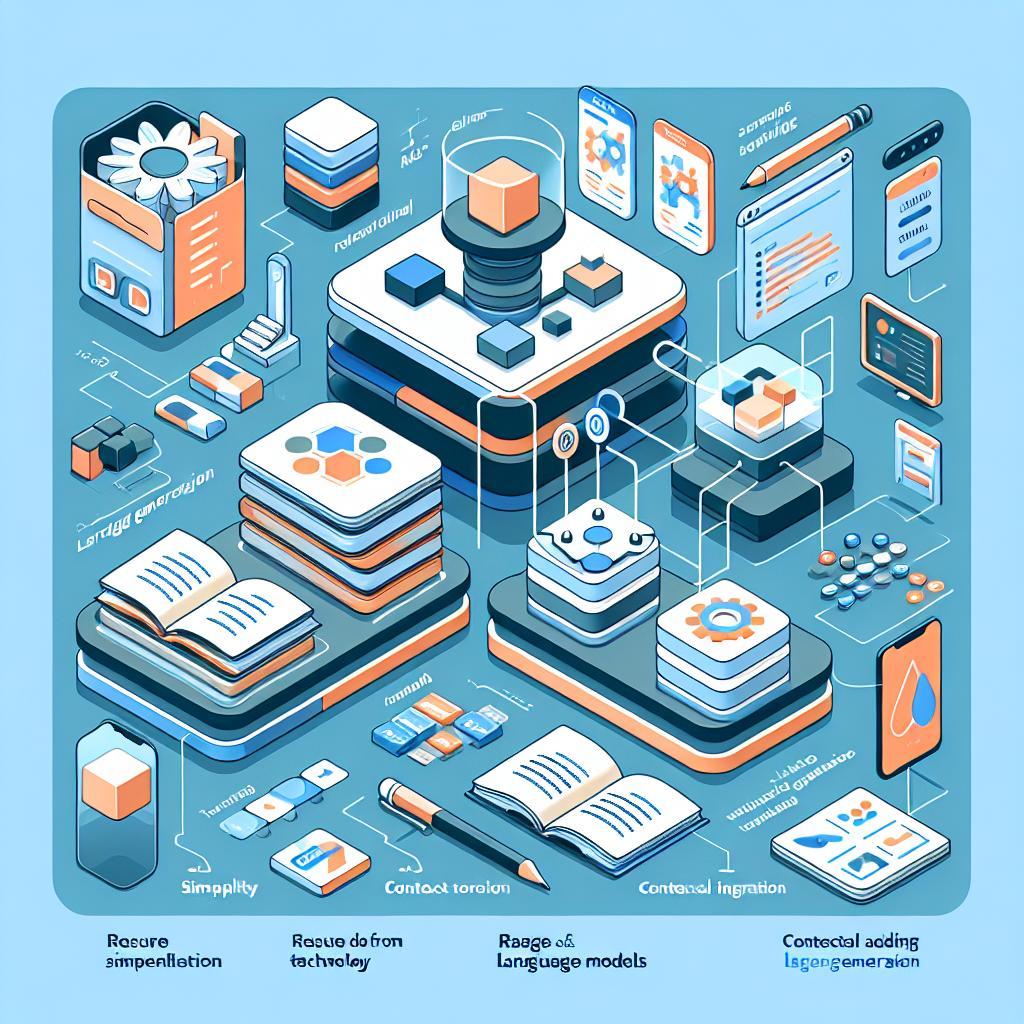
The core mechanism of RAG involves two primary components: retrieval and generation. The retrieval component searches through extensive knowledge bases using techniques such as vector similarity search to identify the most relevant information based on the input query. This retrieved information is then integrated into the generative model, typically a large language model like GPT-3 or T5, which synthesizes it into coherent and contextually appropriate responses. RAG's operation can be broken down into several key steps: 1. **Document Retrieval**: Relevant documents are fetched from an external knowledge base using a retrieval model. 2. **Embedding Conversion**: Retrieved documents are converted into vector embeddings and stored in a vector database. 3. **Query Matching**: User queries are also converted into embeddings and matched against the stored document embeddings to find the most relevant ones. 4. **Response Generation**: The matched documents and the user query are fed into a generative model to produce detailed, context-aware responses. RAG addresses specific challenges of traditional LLMs, such as hallucinations and outdated knowledge, by grounding responses in real-time updated information. It also significantly improves response relevance in applications ranging from automated customer service to complex problem-solving tasks in various industries.
3. Applications and Use Cases of RAG
3-1. Implementation in customer service
Retrieval Augmented Generation (RAG) has been effectively implemented in customer service environments to enhance the precision and relevance of automated responses. Companies like Uber and Shopify utilize RAG-based chatbots to handle a wide range of customer inquiries. These chatbots draw from extensive databases to provide accurate and context-specific answers quickly.
3-2. Utility in content creation
RAG significantly improves the efficiency and accuracy of content creation. For instance, Grammarly leverages RAG to offer enhanced writing suggestions by retrieving pertinent information and generating context-aware recommendations. This technology enables the generation of comprehensive reports, summaries, and insights from large datasets, assisting content creators in producing high-quality material more efficiently.
3-3. Benefits for legal research
RAG technology is invaluable in the legal field, particularly for research and case preparation. Tools like LexisNexis use RAG for extracting relevant legal precedents and insights, streamlining the process of legal research. This enables legal professionals to quickly access and synthesize crucial information from vast legal databases, ensuring thorough and contextually accurate legal documentation.
3-4. Business intelligence applications
RAG is also utilized in various business intelligence applications to analyze and derive insights from large datasets. For example, Bloomberg Terminal employs RAG for financial analysis, helping analysts extract and summarize key insights from financial documents. Similarly, IBM Watson Health uses RAG to analyze patient data and provide treatment recommendations, thereby improving decision-making processes in healthcare.
4. Technical Implementation of RAG
4-1. Building RAG chatbots using LangChain and Streamlit
The use of LangChain and Streamlit in building a RAG chatbot provides a powerful way to engage with PDF documents. LangChain framework facilitates the development of applications powered by language models, while Streamlit, a Python library, helps create web apps for machine learning and data science projects. The components involved include PyPDF2 for reading and manipulating PDF files and FAISS (developed by Facebook AI) for efficient similarity search and clustering of dense vectors. Specific steps involve text extraction from PDFs, converting text chunks into vector representations using SpacyEmbeddings, and storing these vectors in a FAISS database for fast retrieval. This setup enables the integration of relevant PDF data with the generative power of language models to create a responsive and informative chatbot.
4-2. Setting up the retrieval system
The first stage in the Retrieval Augmented Generation (RAG) is setting up a retrieval system. This involves retrieving relevant proprietary information to augment the user's prompt. The ideal retrieval system can vary depending on the workload but typically involves vector similarity search. In this method, documents are represented as vectors (embeddings) which facilitate the retrieval of semantically similar documents based on their proximity in vector space. Postgres, with its pgvector extension, is often used for storing these vectors and performing similarity searches. The process involves generating embeddings from documents, storing them in the vector database, and retrieving the most relevant text based on the user’s input.
4-3. Combining LLMs with vector search
Combining large language models (LLMs) with vector search is a core component of RAG technology. Vector search involves the use of dense vector representations for retrieving relevant information. It allows the LLM to incorporate specific and up-to-date information into its responses. For example, an LLM like GPT can generate embeddings (vector representations) from text, and these embeddings are then used in vector databases such as FAISS to perform a similarity search. This process ensures that LLMs can access and utilize relevant data from large datasets, which significantly enhances the accuracy and contextual relevance of the generated responses.
4-4. Using Postgres and FAISS for storage and retrieval
Postgres and FAISS serve as crucial components in the storage and retrieval phase of RAG. Postgres, particularly with the pgvector extension, acts as a robust vector database capable of storing and indexing vector embeddings generated from documents. FAISS (Facebook AI Similarity Search) is used for fast and efficient similarity searches among these vector embeddings. The setup process includes generating embeddings from proprietary documents, storing these embeddings in Postgres, and using FAISS to perform vector similarity searches to retrieve the most relevant information. This retrieval is then combined with the user's prompt and fed into the generative model to produce a response enriched with pertinent, real-time data.
5. Challenges and Limitations
5-1. Context window limitations
Retrieval Augmented Generation (RAG) systems face challenges regarding context window limitations. Large Language Models (LLMs) operate within a constrained context window, typically supporting a maximum of 4096 to 1 million tokens. This token limitation directly impacts the amount of data that can be retrieved and incorporated into the response generation process. Both blog posts and technical handbooks highlight that larger context windows require increased computational resources and can significantly drive up operational costs. The challenge is to determine what text makes it into the prompt as there is not infinite space in the context window, thus necessitating efficient and strategic information retrieval.
5-2. Bias and data quality requirements
One major challenge for RAG systems is managing bias and ensuring high data quality. According to various documents, fine-tuning models to handle specialized tasks requires access to high-quality, curated data. Any biases present in the training data can be exacerbated, leading to skewed or inappropriate outputs. Moreover, ensuring that the retrieved data is relevant and accurate is crucial for the system's reliability. The Voiceflow document particularly underscores ethical considerations like responsible use and privacy concerns, reflecting the need to address biases in external data sources explicitly.
5-3. Efficient retrieval mechanisms
Effective and efficient retrieval mechanisms are paramount for the optimal performance of RAG systems. The retrieval process involves selecting the most pertinent information from vast knowledge bases and presenting it within the context window's constraints. Different techniques such as vector similarity search and dense retrieval are utilized to optimize this process. For example, RAG splits the task into two stages: deciding on the most relevant, limited proprietary information first, and then concatenating it with the user’s prompt to generate the final response. The complexity of dealing with large-scale data retrieval requires sophisticated algorithms and technologies, as highlighted in the provided documents.
5-4. Ethical considerations and privacy concerns
Implementing RAG systems introduces several ethical and privacy-related challenges. One document specifically notes that ethical considerations include ensuring unbiased and fair information retrieval and generation. Privacy concerns arise when dealing with proprietary or sensitive information, necessitating rigorous safeguards to protect user data. Ethical issues also encompass the necessity to develop comprehensive evaluation metrics to measure the effectiveness of RAG systems responsibly. Overcoming these hurdles is critical for the responsible deployment of RAG technologies in various applications.
6. Case Studies and Real-World Examples
6-1. Databricks Certified Generative AI Engineer Associate Beta Exam
This case study details an individual’s journey towards achieving the Databricks Certified Generative AI Engineer Associate Beta certification. The individual received an email invitation to participate in the beta test in early April 2024. Following the application and survey completion by April 15, 2024, they were selected for the beta exam. The beta test consisted of 135 multiple-choice questions to be completed in 180 minutes. The individual prepared for the exam using Databricks Academy courses such as 'Generative AI Fundamentals' and 'Generative AI Engineering with Databricks (2024)'. The certification exam assessed capabilities in designing and implementing LLM-enabled solutions using Databricks, specifically evaluating skills in problem decomposition, model selection, and development of RAG applications. The individual successfully passed the exam on May 31, 2024.
6-2. LangChain framework in enterprise AI
LangChain is a framework designed to simplify the integration of large language models (LLMs) into enterprise workflows. It enables the use of retrieval augmented generation (RAG), allowing language models to access and incorporate pertinent external data sources like databases and APIs. Key features of LangChain include composable chains for building complex workflows, off-the-shelf agents and chains for rapid development, and support for diverse data formats. LangChain's modular architecture involves agents, tools, memory, and chains, facilitating the development of sophisticated, context-aware applications. The framework is particularly beneficial for enterprises as it streamlines the development process, boosts productivity with reusable components, and ensures up-to-date, accurate information is utilized. The integration of LangChain into an enterprise AI landscape can unlock the full potential of LLMs, making them a powerful tool for data-driven decision making and operational efficiency.
6-3. Streamlit applications in academic labs
In academic labs, important documentation is frequently maintained on paper, leading to information silos and inefficiency. This case study explores the use of Streamlit for rapidly deploying applications that digitize and manage these documents. The individual developed a Scan-OCR-Search (SOS) application using Streamlit to perform optical character recognition (OCR) on scanned documents, enabling keyword searches within digitized text. The backend was developed using DocTR for OCR, TheFuzz for fuzzy search, and Amazon S3 for storage. The frontend was created using Streamlit’s user-friendly interface, facilitating document upload, processing, and searching. The application demonstrates how Streamlit’s ease of use and deployment can save time and improve document management processes in academic settings.
6-4. AI integration in manufacturing and robotics
AI integration in manufacturing and robotics involves several technical challenges such as data shifts, class imbalances, and model degradation over time. This case study covers a discussion on building production-ready AI models for manufacturing. The integration of AI technologies in manufacturing processes includes navigating issues like data acquisition costs and addressing model failures. Solutions include the use of computer vision and machine learning for detecting defects and optimizing production workflows. Additionally, the incorporation of LLMs and recommender systems enhances the precision and functionality of these AI models. Experts from various fields, such as Pavol Bielik and Jürgen Weichenberger, contribute to the development of robust, high-performance AI systems that improve safety, efficiency, and quality in manufacturing.
7. Conclusion
The report underscores the transformative potential of Retrieval Augmented Generation (RAG) technology in enhancing the capabilities and accuracy of AI solutions. Through real-time data retrieval, RAG can significantly improve the context-awareness and relevance of generated responses, addressing limitations seen in traditional LLMs. Despite challenges related to context window limitations, bias, and data quality, the successful integration of RAG in domains like customer service, legal research, and manufacturing demonstrates its far-reaching impact. However, addressing ethical considerations and optimizing retrieval processes are crucial for the responsible and effective deployment of RAG. Future research should focus on expanding the context window capabilities and developing robust, unbiased data management strategies. The practical applications of RAG in tools and frameworks like LangChain and Streamlit show promising paths for future developments and uses in various industries.