Traditional Customs, Respect, and Social Practices in Korean Culture

TABLE OF CONTENTS
- Summary
- Traditional Customs During Major Korean Holidays
- Demonstration of Respect for Elders in Korean Society
- Traditional Korean Clothing
- Traditional Korean Arts and Crafts
- Traditional Korean Weddings
- Korean Birthday Celebrations
- Views on Personal Space and Physical Contact in Korean Society
- Conclusion
1. Summary
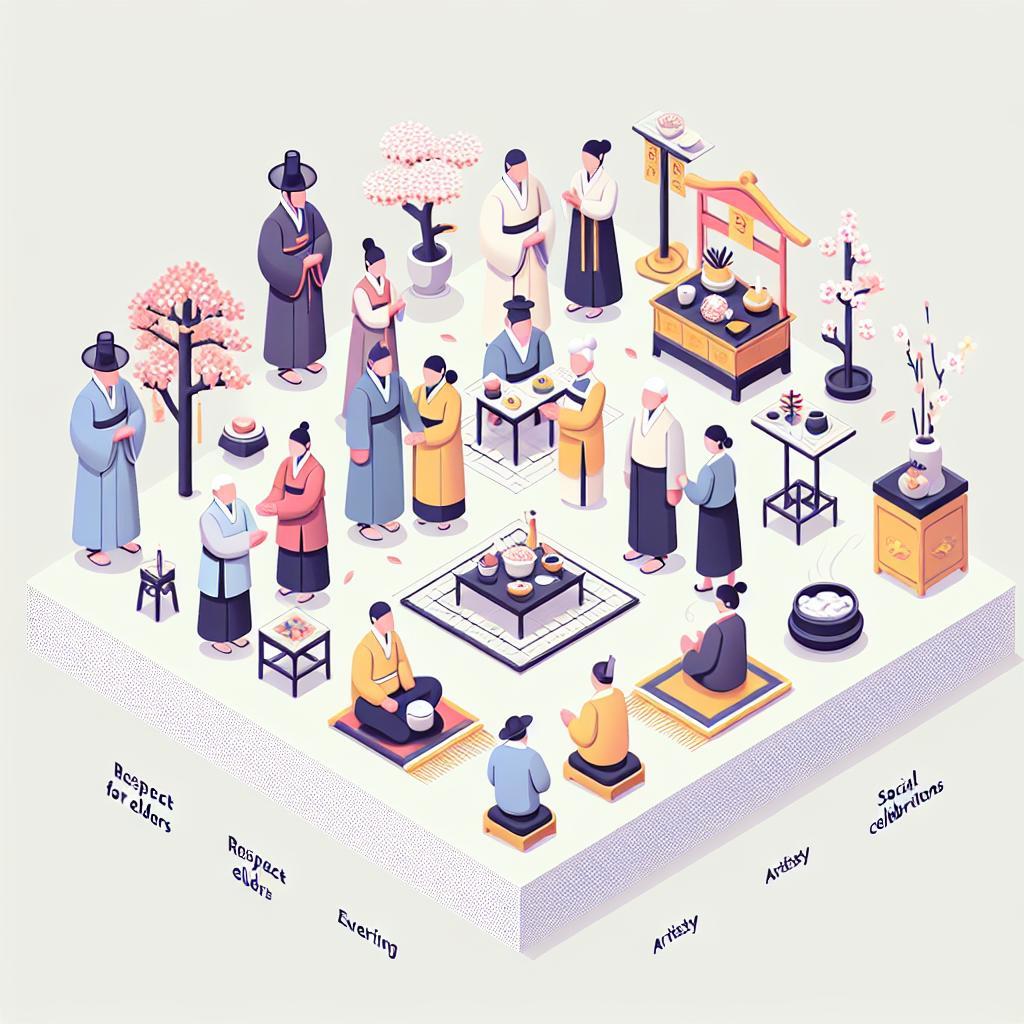
The report titled 'Traditional Customs, Respect, and Social Practices in Korean Culture' provides an in-depth exploration of various aspects of Korean cultural heritage and social norms. The purpose of the report is to document traditional customs observed during major holidays such as Seollal (Lunar New Year) and Chuseok (Korean Thanksgiving), the cultural significance of respect for elders influenced by Confucianism, traditional clothing like Hanbok, traditional arts and crafts including Bojagi and Korean embroidery, as well as traditional Korean weddings and birthday celebrations, and social norms regarding personal space and physical contact. Key findings highlight how deeply rooted these customs and practices are in Korean society, reflecting values such as filial piety, cultural identity, and social harmony.
2. Traditional Customs During Major Korean Holidays
2-1. Seollal (Lunar New Year) Customs
Seollal, also known as the Lunar New Year, is one of the most significant holidays in Korea. Families come together to perform ancestral rites known as 'charye,' pay respect to their ancestors, and wish for the well-being of the family. Traditional games like 'yunnori' are played, and special foods such as 'tteokguk' (rice cake soup) are prepared and consumed. Wearing traditional clothing, known as 'hanbok,' is also a common practice during this festive period.
2-2. Chuseok (Korean Thanksgiving) Customs
Chuseok, often referred to as Korean Thanksgiving, is another crucial holiday in Korea. It is a time when Koreans visit their hometowns to share food and stories with their families. The holiday includes rituals like 'seongmyo' and 'beolcho,' which involve visiting ancestral graves and tidying them up. As with Seollal, traditional foods, especially 'songpyeon' (rice cakes), play a significant role in the celebration. Various folk games, such as 'ganggangsullae' (a traditional circle dance), are also part of the festivities.
3. Demonstration of Respect for Elders in Korean Society
3-1. Confucian Influence
The tradition of respecting elders in Korean society is heavily influenced by Confucianism. This philosophical system, which was introduced during the Joseon Dynasty, instills the importance of filial piety and respect for seniors. Core Confucian values such as loyalty to one's family and respect for hierarchy have deeply permeated Korean social structures and interactions.
3-2. Practical Expressions of Respect
Respect for elders in Korea is demonstrated through various everyday practices. Younger people are expected to bow to seniors as a sign of respect, use honorific language when addressing them, and prioritize elders in social settings such as giving up seats in public transport. During mealtime, elders are served first, and one must wait until the eldest begins eating before starting their meal.
3-3. Ancestral Rites
Ancestral rites, known as 'Jesa,' are significant in Korean culture. These rituals are conducted to honor deceased ancestors and involve offerings of food, alcohol, and incense. The rites are typically carried out during important holidays and commemorative days. Jesa ceremonies reflect the deep-seated respect for ancestral lineage and the continued bond between the living and the deceased.
3-4. Societal Practices
In Korean society, there are numerous practices that reflect the respect for elders. One key societal custom is the celebration of 'Hwangap,' the 60th birthday, which is considered a significant milestone. The event is often marked by large family gatherings and celebrations. Elders also hold influential roles in familial and community decisions, reaffirming their esteemed status within the society.
4. Traditional Korean Clothing
4-1. Hanbok and Its Components
Hanbok, the traditional attire of Korea, consists of several components: jeogori (a blouse or jacket), chima (a wrap-around skirt for women), and baji (pants for men). It is characterized by vibrant colors, simple lines, and lack of pockets. The hanbok has been worn by Koreans for over a thousand years and is seen in various designs for different social statuses and occasions.
4-2. Significance of Traditional Clothing
Hanbok is more than mere attire; it holds cultural and historical significance. It symbolizes Korean identity and tradition. It is worn on special occasions such as festivals, ceremonies, and celebrations including weddings and holidays. The design and colors of hanbok are steeped in cultural meanings, representing aspects such as gender, marital status, and social hierarchy.
5. Traditional Korean Arts and Crafts
5-1. Bojagi
Bojagi, a traditional Korean wrapping cloth, is employed in various ways, including for ceremonial purposes, gift wrapping, and storage. This intricate craft showcases the detailed sewing techniques used by Korean artisans. The custom of using Bojagi reflects the historical emphasis on resourcefulness and aesthetics in Korean culture. Historically, it has evolved from simple, practical cloths to elaborately designed pieces of art, demonstrating the blend of utility and beauty in traditional Korean crafts.
5-2. Korean Embroidery
Korean embroidery, known for its exquisite detail and vibrant colors, is another essential aspect of traditional Korean fabric arts. This craft often adorns traditional clothing such as hanboks, as well as household items like pillows and curtains. The techniques involve meticulous stitching patterns that create intricate designs. Korean embroidery not only serves decorative purposes but also signifies cultural symbolism and artistry passed down through generations, highlighting the patience and skill of Korean craftspeople.
5-3. Knot-Making and Other Fabric Arts
Knot-making, or maedeup, is a traditional Korean craft that has been perfected over centuries. These knots are often used as decorative elements on clothing, accessories, and various items of daily use. The craft requires precise techniques to create complex, interwoven patterns that are both functional and aesthetically pleasing. Knot-making, along with other fabric arts such as quilting and patchwork, emphasizes the creativity and technical prowess of Korean artisans in transforming textiles into pieces of art.
5-4. Preservation of Traditional Crafts
The preservation of traditional Korean crafts is a critical cultural endeavor, ensuring that these time-honored techniques and skills are maintained and passed down through generations. Efforts in this area include government initiatives, cultural heritage programs, and educational activities aimed at teaching and preserving these crafts. The preservation initiatives underscore the importance of maintaining cultural identity and heritage in a modernizing world, protecting these crafts from becoming obsolete.
6. Traditional Korean Weddings
6-1. Pre-Wedding Customs
Pre-wedding customs in traditional Korean weddings involve various rituals and interactions between the families of the betrothed. The primary ceremony is called 'Eui hon,' where families exchange letters of intent to marry. This step is succeeded by 'Napchae,' an auspicious date selection process conducted by a professional matchmaker known as a 'Jung-mae-in.' This step is essential to align the marital timing with favorable astrological conditions. As part of this process, gifts are exchanged, symbolizing the commitment and approval of both families. These rituals emphasize the importance of family agreement and fortune in traditional Korean marriages.
6-2. Wedding Ceremony
The traditional Korean wedding ceremony is known for its elaborate customs and symbolic gestures. The primary ritual involves a two-part ceremony: 'Gireoghage' and 'Paebaek'. 'Gireoghage' is the formal wedding where the bride and groom exchange vows. The ceremony is marked by the groom’s entourage presenting a wooden goose to the bride’s family, symbolizing fidelity and marriage intentions. Another significant ritual, 'Paebaek,' is conducted after the main ceremony, where the couple pays respect to their parents through deep bows and offers of specially prepared food. This ritual underscores filial piety and the importance of family.
6-3. Food and Gifts
Traditional Korean wedding festivities involve an assortment of symbolic foods and thoughtful gift exchanges. One notable item is 'honey-dipped rice cakes,' which symbolize sweetness and prosperity in marriage. Food offerings generally include multiple-course meals featuring delicacies such as 'galbi,' 'bulgogi,' and an assortment of seasonal fruits. Gifts, or 'Yedan,' are meticulously prepared and often presented in 'Hanjis' (traditional Korean paper), including items like fine textiles, clothing, and other necessities to wish the couple a prosperous future. These foods and gifts reinforce themes of abundance and well-wishing in Korean wedding celebrations.
7. Korean Birthday Celebrations
7-1. General Birthday Celebrations
In Korea, birthday celebrations are deeply rooted in cultural traditions. While the format of celebration can vary, it typically involves family gatherings, traditional foods, and rituals that seek to wish good health and prosperity for the individual. Parents and elders play a significant role in these celebrations, emphasizing respect and familial bonds. The communal aspect of birthdays underscores the importance of family and social harmony in Korean culture.
7-2. Milestone Birthdays
Certain birthdays are considered more significant in Korea due to their cultural and historical importance. These include the baek-il (100 days celebration), which marks the survival of the infant during a historically perilous period, and the dol (first birthday), which includes a ritual called doljabi where the child is presented with various objects that signify different future paths. Additionally, hwangap or the 60th birthday is a major milestone, symbolizing the completion of a full zodiac cycle and is celebrated lavishly with extended family and friends.
7-3. Cultural Nuances in Age Calculation
In Korea, age calculation has unique nuances that are different from the Western system. Traditionally, a person is considered one year old at birth and gains another year on New Year's Day, regardless of the actual birth date. This method, known as the Korean age system, highlights the cultural emphasis on community and familial structure over individual milestones. This practice can sometimes lead to differences in age perception between Korean and international contexts.
8. Views on Personal Space and Physical Contact in Korean Society
8-1. Personal Space Norms
In Korean society, personal space is highly valued and respected. The concept of maintaining a respectful distance during interactions is ingrained in social norms and cultural practices. Generally, Koreans prefer to maintain a physical distance, even in crowded public spaces such as subways and buses. This respect for personal space is particularly evident in formal or polite interactions, where minimal physical contact is expected.
8-2. Physical Contact Practices
Physical contact in Korean society is largely shaped by hierarchical and social relationships. While close friends and family members might engage in physical contact, such as hugging or holding hands, it is less common in professional or formal settings. Instead, bowing is a customary way of greeting, showing respect, and saying goodbye, thus avoiding physical contact. In social scenarios, a light pat on the back or shoulder can be seen as a sign of camaraderie, but these gestures are typically reserved for informal interactions.
9. Conclusion
The report underscores the rich tapestry of Korean customs and social norms, from the celebration of major holidays and life milestones to the societal reverence for elders and understanding of personal space. The findings illustrate the deep-rooted cultural practices and values that continue to shape modern Korean society. Despite external influences, Korea’s commitment to preserving its heritage and traditions remains strong. This blend of historical reverence and cultural identity offers valuable insights into the Korean way of life and its evolution. Future research could further explore the adaptability and integration of these practices in a rapidly globalizing world.